
How can a steel aircraft carrier weighing tens of thousands of tons float, while a steel bolt sinks instantly? The answer was worked out more than 2,000 years ago. Archimedes' principle explains buoyancy, the upward push a fluid gives any object placed in it.
Definition
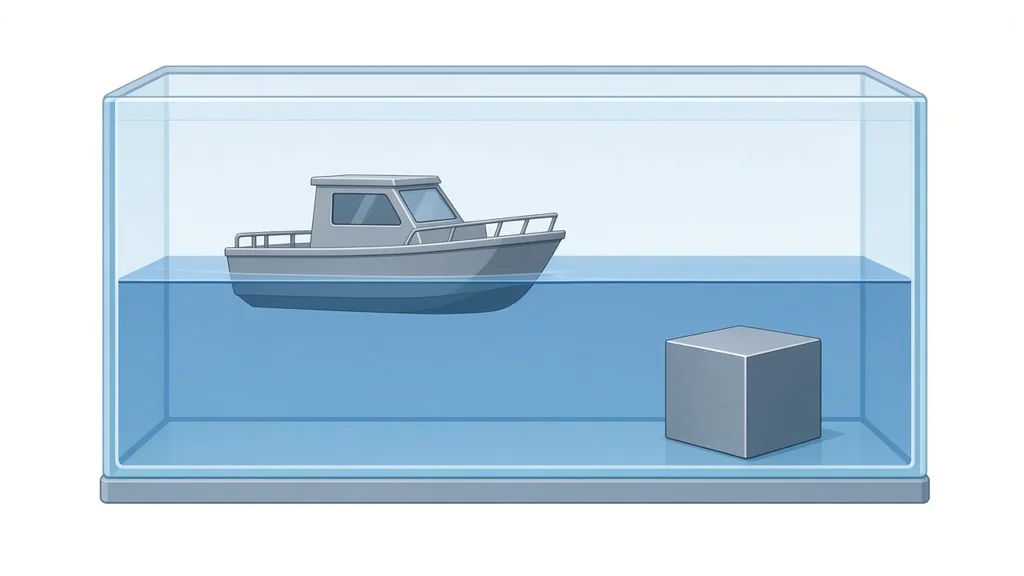
Archimedes' principle states that the buoyant force on an object in a fluid equals the weight of the fluid the object displaces. If that force is greater than the object's weight, the object rises or floats. If it is smaller, the object sinks. If they are equal, the object is neutrally buoyant and stays where it is. The principle applies to gases too, which is why helium and hot-air balloons rise.
Key idea
Floating depends on average density, not on material alone. A steel ship floats because its hollow shape displaces a volume of water that weighs as much as the whole ship.

History
Archimedes of Syracuse described the principle in his treatise On Floating Bodies around 250 BC. A later story told by the Roman writer Vitruvius says Archimedes realized how to test whether a king's crown was pure gold while stepping into a bath and shouted "Eureka!" Historians treat that anecdote with caution, but the principle itself is exact.

US cases
- When and where
- Sonny Carter Training Facility, near Johnson Space Center, Houston, Texas
- What happened
- The laboratory's pool is 202 feet long, 102 feet wide and 40 feet deep and holds 6.2 million US gallons of water. Astronauts wear suits weighted to be neutrally buoyant, so they neither float up nor sink, and rehearse spacewalk tasks beside full-size mockups.
- Why it matters
- Balancing weight against displaced water simulates part of the experience of working in microgravity, making Archimedes' principle part of every spacewalk's preparation.
- When and where
- Held since 1972, now each October, Albuquerque, New Mexico
- What happened
- The festival began with 13 balloons in 1972 and now hosts more than 500 hot-air balloons each year, making it the largest balloon festival in the world. Heating the air inside a balloon lowers its density, so the surrounding cooler air pushes it up.
- Why it matters
- It is one of the most visible demonstrations of buoyancy in air, watched by hundreds of thousands of people each year.
Common misconceptions
- "Heavy things sink": what matters is density compared with the fluid, not weight alone.
- "Floating means no gravity": a floating object still has its full weight; buoyancy simply balances it.
- "Neutral buoyancy equals weightlessness": astronauts in the pool still feel gravity inside their suits, so the simulation is not perfect.
Related concepts
Buoyancy is a balance of forces described by Newton's laws of motion. Hot-air ballooning connects to the ideal gas law, since heating air lowers its density. Raising and lowering objects in fluids also involves conservation of energy, and like Hooke's law and Coulomb's law, Archimedes' principle is a simple rule that predicts everyday forces.
Frequently asked questions
- What is Archimedes' principle in simple terms?
- An object in water or air is pushed upward by a force equal to the weight of the water or air it pushes out of the way.
- Why do ships float but rocks sink?
- A ship's hollow shape displaces enough water to equal its weight, while a rock is denser than water and displaces too little.
- Does Archimedes' principle work in air?
- Yes. Air is a fluid, so balloons rise when they weigh less than the air they displace.