
Key points
- The Business Model Canvas is a one-page business design tool introduced by Alexander Osterwalder and Yves Pigneur in Business Model Generation (2010).
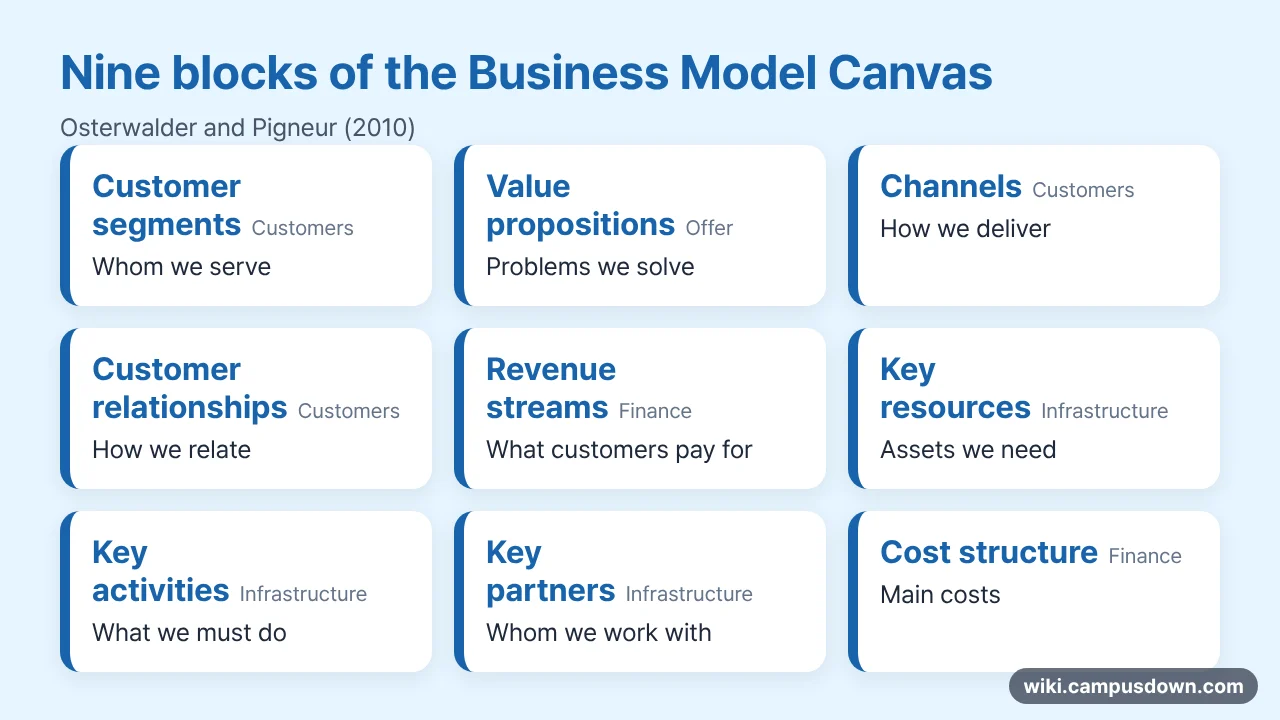
- It has nine blocks: customer segments, value propositions, channels, customer relationships, revenue streams, key resources, key activities, key partners and cost structure.
- The right-hand blocks cover customers and value creation; the left-hand blocks cover the efficiency of producing that value.
- The Lean Canvas, a startup variant, swaps key partners, key activities, key resources and customer relationships for problem, solution, key metrics and unfair advantage.
- A canvas is a set of hypotheses, not a fixed plan, so it should be revised as the market is tested.

What is the Business Model Canvas?
The Business Model Canvas is a design tool that maps on one page, in nine blocks, whom a business serves, what value it offers and how it delivers it, how it earns money in return and what it needs to do so. Alexander Osterwalder and Yves Pigneur introduced it in Business Model Generation (2010), defining a business model as the rationale of how an organisation creates, delivers and captures value. Instead of a long business plan, a team discusses a single shared picture, and the canvas works both for diagnosing an existing business and for designing a new one.
| Item | Details |
|---|---|
| Created by | Alexander Osterwalder and Yves Pigneur (2010) |
| Structure | Nine blocks |
| Uses | Diagnosing a business, designing a new one, team discussion |
| Variants | Lean Canvas (Ash Maurya), Value Proposition Canvas |
The nine blocks
The nine blocks fall into four areas: customers, offer, infrastructure and finances. Each block answers one question.
| Block | Key question |
|---|---|
| Customer segments | For whom are we creating value? |
| Value propositions | Which customer problems do we solve and needs do we meet? |
| Channels | How do we reach customers and deliver value? |
| Customer relationships | What relationship do we build and keep? |
| Revenue streams | What do customers pay for, and how? |
| Key resources | Which assets does the model need most? |
| Key activities | What must we do well? |
| Key partners | Whom do we work with? |
| Cost structure | What are the most important costs? |
Order of filling it in
Teams usually work from right to left. Start with customer segments and value propositions, complete the customer side with channels, relationships and revenue streams, then fill in the key resources, activities, partners and cost structure that make it possible. The right side shows value creation and the left side efficiency, so check that the two fit together. A 3C analysis or SWOT analysis beforehand helps clarify customers and competitors, and a VRIO analysis tests whether key resources are a real competitive advantage.
How the Lean Canvas differs
Ash Maurya adapted the canvas for early-stage startups facing high uncertainty. The Lean Canvas replaces four original blocks, key partners, key activities, key resources and customer relationships, with problem, solution, key metrics and unfair advantage (something that cannot easily be copied or bought). The idea is that early on it matters more to understand the problem than to list partners, and to define metrics than to catalogue resources. It pairs with the lean startup method of testing hypotheses quickly.
| Business Model Canvas | Lean Canvas |
|---|---|
| Key partners | Problem |
| Key activities | Solution |
| Key resources | Key metrics |
| Customer relationships | Unfair advantage |
Limits and tips
A canvas is a snapshot, so it does not show competitors' moves or change over time, and filling in the blocks does not validate a business. Treat each block as a hypothesis, check it through customer interviews or small experiments, and revise. To match value propositions to customer segments in more detail, use the same authors' Value Proposition Canvas (2014); to find problems from the user's side, combine it with design thinking.
Frequently asked questions
Who created the Business Model Canvas?
Alexander Osterwalder and Yves Pigneur, in their 2010 book Business Model Generation.
What are the nine blocks?
Customer segments, value propositions, channels, customer relationships, revenue streams, key resources, key activities, key partners and cost structure.
In what order should I fill it in?
Usually start on the right with customer segments and value propositions, then channels, relationships and revenue, then move left to resources, activities, partners and costs.
How is the Lean Canvas different?
It is an early-stage startup variant that replaces key partners, key activities, key resources and customer relationships with problem, solution, key metrics and unfair advantage.
References
- Osterwalder, A., & Pigneur, Y. (2010). Business Model Generation. Wiley.
- Osterwalder, A., Pigneur, Y., Bernarda, G., & Smith, A. (2014). Value Proposition Design. Wiley.
- Maurya, A. (2012). Running Lean (2nd ed.). O'Reilly.
- Teece, D. J. (2010). Business models, business strategy and innovation. Long Range Planning, 43(2–3), 172–194.
- Zott, C., Amit, R., & Massa, L. (2011). The business model: Recent developments and future research. Journal of Management, 37(4), 1019–1042.
- Strategyzer. (n.d.). The Business Model Canvas. https://www.strategyzer.com/library/the-business-model-canvas
- LEANFoundry. (n.d.). Lean Canvas. https://www.leanfoundry.com/tools/lean-canvas