
How does spinning water turn into the electricity that charges your phone? Almost every power plant in the United States, whether it burns gas, splits atoms or uses wind, ends in the same step: a magnet and a coil of wire moving relative to each other. That step is Faraday's law of induction.
The law
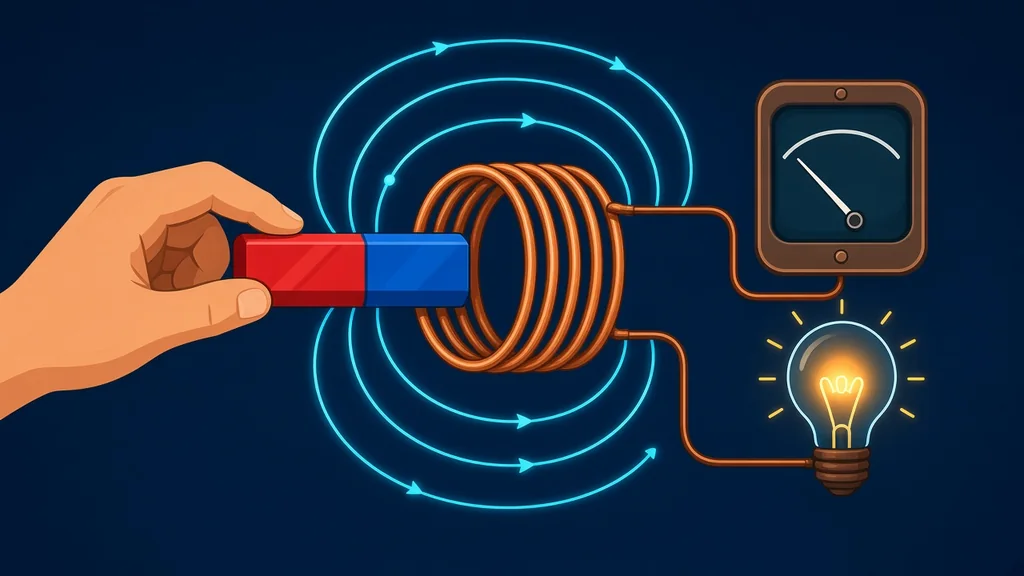
Faraday's law states that a changing magnetic field passing through a loop of wire induces a voltage, called an electromotive force (emf), in that loop. The faster the magnetic flux changes, and the more turns of wire there are, the larger the voltage. If the loop is part of a closed circuit, a current flows.
Key idea
It is the change that matters. A magnet sitting still inside a coil produces nothing; moving it in or out, or rotating the coil, produces a current.
The direction of the induced current is given by Lenz's law: it flows so as to oppose the change that caused it. This is why a magnet dropped through a copper pipe falls slowly, braked by the currents it creates.

Discovery
The English scientist Michael Faraday demonstrated electromagnetic induction in 1831, showing that a changing magnetic field could induce an electric current in a circuit. Later, James Clerk Maxwell wrote the idea into the equations of electromagnetism, where it appears as the Maxwell–Faraday equation.

US cases
- When and where
- 1832, Albany, New York
- What happened
- Joseph Henry, a professor at The Albany Academy, independently observed induction in 1832. He went on to become the first secretary of the Smithsonian Institution in Washington.
- Why it matters
- The SI unit of inductance, the henry, is named for him, a lasting reminder that the discovery was made on both sides of the Atlantic.
- When and where
- 1895, Niagara Falls, New York
- What happened
- The Edward Dean Adams Power Plant, which went into operation on August 25, 1895, was the first large-scale alternating current generating plant in the world. Westinghouse Electric built its 5,000-horsepower generators.
- Why it matters
- Its generators used falling water to spin conductors through magnetic fields, applying Faraday's law on an industrial scale and helping establish AC power across the United States.
Limits and criticisms
- Two explanations for one effect: for decades, physicists explained induction by moving wires and by changing fields in different ways, a puzzle that helped lead to Einstein's special relativity.
- Ideal conditions: simple textbook forms assume thin wires and slowly changing fields; real devices lose energy to heat and eddy currents.
- Sign conventions: students often find the minus sign from Lenz's law and the direction of current confusing.
Related concepts
Induction works alongside Ohm's law, which relates voltage and current in a circuit, and Coulomb's law, which describes the force between charges. The braking effect of Lenz's law follows the logic of Newton's laws of motion. Modern physics describes the same electromagnetic field using quantum mechanics.
Frequently asked questions
- What is Faraday's law in simple terms?
- A changing magnetic field through a loop of wire creates a voltage in that loop, and the faster the change, the bigger the voltage.
- Where is Faraday's law used today?
- In power plant generators, transformers on utility poles, wireless phone chargers, induction cooktops and electric guitar pickups.
- Who discovered electromagnetic induction?
- Michael Faraday in England in 1831; Joseph Henry in the United States observed it independently in 1832.