
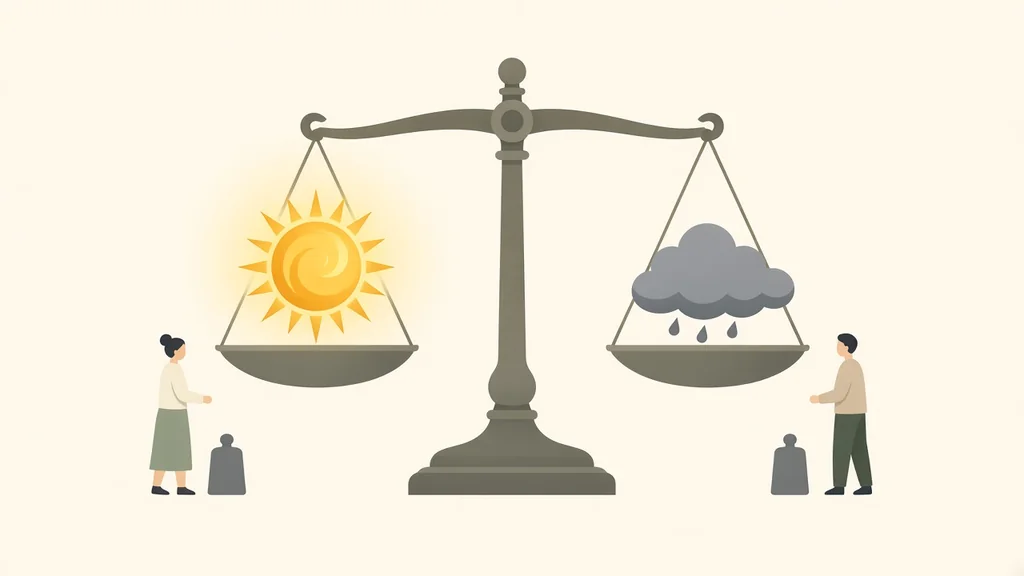
Is a good life just a life with more pleasure and less pain? Hedonism says yes, or close to it. It is one of the oldest ideas in philosophy, and it still shapes how economists, psychologists, and policy makers talk about well-being.

Two kinds of hedonism
Philosophers separate two claims that are easy to mix up.
- Psychological hedonism is a claim about motivation: people always act to get pleasure or avoid pain.
- Ethical hedonism is a claim about value: pleasure is the only thing good in itself, so the best life or action produces the most of it.
You can accept one and reject the other. Many philosophers reject psychological hedonism because people sometimes sacrifice their own pleasure for duty, love, or truth.

Ancient roots
Aristippus of Cyrene, a student of Socrates, taught that immediate bodily pleasure is the goal of life. Epicurus (341–270 BCE) took a quieter line. For him, the highest pleasure was ataraxia, a calm mind, and aponia, a body free of pain. That meant simple food, friendship, and freedom from fear, not feasting. The popular word "epicurean" for luxury badly misreads him.
Modern versions
Jeremy Bentham's 1789 book *An Introduction to the Principles of Morals and Legislation* proposed a "felicific calculus" that weighs pleasures by intensity, duration, certainty, and other factors. John Stuart Mill's *Utilitarianism* (1861) added that some pleasures are higher in quality than others. Both versions feed directly into utilitarianism.
What US research found
- When and where
- 1978, Northwestern University and University of Massachusetts researchers
- What happened
- Philip Brickman, Dan Coates, and Ronnie Janoff-Bulman compared recent Illinois lottery winners with controls and with people recently paralyzed in accidents. Winners were not significantly happier than controls a short time later, and took less pleasure in ordinary daily activities.
- Why it matters
- It suggested that big pleasures fade, the idea later called hedonic adaptation, which challenges simple "more pleasure" strategies.
- When and where
- 2010 and 2023, Princeton and Penn researchers
- What happened
- Daniel Kahneman and Angus Deaton reported in 2010 that day-to-day emotional well-being rose with income only up to about $75,000 a year. A 2023 joint paper with Matthew Killingsworth found that for most people it keeps rising, while an unhappy minority levels off.
- Why it matters
- These studies test a hedonist-style question directly: what actually increases felt pleasure over time?
Criticisms
The best-known objection is Robert Nozick's experience machine (1974). If a machine could give you perfect pleasurable experiences for life, most people say they would not plug in, which suggests we value more than pleasure. Henry Sidgwick also described the "paradox of hedonism": aiming straight at pleasure often makes it harder to get.
Key idea
Ethical hedonism says only pleasure matters in itself. Its critics argue that truth, achievement, and real relationships matter even when they bring no extra pleasure.
Related concepts
Compare hedonism with Epicurus, Stoicism (which treats pleasure as indifferent to virtue), and virtue ethics. Positive psychology research on well-being picks up many of the same questions.
Read next on CampusDown: The One Person the Greatest Happiness Misses: Strengths and Limits of Utilitarianism in Social Work Practice
Study material (Korean): 「서양철학사 과제 - 소크라테스부터 아리스토텔레스까지 쾌락과 윤리」
Frequently asked questions
- Is hedonism the same as selfishness?
- No. Ethical hedonism can count everyone's pleasure equally, which is the basis of utilitarianism.
- Was Epicurus a party lover?
- No. He recommended simple living and saw calm and the absence of pain as the highest pleasure.
- What is the paradox of hedonism?
- It is the observation that people who chase pleasure directly often find less of it than people absorbed in other goals.