
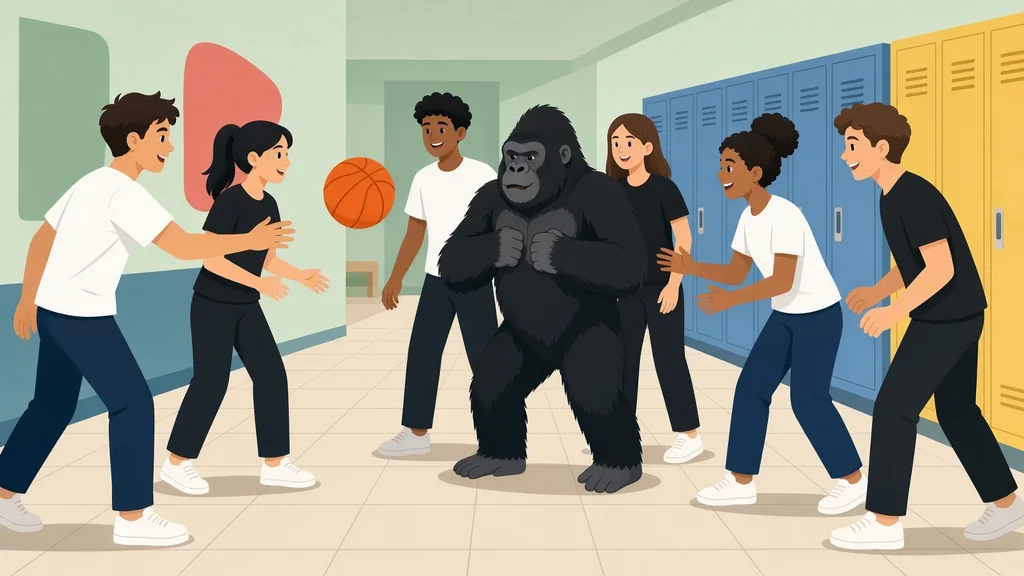
Could you miss a gorilla walking right through the middle of a scene you were watching closely? About half the people in one famous experiment did. Inattentional blindness is the failure to notice something fully visible because your attention is busy with something else.
Definition
Inattentional blindness, also called perceptual blindness, happens when a person does not perceive an unexpected stimulus in plain sight. It is not a vision problem: the eyes take in the scene, but attention does not pick out the unexpected object. Psychologists Arien Mack and Irvin Rock chose the term in 1992 and used it as the title of their 1998 MIT Press book.
Key idea
The more demanding the main task, the more likely people are to miss the unexpected. And most people are confident they would notice, which is what makes the effect dangerous.

US cases
- When and where
- 1999, Harvard University, Cambridge, Massachusetts
- What happened
- Daniel Simons and Christopher Chabris, building on earlier work by Ulric Neisser, asked viewers to count basketball passes made by players in white or black T-shirts. Midway through the video, a person in a gorilla suit, or in another version a woman with an umbrella, walked through the scene. In most groups about 50 percent of viewers did not report seeing it. The paper, "Gorillas in Our Midst," appeared in the journal Perception.
- Why it matters
- The video became the best-known demonstration of inattentional blindness and is widely used to teach how limited attention is.
- When and where
- January 25, 1995, Boston, Massachusetts
- What happened
- During a night-time chase after a shooting report, Boston officers mistook undercover officer Michael Cox for a suspect and beat him badly. Officer Kenny Conley, chasing the actual suspect, told a grand jury he had seen neither Cox's pursuit nor the beating. In 1998 a federal jury convicted him of perjury and obstruction for saying he had not seen Cox chasing the suspect, while acquitting him on the beating count. The conviction was later set aside because prosecutors had withheld evidence, and charges were dismissed in 2005.
- Why it matters
- In 2011 Chabris, Simons and colleagues simulated the chase: runners following a person while counting his head touches passed a staged fight. At night only 35 percent noticed it; during the day 56 percent did, showing that Conley's account was psychologically plausible.
Why it matters
- Driving: drivers focused on traffic or a phone can miss cyclists and pedestrians in plain view.
- Medicine and security: experts searching images for one kind of problem can overlook another.
- Eyewitness testimony: juries may assume a witness "must have seen" something that attention could easily have missed.
Criticisms
- Seeing vs. remembering: some researchers argue people may briefly see the unexpected object but fail to remember or report it, so the label "blindness" overstates the effect.
- Lab vs. life: results from short videos may not transfer cleanly to real situations with more time and motivation.
- Individual differences: studies disagree on how much age, expertise or working memory affect who notices.
Related concepts
Attention shaped by a recent intense task shows up in the Tetris effect, and what we fail to notice can later be filled in with false memories. Seeing what we expect is linked to confirmation bias, and eyewitness limits matter for proof beyond a reasonable doubt.

Frequently asked questions
- What is inattentional blindness in simple terms?
- It is missing something right in front of you because your attention is focused on something else.
- What is the invisible gorilla test?
- A 1999 experiment in which viewers counting basketball passes often failed to notice a person in a gorilla suit walking through the scene.
- Is inattentional blindness the same as change blindness?
- No. Change blindness is failing to notice that something changed; inattentional blindness is failing to notice an unexpected object at all.