
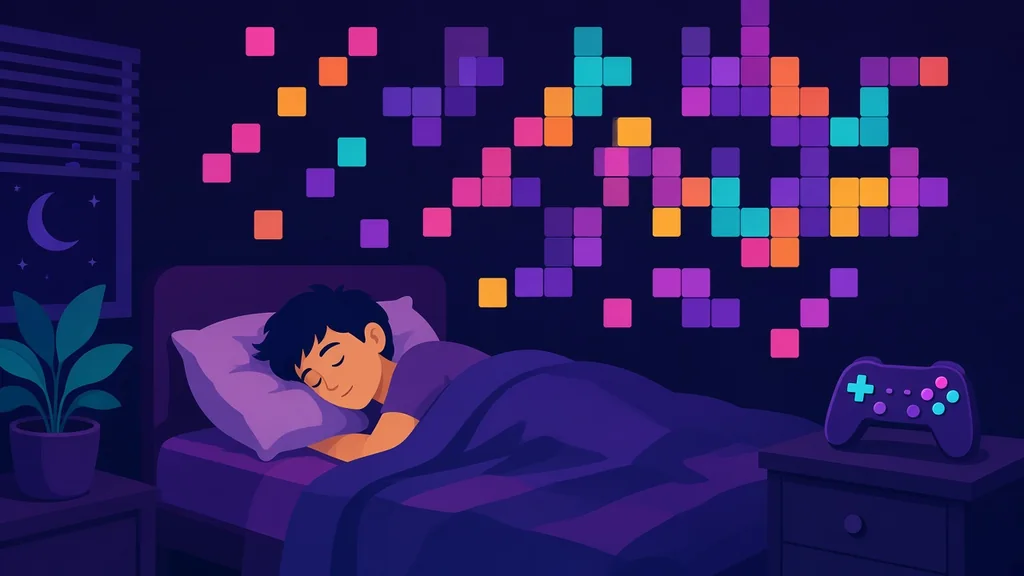
Have you ever closed your eyes after a long gaming session and still seen the game playing? Many Tetris players report watching blocks fall and rotate as they try to sleep, or catching themselves wondering how real objects would fit together. This experience is called the Tetris effect.
Definition
The Tetris effect describes what happens when people spend so much time and attention on an activity that it starts to shape their thoughts, mental images and dreams. It is not limited to Tetris. People report similar experiences after long hours of skiing, coding, data entry or other games. Psychologists connect it to hypnagogic imagery, the images that appear as we fall asleep, and to the brain's tendency to keep rehearsing recently learned skills.
Key idea
The Tetris effect shows that practice does not stop when the activity does. The brain keeps replaying patterns, especially during the transition into sleep.

Origin of the name
Tetris was created by Soviet programmer Alexey Pajitnov in 1984 and became a worldwide hit. In a May 1994 Wired article titled "This Is Your Brain on Tetris," writer Jeffrey Goldsmith used the phrase "the Tetris effect," describing it as a metaphor for curiosity and the urge to fit shapes together.

US cases
- When and where
- 1991–1992, University of California, Irvine
- What happened
- Haier scanned the brains of people learning Tetris. As reported in Wired, first-time players showed sharply raised brain glucose use, but after four to eight weeks of daily practice, glucose use fell back toward normal while performance improved on average about seven-fold.
- Why it matters
- The study supported a "brain efficiency" idea: practice lets the brain do more with less energy.
- When and where
- October 2000, Harvard Medical School; published in Science
- What happened
- Robert Stickgold and colleagues had people play Tetris and then recorded their sleep-onset images. Most reported seeing Tetris pieces, including patients with severe amnesia who could not remember having played the game.
- Why it matters
- The finding suggested that the Tetris effect comes from memory systems that work outside conscious recall, and it became a widely cited study of sleep and learning.
Criticisms and limits
- Mostly self-reported: much of the evidence comes from people describing their own experiences.
- Not a disorder: for most people the effect is harmless and fades after they stop the activity.
- Broad label: researchers studying "game transfer phenomena" argue that the effect covers many different experiences.
Related concepts
The Tetris effect fits Hebbian theory, the idea that neurons that fire together wire together. It involves working memory during play and long-term skill learning afterward, and the amnesia research connects it to how memory systems separate, a theme also seen in childhood amnesia. Focused attention on one pattern can also cause inattentional blindness to other things.
Study material (Korean): 「수면과 시상하부, 호르몬 관련 핵심 내용 요약 정리」
Frequently asked questions
- What is the Tetris effect in simple terms?
- It is when an activity you do a lot, like playing Tetris, keeps showing up in your thoughts, mental images or dreams after you stop.
- Is the Tetris effect harmful?
- Usually not. It tends to fade once you stop the activity, though some people find it distracting.
- Does the Tetris effect only happen with Tetris?
- No. People report it after many repetitive activities, from other video games to sports and work tasks.