
How many grains of sand make a heap? One grain is clearly not a heap, and a million grains clearly are, but no one can name the exact grain that makes the difference. The sorites paradox, from the Greek word soros for "heap," turns this everyday puzzle into a serious problem for logic, law and language.
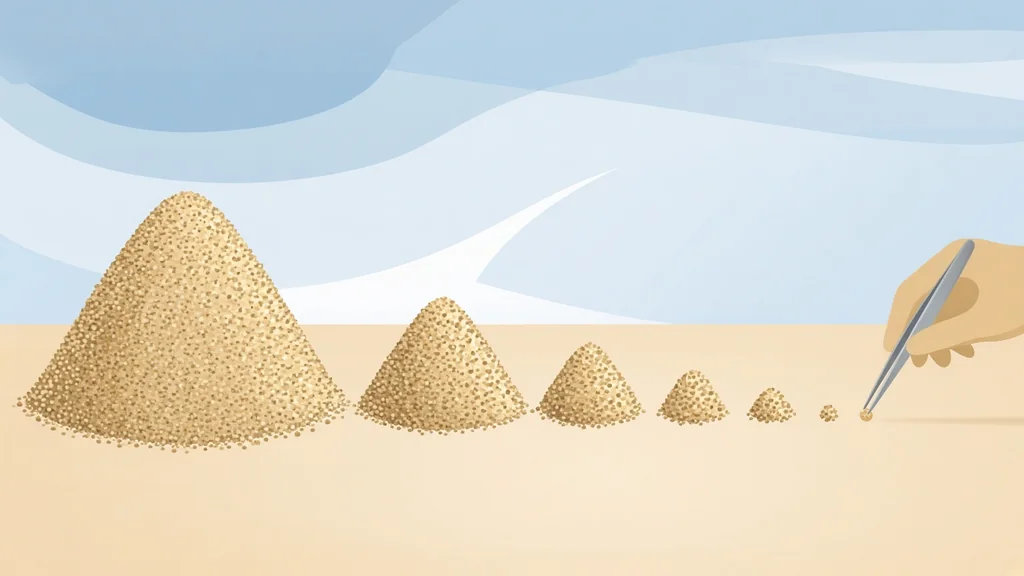
The paradox
The classic version runs:
- Premise 1: A million grains of sand make a heap.
- Premise 2: If n grains make a heap, then n − 1 grains also make a heap.
- Conclusion: Applying premise 2 again and again, one grain, and even zero grains, make a heap.
Each premise seems true and each step seems valid, yet the conclusion is plainly false. The same pattern works with "bald" (the falakros version: removing one hair never makes a person bald), "tall," "rich," "old" or "red." The puzzle is traditionally credited to Eubulides of Miletus in the 4th century BC.
Key idea
The sorites paradox is not about sand. It shows that vague words have borderline cases and no obvious sharp boundary, and that ordinary step-by-step reasoning can carry us across a line we never noticed.

Main solutions
- Epistemicism: philosophers such as Timothy Williamson and Roy Sorensen argue that there is a sharp cutoff, but we cannot know where it is.
- Supervaluationism: a vague sentence is true if it is true on every acceptable way of making the word precise, false if false on every way, and neither in borderline cases.
- Fuzzy logic: truth comes in degrees between 0 and 1, so "this is a heap" becomes slightly less true with each grain removed. The approach grew from Lotfi Zadeh's 1965 paper on fuzzy sets.
- Contextualism: where the boundary falls depends on the context and the comparison class.
- Rejecting the premise: some simply deny premise 2, accepting that somewhere one grain makes a difference even if it is odd to say so.
US cases
- When and where
- 1965, University of California, Berkeley
- What happened
- Lotfi A. Zadeh, a professor of electrical engineering at UC Berkeley, published "Fuzzy sets" in the journal Information and Control. Instead of saying an object either belongs to a set or does not, he let membership take any value between 0 and 1, so that "tall men" or "heaps" could have gradual boundaries.
- Why it matters
- Fuzzy logic gave engineers a practical way to handle vague categories and became one of the best-known formal answers to sorites-style vagueness, used later in control systems for appliances and machines.
- When and where
- August 2, 2013, United States
- What happened
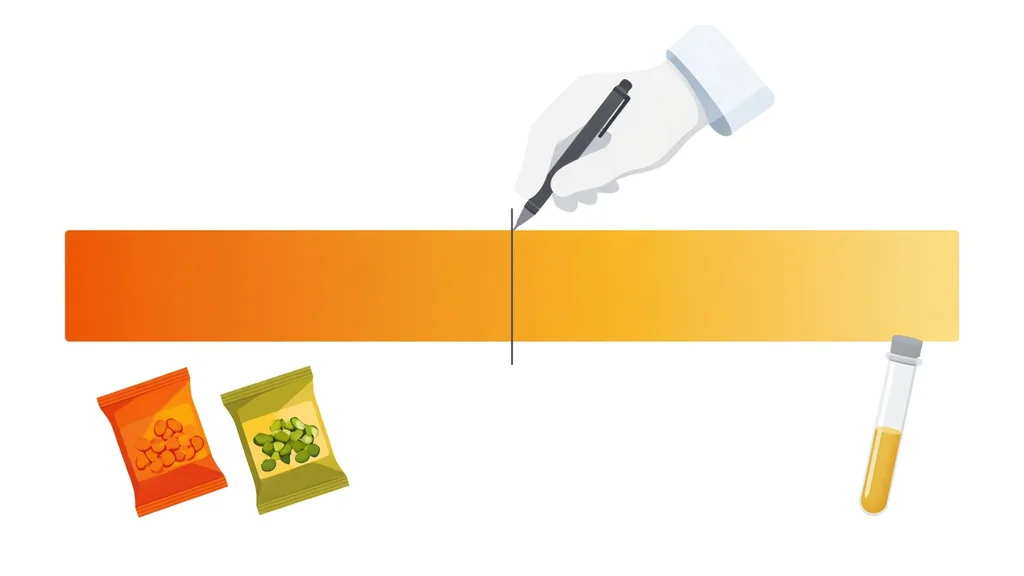
- The US Food and Drug Administration issued a final rule defining "gluten-free" for food labels. Among other conditions, any unavoidable gluten in a food labeled gluten-free must be below 20 parts per million.
- Why it matters
- Gluten content is a smooth quantity, and a food with 19 ppm is not very different from one with 21 ppm, yet the law needs a single line. The rule shows how regulators answer a sorites problem by choosing a precise threshold based on evidence, testing methods and public health.
- When and where
- 1964, US Supreme Court
- What happened
- In Jacobellis v. Ohio, a case about whether a French film could be banned as obscene, Justice Potter Stewart wrote in a concurring opinion that he would not try to define hard-core pornography, adding, "But I know it when I see it."
- Why it matters
- The line became a famous example of how courts deal with vague legal categories: instead of a sharp definition, judges sometimes rely on judgment in borderline cases.
Criticisms
- Sharp cutoffs feel arbitrary: critics of epistemicism find it hard to believe that "heap" has a precise but unknowable boundary.
- Fuzzy logic has its own line problem: if "heap" is 0.5 true at some point, it still seems arbitrary which pile is exactly 0.5, a problem often called higher-order vagueness.
- Slippery slope arguments: in law and politics, sorites-style reasoning is used to argue that a small change will lead to a large one. Such arguments can be reasonable or fallacious depending on whether there is evidence for the slide.
Related concepts
Ancient Greece produced another famous family of puzzles about dividing things into tiny steps, Zeno's paradoxes. The question of how fact-based steps reach a judgment echoes the is-ought problem, and Plato's theory of forms imagined perfect, sharply defined ideas behind messy everyday things. In court, the vague standard of reasonable doubt is a live example of a boundary without a number, and the infinite monkey theorem is another case where intuition struggles with very large step-by-step processes.
Study material (Korean): 「예술학 과제 – 세라노와 메이플소프 작품으로 본 외설과 예술의 경계」
Frequently asked questions
- What is the sorites paradox in simple terms?
- If taking one grain from a heap never turns it into a non-heap, then repeating that step would make even one grain a heap, which is absurd. The puzzle shows that vague words lack sharp boundaries.
- What does sorites mean?
- It comes from the Greek word soros, meaning "heap."
- How does fuzzy logic answer the sorites paradox?
- It treats truth as a matter of degree, so each grain removed makes "this is a heap" a little less true instead of switching suddenly from true to false.