
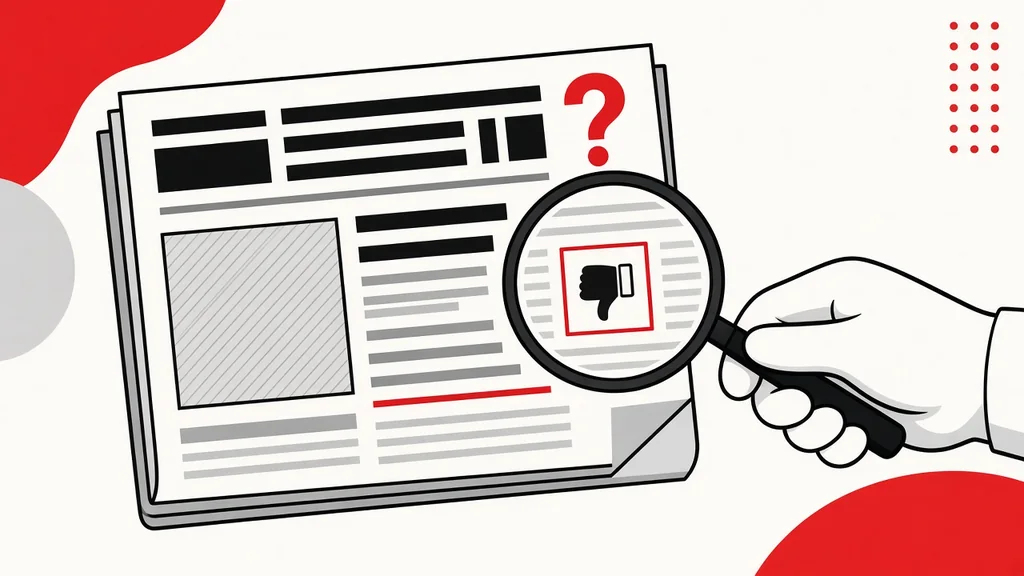
"Is your phone secretly listening to you?" "Did scientists just find a cure?" When a headline asks a question, the honest answer is very often "no." That observation is known as Betteridge's law of headlines: any headline that ends in a question mark can be answered with the word no.
The idea
The logic is simple. If a reporter had solid evidence, the headline would state the claim directly: "Phone maker caught recording users." Writers turn a claim into a question when they want the attention of a dramatic idea without having to stand behind it. The question lets them publish speculation, rumor, or a long shot while technically asserting nothing.
Key idea
Betteridge's law is a rule of thumb for readers, not a scientific law. It reminds you to ask what evidence the article actually gives.

Origin
The law is named after Ian Betteridge, a British technology journalist, who wrote about it in February 2009. Similar maxims had circulated earlier; a 1991 collection of Murphy's law variants called a version "Davis's law," and older journalism guides warned against question headlines. Betteridge's post went viral, and his name stuck.

US cases
- When and where
- February 2009, TechCrunch, San Francisco
- What happened
- The US tech news site TechCrunch ran a story under the headline "Did Last.fm Just Hand Over User Listening Data To the RIAA?" based on a single anonymous source. Last.fm strongly denied it. Betteridge cited this headline as a perfect example: the question allowed the site to run a story it could not confirm.
- Why it matters
- It is the founding example of the law, and it came from a US tech publication.
- When and where
- 2015, independent data analysis
- What happened
- A data scientist analyzed about 26,000 articles from 13 news websites. Fewer than 3% of headlines ended in a question mark, and among yes/no questions the answers split roughly evenly between "yes," "no," and unclear.
- Why it matters
- It suggests the law is better treated as a warning sign about speculative headlines than as a literal statistical rule.
How well does the law hold?
Studies of academic journals found that question titles are rare and, when used, are more often answered "yes" or "maybe" than "no." Scientific titles tend to ask questions the paper actually answers. News and viral content are a different case, where question headlines often signal thin sourcing.
Criticisms
- Not literally true: many question headlines do have a "yes" answer, or no clear answer at all.
- Genre matters: explainers, opinion pieces, and science articles use questions honestly to frame a topic.
- Cynicism risk: dismissing every question headline can lead readers to skip legitimate reporting.
Related concepts
Question headlines shape how readers interpret a story, a process studied in media framing theory and the framing effect. Repeating a suggestive question can also make a claim feel familiar, which feeds the illusory truth effect and misinformation. Editors decide which questions get headlines through gatekeeping.
Study material (Korean): 「가짜뉴스를 가려내는 나만의 분별법 10가지와 실제 가짜뉴스 세 건에 적용한 결과」
Frequently asked questions
- What is Betteridge's law of headlines?
- The rule of thumb that any headline ending in a question mark can be answered "no."
- Is Betteridge's law always true?
- No. It is a warning sign for speculative stories; studies find many question headlines are answered "yes" or have no clear answer.
- Why do journalists use question headlines?
- To attract attention to an idea they cannot confirm as fact, or sometimes to frame an honest explainer.