
How do you know you are not just a brain in a jar, wired to a computer that is feeding you this very sentence? The brain in a vat is one of the most famous thought experiments in modern philosophy, and it sits behind many everyday questions about simulations and virtual reality.
The scenario
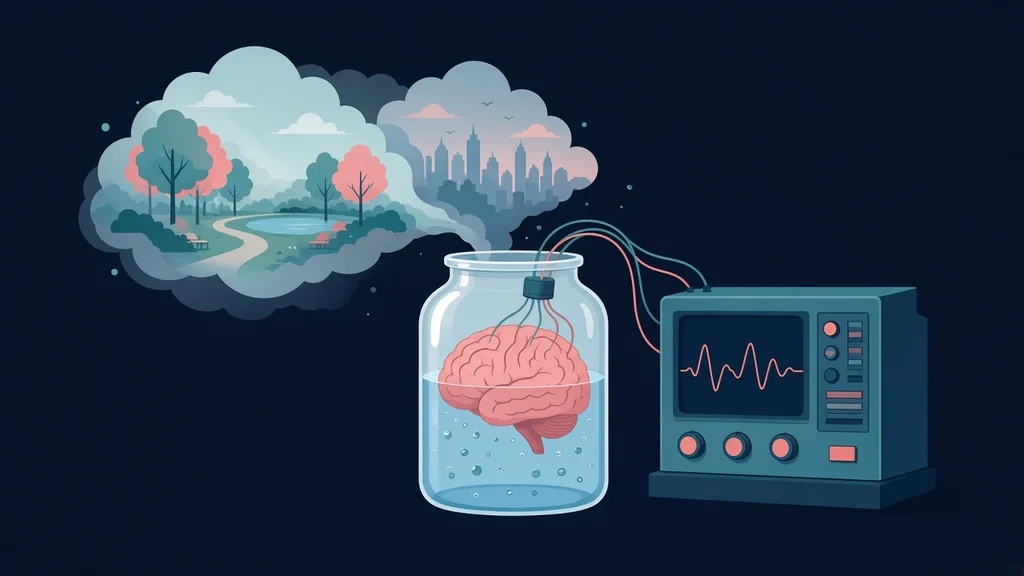
Imagine a scientist removes your brain, keeps it alive in a vat of nutrients and connects its nerve endings to a supercomputer. The computer sends exactly the electrical signals your brain would receive from a real body walking through a real world. From the inside, nothing would feel different.
The scenario was conceived by American philosopher Gilbert Harman, who taught at Princeton University, and it is a modern version of René Descartes' evil demon, which might deceive us about everything we perceive.

The skeptical argument
1. If you know you have hands, you know you are not a brain in a vat. 2. You cannot know you are not a brain in a vat, because your experiences would be the same either way. 3. So you do not know you have hands.

Key idea
The puzzle is not that we probably are brains in vats. It is that our evidence seems unable to rule the possibility out.
Putnam's reply
Harvard philosopher Hilary Putnam turned the scenario into an argument against skepticism in Reason, Truth and History (1981). Relying on a causal theory of reference, he argued that a word refers to something only if it has the right causal link to it. A brain that has only ever lived in a vat has never been causally connected to real brains or real vats, so when it thinks "I am a brain in a vat," it is not referring to them. Putnam concluded that the thought "I am a brain in a vat" is either false or meaningless.
US cases
- When and where
- 1981, Harvard University, Cambridge, Massachusetts
- What happened
- Putnam, who taught at Harvard from 1965 for the rest of his career, presented the brain-in-a-vat argument in Reason, Truth and History.
- Why it matters
- The argument became a cornerstone of semantic externalism, the view that the meaning of our words depends partly on the world outside our heads, and it produced a large body of philosophical literature.
- When and where
- Released in US theaters March 31, 1999
- What happened
- The science fiction film written and directed by the Wachowskis imagines humans whose bodies are kept in pods while their minds live inside a computer simulation. The film won all four Academy Awards it was nominated for, including Best Visual Effects.
- Why it matters
- The Matrix is widely described as inspired by Putnam's scenario, and it made the brain-in-a-vat question a topic in American classrooms, dorm rooms and philosophy books aimed at general readers.
Criticisms
- Does Putnam's argument prove too little? Critics note that it may not rule out a brain that was envatted recently, after years of normal life, since that brain's words were linked to the real world.
- Reliance on externalism: the argument works only if the causal theory of reference is true, which many philosophers dispute.
- Practical irrelevance: some argue that if a simulation is perfect, the question makes no difference to how we should live, a point that connects to the debate over the experience machine.
Related concepts
A similar worry about whether our minds can be trusted appears in the Boltzmann brain problem in cosmology. Questions about what an inner experience really is also drive the philosophical zombie argument, and Plato's cave in the theory of forms is an ancient ancestor of the vat. Online worries about an internet filled with fake activity, the dead internet theory, borrow the same unease about what is real.
Study material (Korean): 「서양철학 과제 – 데카르트 명상의 회의주의 논증과 플라톤」
Frequently asked questions
- What is the brain in a vat theory in simple terms?
- It is a thought experiment asking how you could know you are not a brain kept alive in a lab and fed fake experiences by a computer.
- Who came up with the brain in a vat?
- Gilbert Harman conceived the scenario, and Hilary Putnam made it famous in his 1981 book Reason, Truth and History.
- Is the brain in a vat the same as The Matrix?
- Not exactly, but The Matrix is widely seen as inspired by it: both imagine a mind receiving a simulated world it cannot tell apart from reality.