
If you add more of one ingredient to a reaction that has settled into balance, what happens? Le Chatelier's principle gives a quick prediction: the system shifts to use up some of what you added. It is a core topic in AP Chemistry and first-year college chemistry in the United States, and it explains processes from fertilizer factories to the ocean.
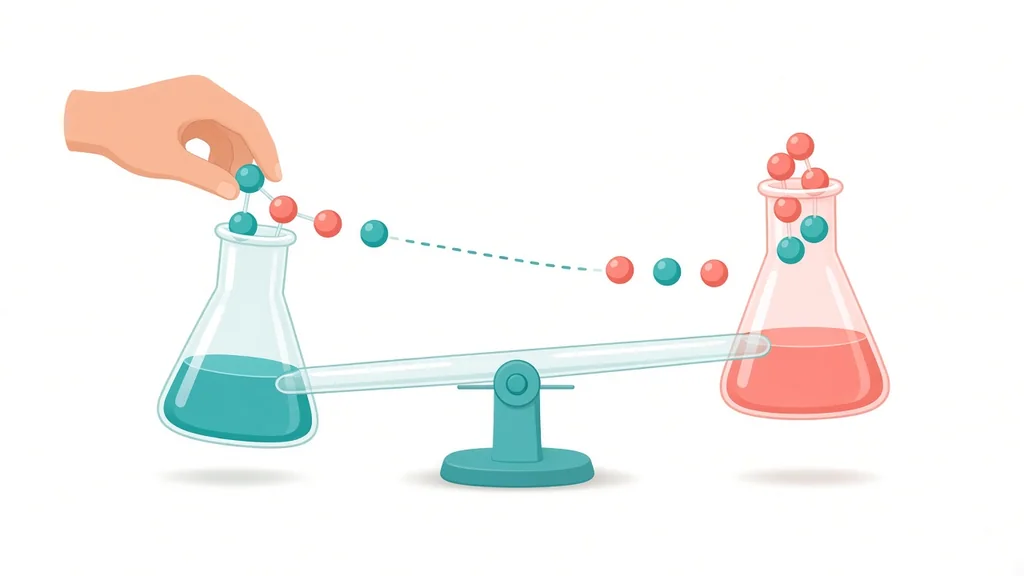
The principle
French chemist Henry Louis Le Chatelier stated the principle in 1884; it is also called the Le Chatelier–Braun principle after the German physicist Karl Ferdinand Braun. In plain terms: a system at equilibrium responds to a disturbance by shifting in the direction that partly undoes it.
Key idea
The shift only partly offsets the change. The system reaches a new equilibrium; it does not return exactly to where it started.

The rules for common changes
- Concentration: adding a reactant shifts the reaction toward products; removing a product does the same.
- Pressure (gases): increasing pressure by reducing volume shifts the reaction toward the side with fewer gas molecules.
- Temperature: heating favors the endothermic direction, and cooling favors the exothermic direction. Unlike the other changes, temperature actually changes the equilibrium constant.
- Catalysts: a catalyst speeds up the forward and reverse reactions equally, so it helps reach equilibrium faster but does not shift it.
- Inert gas at constant volume: adding a gas that does not react does not shift the equilibrium, because partial pressures of the reacting gases are unchanged.
A classic example: the Haber process
Ammonia for fertilizer is made from nitrogen and hydrogen: N2 + 3H2 ⇌ 2NH3, a reaction that releases heat. Four gas molecules become two, so high pressure pushes the equilibrium toward ammonia. Low temperature would also favor ammonia, but it slows the reaction too much, so industrial plants choose a compromise temperature, use a catalyst, and remove ammonia as it forms.

US cases
- When and where
- Early summer 2009, Oregon coast
- What happened
- Scientists studying an oyster hatchery on the Oregon coast measured how the chemistry of the seawater the hatchery drew in varied, with pH ranging from below 7.6 to above 8.2. Published in Limnology and Oceanography in 2012, the study found that larval production and midstage growth of Pacific oysters were significantly related to the aragonite saturation state of the water in which the larvae were spawned and reared in their first 48 hours.
- Why it matters
- When seawater takes up more carbon dioxide, the equilibria CO2 + H2O ⇌ H2CO3 ⇌ H+ + HCO3− shift to the right, and the extra hydrogen ions combine with carbonate ions, leaving less carbonate for shell building. The case brought Le Chatelier's principle out of the textbook and into the Pacific Northwest shellfish industry.
- When and where
- 1947, Cambridge, Massachusetts
- What happened
- In Foundations of Economic Analysis, published by Harvard University Press and based on his Harvard doctoral dissertation, the American economist Paul Samuelson introduced a generalized Le Chatelier principle for economics. It predicts, for example, that a firm's response to a price change is larger in the long run, when all inputs can adjust, than in the short run, when some inputs are fixed.
- Why it matters
- The idea showed how a principle from chemistry could organize reasoning about economic equilibrium and became a standard result in mathematical economics.
Limits and criticisms
- Qualitative only: the principle tells the direction of a shift, not its size. For numbers, chemists use the equilibrium constant and the reaction quotient.
- Ambiguous cases: some changes, such as adding a reactant gas at constant pressure, can shift equilibrium in the opposite direction from what a quick reading predicts, so textbook statements need care.
- Not about speed: it says nothing about how fast equilibrium is reached.
- Overextension: using the principle loosely for living systems, markets or societies can blur the difference between true equilibrium and other kinds of steady state.
Related concepts
How much carbon dioxide dissolves in the first place is governed by Henry's law, and the pressure-volume-temperature behavior of gases follows the ideal gas law. Energy released or absorbed in a reaction is accounted for by conservation of energy, while the long-term fate of all such processes is connected to entropy and the heat death of the universe. The idea that Earth's systems push back against change is central to the Gaia hypothesis.
Study material (Korean): 「화학 과제 – 갈륨의 특성과 알루미늄 반응을 통한 수소발생 원리」
Frequently asked questions
- What is Le Chatelier's principle in simple terms?
- When something changes a system in balance, the system shifts in a way that partly cancels the change and settles at a new balance.
- Does a catalyst shift equilibrium?
- No. A catalyst speeds up both directions of the reaction equally, so equilibrium is reached faster but its position does not change.
- How does Le Chatelier's principle relate to ocean acidification?
- Extra carbon dioxide in seawater shifts the carbonic acid equilibria toward more hydrogen ions, which then combine with carbonate ions, leaving less carbonate for shellfish to build shells.