
Why does a bottle of soda hiss and foam the moment you open it, and why must scuba divers rise slowly? Both answers come from Henry's law, a simple rule about how gases dissolve in liquids. It is a standard topic in US high school and college chemistry and in diver training.
The law
Henry's law says that at a constant temperature, the amount of gas that dissolves in a liquid is proportional to the partial pressure of that gas above the liquid. A common form is:
C = kH × P
Here C is the concentration of dissolved gas, P is the partial pressure of that gas, and kH is Henry's law constant, which depends on the gas, the liquid and the temperature. Double the pressure of a gas over water and, at equilibrium, roughly twice as much of it dissolves.
The English chemist William Henry reported the relationship in 1803 after experiments on how much gas water absorbs at different pressures.
Key idea
Pressure pushes gas into a liquid, and releasing pressure lets it out. Temperature matters too: most gases are less soluble in warm water, which is why warm soda goes flat faster.

Everyday examples
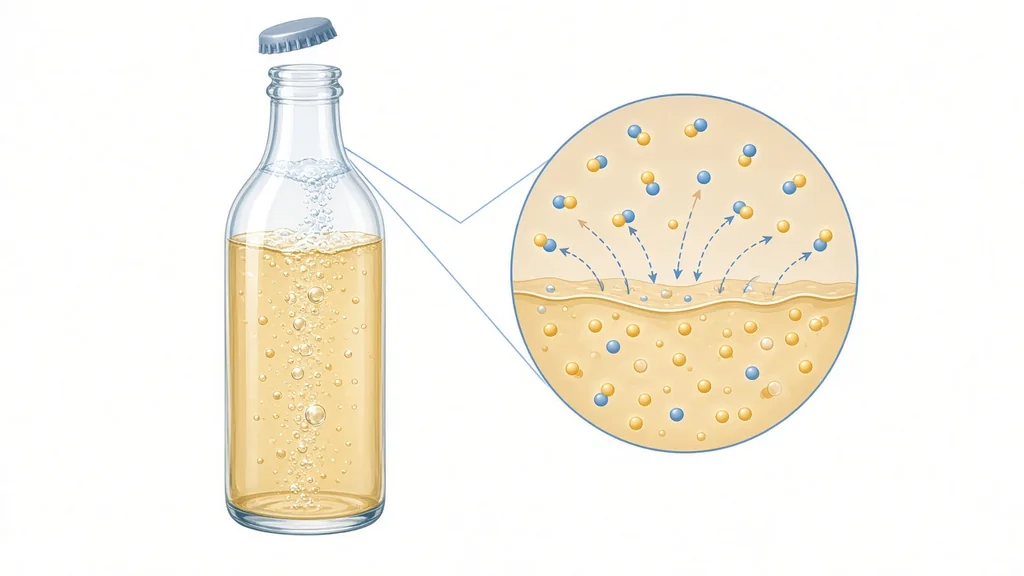
- Soda: carbon dioxide is dissolved in the drink under high pressure in the sealed bottle. When the cap comes off, the pressure above the liquid drops, the drink holds less gas, and bubbles form.
- Scuba diving: at depth, a diver breathes air at higher pressure, so more nitrogen dissolves in the blood and tissues. If the diver rises too fast, the nitrogen comes out of solution as bubbles, causing decompression sickness, often called the bends.
- Oceans and climate: the ocean absorbs carbon dioxide from the air in part according to Henry's law, so a rising concentration of carbon dioxide in the atmosphere means more dissolves in seawater.
- Medicine: anesthetic gases and oxygen therapy, including hyperbaric chambers, rely on how much gas dissolves in blood at a given pressure.
US cases
- When and where
- 1870–1872, New York City
- What happened
- To build the foundations of the Brooklyn Bridge, workers dug inside huge wooden caissons sunk into the East River. The chambers were filled with compressed air to keep water out, so the men breathed air at high pressure for hours. Many developed what the project physician Andrew Smith called caisson disease, now known as decompression sickness, after returning to normal air pressure. Between January 25 and May 31, 1872, Smith treated 110 cases, and three workers died of the disease. Chief engineer Washington Roebling himself was disabled by it and later directed the work from his apartment, while his wife Emily Warren Roebling carried his instructions to the site. The bridge opened on May 24, 1883.
- Why it matters
- The case is one of the best-known American examples of Henry's law in action: gas dissolved in the body under pressure forms bubbles when the pressure is released too quickly.
- When and where
- 2008, Appalachian State University, North Carolina
- What happened
- After viral videos and a 2006 MythBusters episode made the Diet Coke and Mentos "geyser" famous, physicist Tonya Coffey studied why it happens and published the results in the American Journal of Physics. The study reported that the rough surface of the candy provides many tiny sites where bubbles can form, and that ingredients in the drink, such as aspartame, lower the surface tension and make bubble growth easier.
- Why it matters
- The study shows the other half of Henry's law in a bottle: the soda is supersaturated with carbon dioxide once opened, and the gas escapes as fast as bubbles can form.
Limits and criticisms
- Dilute solutions only: Henry's law works best for gases that dissolve in small amounts and do not react strongly with the solvent.
- Reactive gases: gases such as carbon dioxide in water and ammonia partly react to form other species, so the simple law describes only the dissolved gas itself, not the total.
- Temperature dependence: the constant changes with temperature, so values must be quoted for a stated temperature.
- Equilibrium assumption: the law describes the final equilibrium, not how fast gas enters or leaves. Real soda and real divers depend on rates and bubble formation as well.
Related concepts
Henry's law sits beside the ideal gas law, which links pressure, volume and temperature of a gas. When dissolved gas reacts, the shift in balance is described by Le Chatelier's principle. The buoyancy that lifts rising bubbles is explained by Archimedes' principle, and chemists who measure dissolved substances by light often use the Beer–Lambert law. The energy carried away as gas expands fits within conservation of energy.

Study material (Korean): 「해양산성화의 원인과 영향, 해결방안: 이산화탄소 흡수와 pH 저하, 탄산칼슘 생물 피해, 재생에너지 전환」
Frequently asked questions
- What is Henry's law in simple terms?
- The more pressure a gas has above a liquid, the more of it dissolves in the liquid, as long as the temperature stays the same.
- How does Henry's law explain the bends?
- Under water, divers breathe air at high pressure, so extra nitrogen dissolves in their bodies. If they rise too quickly, the pressure drops and the nitrogen forms bubbles in the blood and tissues.
- Why does warm soda go flat faster?
- Most gases, including carbon dioxide, are less soluble in warm liquids, so warm soda holds less gas and loses it faster.