
Your patient scores a 13 on the Braden Scale. Is that a lot? And does a 13 change what you do in the next hour?

The Braden Scale is on nearly every nursing exam and unit. This guide explains it using OpenStax's Fundamentals of Nursing (24.3 Wound Classification) and Medical-Surgical Nursing (28.3 Pressure Injury and 35.7 Integumentary Concerns), plus a Hartford Institute "Try This" geriatric nursing resource on predicting pressure injury risk. It is a study aid, not orders; your instructor, facility policy and the provider decide how it is used. If you want to learn more about the injuries themselves, take a closer look at pressure injury stages.
What the scale does
OpenStax says the Braden Scale is the most used pressure injury risk assessment tool in the United States, used in critical and acute care, long-term care, rehabilitation and home care. It evaluates the relative risk of a patient developing skin breakdown and pressure injuries, and the scores can tailor prevention interventions to at-risk patients.

The six subscales
OpenStax lists them and describes the scoring:
| Subscale | Lowest score (1) to highest |
|---|---|
| Sensory perception | Completely limited, unresponsive; very limited, responds only to painful stimuli; responds to verbal commands but limited; no impairment |
| Moisture | Constant moisture; frequent moisture or linen changes; occasional moisture; usually dry |
| Activity | Bedbound; chairbound, limited walking; short-distance walking; frequent walking |
| Mobility | Immobile; very limited; slight limitations; no limitations |
| Nutrition | Very poor; likely inadequate; adequate; excellent |
| Friction and shear | Constant friction, requires assistance; moves with minimal assistance; moves independently (this item only goes up to 3) |
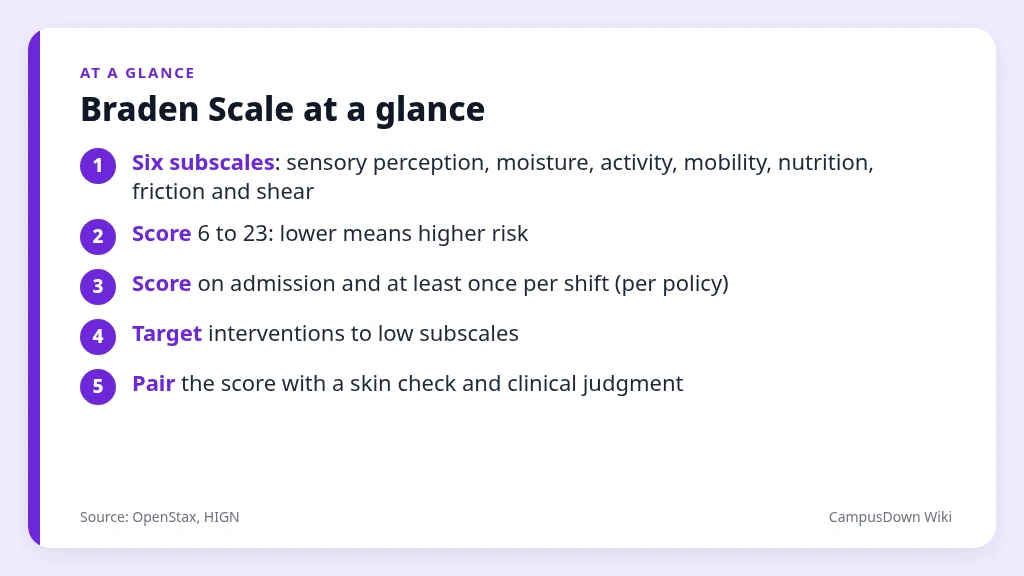
Each subscale is scored 1 to 4 (friction and shear 1 to 3), and the ratings are added for a total of 6 to 23. The lower the score, the greater the risk of a pressure injury. Your facility's official form has the full wording for each level; use it, not memory.
Score ranges and risk categories
Sources differ slightly, so learn the one your instructor uses:
- A Hartford Institute geriatric resource lists 15 to 18 at risk, 13 to 14 moderate risk, 10 to 12 high risk, and 9 or below very high risk.
- OpenStax's Fundamentals text says patients scoring 18 or below should be reassessed regularly, on a schedule set by the facility, and those above 18 should be reassessed when their condition changes.
- OpenStax's Med-Surg text says a total of 12 or less represents high risk.
Notice the pattern: the cut-offs are not identical across sources, which is why your facility's protocol and instructor's chart rule. Quiz questions usually name the cut-offs they want.
How often to score
OpenStax says the scale is typically completed on admission and once per shift, and in critical care, at least once per shift per hospital and unit protocols. The geriatric resource says guidelines recommend a structured risk assessment as soon as possible but within 8 hours of admission or first contact, repeated according to the patient's acuity or significant changes in condition.
Using the score to act
The geriatric resource advises not relying only on the total score: basing prevention on low subscale scores targets the problem. For example (a learning aid, not orders):
- Low sensory perception or mobility/activity: repositioning and offloading plans, and assistance with movement.
- Low moisture: manage incontinence and linen or skin moisture, since OpenStax says moisture worsens tissue breakdown.
- Low nutrition: involve the care team about intake.
- Low friction/shear: avoid dragging and manage positioning to reduce shear.
OpenStax's Med-Surg text says the cornerstone of prevention is to reduce pressure, moisture and friction, that turning and repositioning every two hours is the typical unofficial rule (some patients need more frequent turns), and that specialty beds, pillows and foam dressings can reduce pressure on bony prominences; for example, elevating heels off the bed with a pillow. Look at a "quality turn" so the patient isn't just propped sideways. Related: pressure sores in bedbound patients and wound care dressings.
Limits of the score
- OpenStax notes recent studies show a nurse's clinical judgment is just as effective, if not more, at identifying patients at risk, so don't ignore your own assessment.
- Risk factors beyond the scale include advanced age, immobility, poor perfusion, altered level of consciousness, skin infections, other conditions, and, per the geriatric resource, previous or existing pressure injuries, diabetes, incontinence, fever and others.
- The geriatric resource reports published sensitivity of 83 to 100% and specificity of 64 to 90% depending on the cut-off used, so no cut-off is perfect.
- A score estimates risk; it doesn't stage or describe an existing injury. Use the staging guide for that, and a head-to-toe assessment to check skin.
Documentation
Record each subscale and the total, the time, and the interventions you started or changed. See nursing charting basics and the nursing process for how a risk score feeds a plan of care.
Study tips
- Memorize the six subscales with a mnemonic you invent, and that friction and shear tops out at 3.
- Remember: lower score, higher risk, and total range 6 to 23.
- Write down the cut-offs your instructor uses.
- Practice turning a score into a subscale plan.
- Learn the typical frequency: admission and each shift.
Questions for your instructor
- Which cut-offs and categories do we use?
- How often does our unit score patients?
- Which interventions go with which low subscales?
- When do we call wound care?
- How do we document the score and the plan?
Example scenario: the number behind the turn
- Who
- Eudora, 23, a nursing student in Spokane, Washington, scored a patient's Braden subscales on her first clinical day and found low marks for mobility and moisture.
- What happened
- She wasn't sure the total was low enough to matter.
- How it felt
- She felt unsure and a little shy.
- What they did
- She asked her instructor, who asked which subscales were low and what could be done about them; together they checked the patient's skin and reviewed the turning plan with the nurse. Eudora began writing the lowest subscale beside the total.
- How it turned out
- Eudora said the low items told her what to do, not just that something was wrong.
This is an illustrative example, not a real patient or a review.
Eudora's story is an illustrative example. Real care follows your instructor, your facility and the provider's orders.
Most-asked questions about the Braden Scale
How is the Braden Scale scored?
Six subscales are scored 1 to 4 (friction and shear 1 to 3) and added for a total of 6 to 23; a lower score means higher risk.
Why people ask: "braden scale scoring" is #2 for "braden scale" (US autocomplete, November 2026).
How is the Braden Scale assessment done?
A nurse rates the six subscales, typically on admission and once per shift, and uses low subscales to guide prevention.
Why people ask: "braden scale assessment" is #3 for "braden scale" (US autocomplete, November 2026).
What does a Braden Scale score mean?
A lower total means higher risk of pressure injury; a Hartford Institute resource lists 15 to 18 at risk, 13 to 14 moderate, 10 to 12 high and 9 or below very high.
Why people ask: "braden scale score meaning" is #4 for "braden scale" (US autocomplete, November 2026).
What are the Braden Scale ranges?
Total scores range from 6 to 23; cut-offs differ by source, so use your facility's.
Why people ask: "braden scale ranges" is #7 for "braden scale" (US autocomplete, November 2026).
What is the Braden Scale in nursing?
A six-item risk assessment for pressure injuries used by nurses in many settings.
Why people ask: "braden scale nursing" is #8 for "braden scale" (US autocomplete, November 2026).
What is a Braden Scale chart?
The six subscales with descriptions for each level; see the table above and use your facility's form.
Why people ask: "braden scale chart" is #9 for "braden scale" (US autocomplete, November 2026).
What are the Braden Scale categories?
At risk, moderate, high and very high risk in one geriatric resource; categories vary by source.
Why people ask: "braden scale categories" is #10 for "braden scale" (US autocomplete, November 2026).
What are the nursing interventions for the Braden Scale?
Reposition, offload bony areas, manage moisture, support nutrition and reduce friction and shear, targeted to low subscales.
Why people ask: "braden scale nursing interventions" is #2 for "braden scale nursing" (US autocomplete, November 2026).
What is nursing management based on the Braden Scale?
Score on admission and each shift, target low subscales, check skin and document the plan.
Why people ask: "braden scale nursing management" is #6 for "braden scale nursing" (US autocomplete, November 2026).
What is a Braden score in nursing?
The total from the six subscales, from 6 to 23, used to estimate pressure injury risk.
Why people ask: "braden score nursing" is #8 for "braden scale nursing" (US autocomplete, November 2026).
Related on CampusDown
You can learn more about the nursing student hub and check it for yourself in the pressure injury stages guide. For skin checks in detail, see head-to-toe assessment.
Frequently asked questions
- What is the total score range?
- 6 to 23.
- Is a lower score better?
- No; a lower score means higher risk.
- How often is it scored?
- Typically on admission and once per shift, per facility policy.
- Is friction and shear scored to 4?
- No; it is scored 1 to 3.
- Should I rely only on the total?
- No; use subscales, a skin check and clinical judgment.
The Braden Scale turns six observations into a risk score from 6 to 23. Know the subscales, your facility's cut-offs and how to link low subscales to prevention, and keep trusting your own assessment.
Browse more guides like this in the Nursing Student and NCLEX hub.
This article is for general education and does not replace advice from your own doctor, nurse or pharmacist.
References
- OpenStax: Fundamentals of Nursing, 24.3 Wound Classification
- OpenStax: Medical-Surgical Nursing, 28.3 Pressure Injury
- OpenStax: Medical-Surgical Nursing, 35.7 Integumentary Concerns
- Ayello EA: Predicting Pressure Injury Risk, Try This: Best Practices in Nursing Care to Older Adults, Hartford Institute for Geriatric Nursing, revised 2017