
Do you need the newest GLP-1 to get good results? Not necessarily. Trulicity was approved in 2014, is taken once a week with a single-dose pen, and remains a well-studied option for type 2 diabetes, including in older adults.

This guide uses the Trulicity prescribing information and Medication Guide on DailyMed (updated November 2026). It explains in detail what the label says. Always follow your prescriber's instructions; never change your dose on your own.
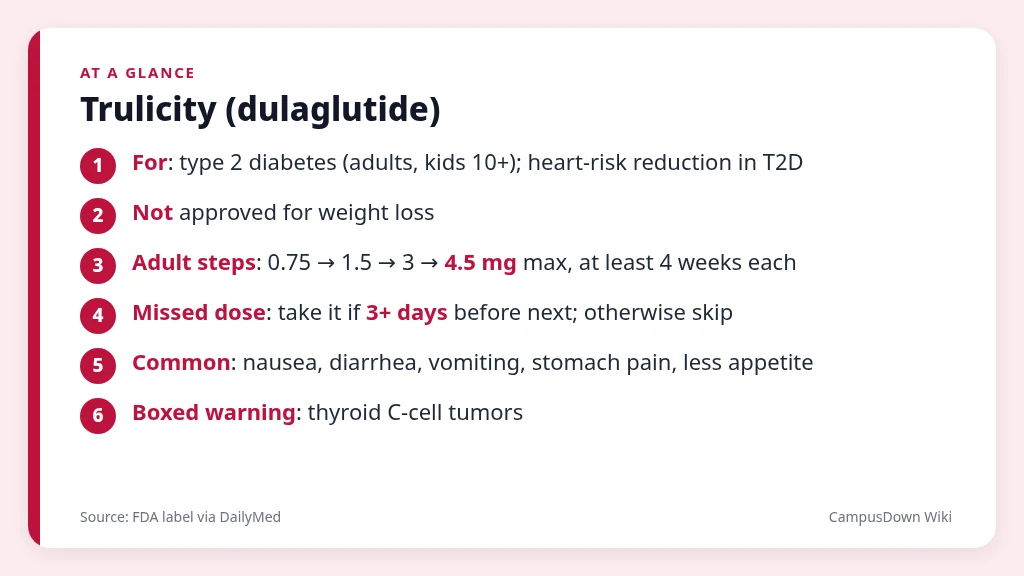
What Trulicity is approved for
Trulicity (dulaglutide), made by Eli Lilly, is a GLP-1 receptor agonist. The label lists two uses:
- With diet and exercise, to improve blood sugar in adults and children 10 and older with type 2 diabetes.
2. To reduce the risk of major cardiovascular events (cardiovascular death, heart attack or stroke) in adults with type 2 diabetes who have established cardiovascular disease or multiple cardiovascular risk factors.
It is not approved for weight loss or for type 1 diabetes. Some people lose weight on it, but that isn't an approved use.

Doses on the label
Trulicity comes in single-dose pens of 0.75, 1.5, 3 and 4.5 mg.
- Adults: start at 0.75 mg once weekly. After 4 weeks, the dose may go to 1.5 mg for more blood sugar control, then up in 1.5 mg steps after at least 4 weeks on each dose, to a maximum of 4.5 mg.
- Children 10+: start at 0.75 mg; may increase to a maximum of 1.5 mg after at least 4 weeks.
Inject under the skin of the abdomen, thigh or upper arm, once weekly, any time of day, with or without food. Rotate sites. If you also use insulin, give separate injections and never mix them; they can go in the same area but not right next to each other.
The missed-dose rule
Trulicity's rule is different from tirzepatide's. Take a missed dose as soon as possible if at least 3 days (72 hours) remain before your next scheduled dose. If less than 3 days remain, skip it and take the next dose on your usual day. You can change your injection day if the last dose was 3 or more days earlier.
Side effects
Most common (Medication Guide): nausea, diarrhea, vomiting, stomach pain and decreased appetite. These are often worse during dose increases.
Label warnings include:
- Thyroid C-cell tumors (boxed warning) in rodents; unknown in humans. Not for people with a personal or family history of medullary thyroid carcinoma or MEN 2.
- Pancreatitis: severe stomach pain that won't go away. See pancreatitis.
- Low blood sugar with insulin or sulfonylureas. Learn the signs in hypoglycemia in older adults.
- Kidney injury from dehydration due to vomiting or diarrhea.
- Severe gastrointestinal reactions.
- Diabetic retinopathy complications in people with a history of retinopathy.
- NAION, a rare cause of sudden, painless vision loss in one eye, reported with GLP-1 receptor agonists.
- Gallbladder disease and serious allergic reactions.
- Aspiration during anesthesia or deep sedation: tell providers before procedures.
What the label says about older adults
In the label's diabetes trials, 19% of Trulicity-treated patients were 65 or older and 2% were 75 or older; in the cardiovascular outcomes trial, 53% were 65 or older. The label states no overall differences in safety or effectiveness were seen between those 65 and older and younger adults. Older adults are still more vulnerable to dehydration, so the advice to report vomiting or diarrhea that won't stop matters. See diabetes in older adults.
Get help now if
Call your provider right away for severe stomach pain that won't go away, signs of an allergic reaction such as swelling of the face or throat, or sudden vision loss in one eye.
Trulicity vs Ozempic
| Trulicity | Ozempic injection | |
|---|---|---|
| Ingredient | Dulaglutide | Semaglutide |
| Maker | Eli Lilly | Novo Nordisk |
| Dosing | Weekly, single-dose pens, 0.75 to 4.5 mg | Weekly pen, 0.25 mg start, up to 2 mg |
| Extra approved uses | Heart-risk reduction; children 10+ | Heart-risk reduction; kidney outcomes in T2D with CKD |
It's worth taking a closer look with your doctor, because which is "better" depends on your health, your other medicines and your plan's coverage. Learn more in semaglutide (Ozempic, Wegovy).
Example scenario: the circled day
- Who
- Henrietta, 71, a retired church secretary in Des Moines, had type 2 diabetes managed with metformin. Her A1C crept up, and her doctor added Trulicity 0.75 mg.
- What happened
- She dreaded needles. In the first two weeks, mild nausea made her skip lunch, and once she forgot her dose until Thursday.
- How it felt
- She felt overwhelmed and a bit ashamed, convinced she'd "ruined" the medicine by missing a day. She also worried about low blood sugar living alone.
- What they did
- Her pharmacist explained the label's 3-day rule: with three days still before Sunday, she could take it right away. He suggested smaller meals, sipping fluids, and calling if vomiting started. Her granddaughter put a Sunday sticker on her calendar and a reminder on her phone.
- How it turned out
- By her three-month visit, Henrietta's nausea had settled, she hadn't missed another dose, and her doctor reviewed her numbers before deciding on any increase. She said the calendar sticker did more for her confidence than any pamphlet.
This is an illustrative example, not a real patient or a review.
Henrietta is an illustrative example. Your prescriber decides your treatment.
Most-asked questions about Trulicity
What are Trulicity side effects in the elderly?
The label reported no overall differences in safety or effectiveness in adults 65 and older, but watch for nausea, vomiting and diarrhea that can cause dehydration, and for low blood sugar with insulin or sulfonylureas.
Why people ask: "trulicity side effects in elderly" is #3 for "trulicity side effects" (US autocomplete, November 2026).
What is the Trulicity dosing schedule?
Adults start at 0.75 mg weekly and may step up to 1.5, 3 and 4.5 mg after at least 4 weeks at each dose.
Why people ask: "trulicity dosing" is #2 for "trulicity" (US, November 2026).
Is Trulicity approved for weight loss?
No. It is approved for type 2 diabetes and heart-risk reduction in type 2 diabetes.
Why people ask: "trulicity for weight loss" is #3 for "trulicity" (US, November 2026).
Trulicity vs Ozempic: what's the difference?
Different ingredients and makers (dulaglutide by Lilly, semaglutide by Novo Nordisk), different dose steps, and slightly different approved uses.
Why people ask: "trulicity vs ozempic" is #4 for "trulicity" (US, November 2026).
Is there a generic Trulicity?
Dulaglutide is a biologic, so a copy would be a biosimilar. You can check it for yourself with your pharmacist or the FDA Purple Book for current status.
Why people ask: "trulicity generic" is #6 for "trulicity" (US, November 2026).
Related on CampusDown
To take a closer look at diabetes basics, see metformin, what an A1C of 5.7 means and diabetes.
Frequently asked questions
- Can I inject Trulicity in my arm?
- Yes. The label lists the abdomen, thigh or upper arm. Rotate sites each week.
- Can I take Trulicity with insulin?
- The label allows use with insulin but as separate injections, never mixed. Your prescriber may adjust insulin to lower low-blood-sugar risk.
- Can I take Trulicity with other GLP-1 drugs?
- Don't combine GLP-1 receptor agonists unless your prescriber specifically directs it. Tell them about every medicine you use.
Trulicity is a once-weekly, label-guided option for type 2 diabetes with a long track record. Pick a day, learn the 3-day missed-dose rule, watch for warning signs, and talk to your doctor or pharmacist before changing anything.
Browse more guides like this in the Medicines hub.
This article is for general education and does not replace advice from your own doctor, nurse or pharmacist.