
Key points
- A learning organization is one where people keep expanding their abilities and the organization changes itself based on what it learns.
- Peter Senge popularised the idea in The Fifth Discipline (1990) and named five disciplines; systems thinking is the fifth, which ties the others together.
- Argyris and Schön's distinction between single-loop and double-loop learning explains why some organizations only fix mistakes while others change the assumptions behind them.
- David Garvin gave a more practical definition based on creating, acquiring and transferring knowledge and changing behaviour.

The five disciplines
- Personal mastery: individuals clarify what they want to achieve and keep building the skills to get there.
- Mental models: people bring their hidden assumptions about how things work to the surface and test them.
- Shared vision: members build a picture of the future that they genuinely commit to, rather than one handed down from the top.
- Team learning: groups learn to think together through dialogue and discussion, so the team's understanding exceeds that of any single member.
- Systems thinking: seeing the feedback loops and delays in the whole system instead of isolated events. Senge called it the fifth discipline because it integrates the other four.
Background
Senge worked at MIT, and systems thinking draws on general systems theory and Jay Forrester's system dynamics. A well-known illustration is the "beer game", a supply-chain simulation in which players who see only their own part of the chain create large swings in orders, even though no one acts irrationally.
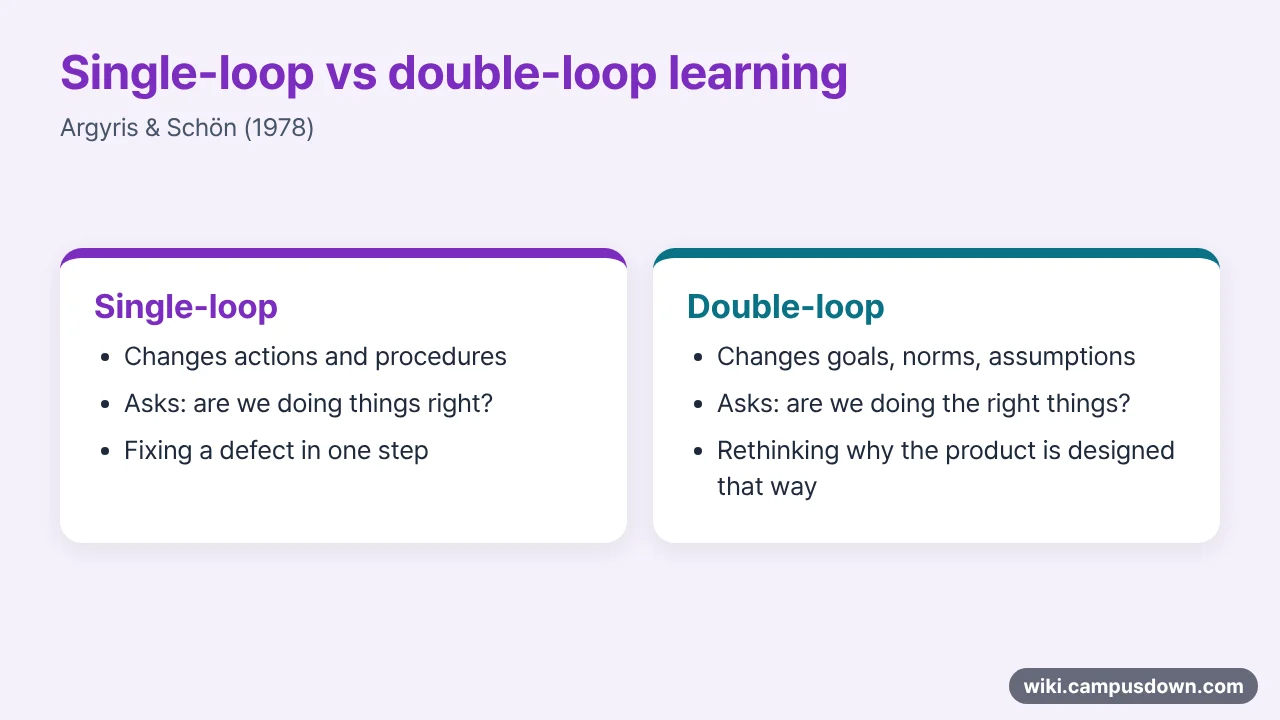
Earlier, Chris Argyris and Donald Schön described two kinds of learning. In single-loop learning an organization corrects actions to meet existing goals, like a thermostat that turns the heat on when the room gets cold. In double-loop learning it questions the goals and assumptions themselves, for example asking whether the target temperature is right in the first place.
Single-loop vs double-loop learning
| Single-loop | Double-loop | |
|---|---|---|
| Question asked | Are we doing things right? | Are we doing the right things? |
| What changes | Actions and procedures | Goals, norms and assumptions |
| Typical example | Fixing a defect in a production step | Rethinking why the product is designed that way |
Building a learning organization
Garvin, Edmondson and Gino (2008) grouped the conditions into three building blocks:
- A supportive learning environment: psychological safety, appreciation of differences, openness to new ideas and time for reflection. Edmondson's research found that teams with higher psychological safety reported and discussed errors more openly.
- Concrete learning processes: experimentation, information collection and analysis, and knowledge sharing, such as after-action reviews that ask what was planned, what happened, why, and what to do next time.
- Leadership that reinforces learning: managers who ask questions, listen, and give time and resources for learning.
Critiques
Critics say the concept is abstract and hard to measure, and that much of the early literature was prescriptive rather than based on evidence. Garvin answered with a definition tied to observable behaviour: an organization skilled at creating, acquiring and transferring knowledge, and at changing its behaviour to reflect new knowledge. Others point out that the approach can underplay power and politics inside organizations, since people may hide mistakes when careers are at stake.
Frequently asked questions
Is a learning organization the same as organizational learning?
Not quite. Organizational learning describes the process by which any organization learns. A learning organization is an ideal type that is deliberately designed to learn well.
Why is systems thinking called the fifth discipline?
Because it connects the other four. Without it, Senge argued, personal mastery, mental models, shared vision and team learning remain separate techniques.
How does it relate to knowledge management?
Knowledge management focuses on capturing and sharing knowledge, as in Nonaka and Takeuchi's SECI model. A learning organization also requires that the organization change its behaviour based on that knowledge.
See also: Organizational Change and Resistance Management, Argyris's Immaturity–Maturity Theory, Knowledge Management and the SECI Model
References
- Senge, P. M. (1990). The Fifth Discipline: The Art and Practice of the Learning Organization. Doubleday.
- Argyris, C., & Schön, D. A. (1978). Organizational Learning. Addison-Wesley.
- Garvin, D. A. (1993). Building a learning organization. Harvard Business Review, 71(4), 78-91.
- Garvin, D. A., Edmondson, A. C., & Gino, F. (2008). Is yours a learning organization? Harvard Business Review, 86(3), 109-116.
- Nonaka, I., & Takeuchi, H. (1995). The Knowledge-Creating Company. Oxford University Press.
- Edmondson, A. (1999). Psychological safety and learning behavior in work teams. Administrative Science Quarterly, 44(2), 350–383.