
Do children learn aggression just by watching it? In the early 1960s, Stanford psychologist Albert Bandura put that question to a simple test with an inflatable clown doll, and the answer reshaped psychology and fueled decades of American debate about violence on television and in video games.
The 1961 experiment
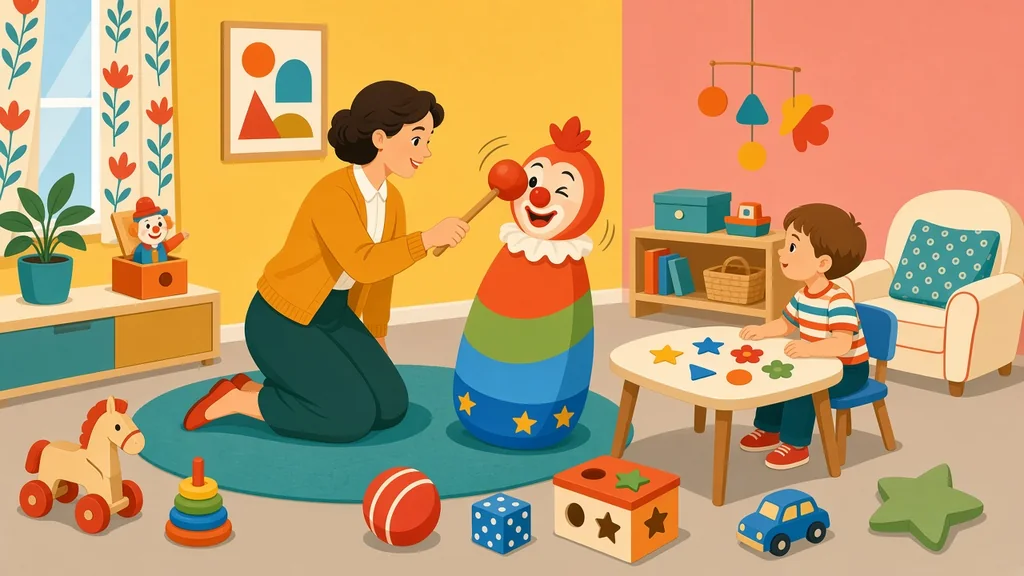
Bandura, with Dorothea Ross and Sheila Ross, studied 72 children from the Stanford University nursery school, aged 37 to 69 months. Each child was taken individually into a playroom. One third watched an adult model play quietly, one third watched an adult model attack a Bobo doll, an inflatable toy that bounces back when hit, and the rest formed a control group.
The aggressive model punched the doll, hit it in the face with a toy mallet, threw it around and shouted phrases such as "Sock him" and "Throw him in the air." Afterward, each child was mildly frustrated and then left alone in a room with toys, including a Bobo doll.
- Children who had watched the aggressive model were more likely to act physically and verbally aggressive.
- Many reproduced the model's exact actions and words.
- Boys showed more physical aggression than girls, and same-sex models tended to have more influence.
Key idea
The children were never rewarded for hitting the doll. They learned the behavior simply by watching, which was the central claim of Bandura's social learning theory.

Later studies
- 1963: 96 children from the Stanford nursery watched a live model, a filmed model or a cartoon cat attack the doll. All three groups showed similar increases in aggression compared with the control group, and watching aggression did not produce a calming, cathartic effect.
- 1965: 66 children saw the model rewarded, punished or given no consequence. Children who saw the model punished imitated less, but when they were offered incentives, children in all groups reproduced the aggression, showing they had learned it even when they did not perform it.
US cases
- When and where
- 1961–1963, Stanford University, California
- What happened
- Bandura and the Rosses published "Transmission of aggression through imitation of aggressive models" (1961) and "Imitation of film-mediated aggressive models" (1963) in the Journal of Abnormal and Social Psychology.
- Why it matters
- The studies became the classic evidence for observational learning and modeling, ideas that now appear in every introductory psychology textbook in the United States.
- When and where
- June 27, 2011, US Supreme Court
- What happened
- California had passed a law restricting the sale or rental of violent video games to minors. In a 7–2 decision, the Court struck it down under the First Amendment, finding that studies purporting to show a link between violent games and harm to children "do not prove that such exposure causes minors to act aggressively" and that any demonstrated effects "are both small and indistinguishable from effects produced by other media."
- Why it matters
- The ruling showed the limit of research in the Bobo doll tradition as a basis for law: imitation in a lab is not the same as proof of real-world harm.
Criticisms
- Ethics: some psychologists argue that deliberately exposing young children to aggression and then frustrating them would not meet modern standards.
- Short time frame: children imitated the model almost immediately, so the studies say little about long-term effects of exposure to violence.
- The doll is meant to be hit: some critics note that a Bobo doll is designed to be punched and bounce back, so hitting it may be play rather than real aggression toward a person.
Related concepts
The Bobo doll studies are often taught alongside the Little Albert experiment, another classic study of how children learn emotional responses, and the Rosenhan experiment, another study that raised hard questions about method and ethics. How repeated exposure shapes thoughts and images is also seen in the Tetris effect, and the brain-level idea that repeated experience strengthens connections is captured by Hebbian theory. The body's arousal during conflict is described by the fight-or-flight response.
Study material (Korean): 「아동발달 과제 – 반두라 관찰학습의 의미와 효과」
Frequently asked questions
- What was the Bobo doll experiment in simple terms?
- Children watched an adult hit an inflatable doll, and many of them later copied the same aggressive actions when they were given the chance.
- What did the Bobo doll experiment prove?
- It showed that children can learn new behaviors, including aggression, simply by observing others, which supported Bandura's social learning theory.
- Why is the Bobo doll experiment criticized?
- Critics question its ethics, its short time frame and whether hitting a toy designed to be hit is real aggression.