
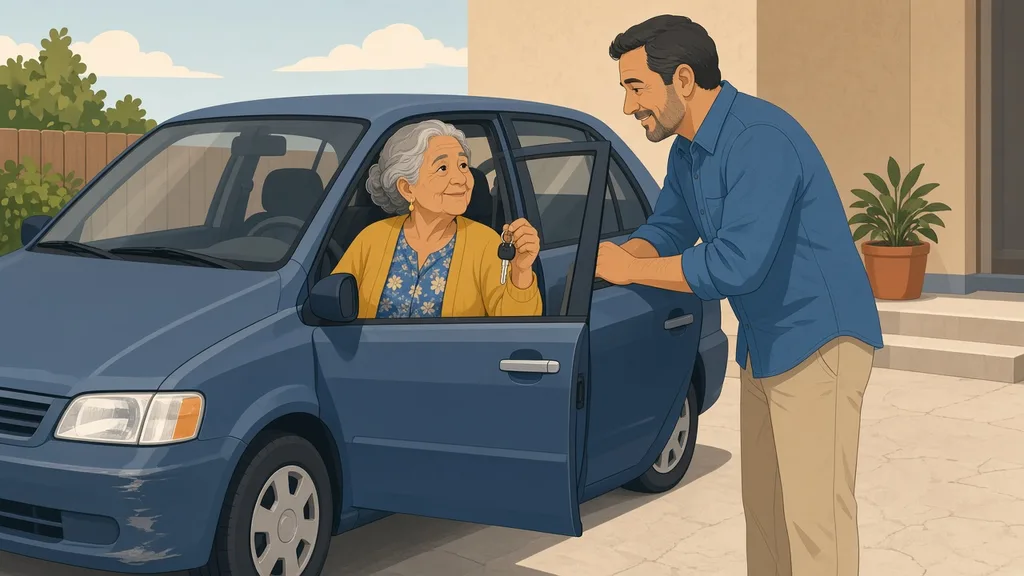
Have you noticed new scrapes on Dad's car, or felt your foot pressing an imaginary brake while Mom drives? Talking about driving is one of the hardest conversations families have, because the car often means independence. NIA's guidance can help you look at the facts and talk about them kindly.
This guide is based on the National Institute on Aging (NIA) page on safe driving for older adults. It explains in detail the warning signs, assessments and how to talk about stopping. State license rules vary, so check it for yourself with your state's DMV.
How aging can affect driving
NIA lists several changes:
- Stiff joints and weaker muscles make it harder to turn your head, steer quickly or brake.
- Vision changes, glare and eye diseases like cataracts, glaucoma and macular degeneration. NIA suggests a dilated eye exam every 1 to 2 years from age 60. See cataract surgery recovery.
- Hearing changes can hide horns and sirens. NIA suggests hearing checks at least every 3 years after 50.
- Medicines that cause drowsiness or lightheadedness, even without a warning label. See the Beers Criteria.
- Slower reactions and numb feet or fingers.
- Conditions such as Parkinson's disease or stroke can make driving unsafe.

Dementia and driving
NIA says some people with early dementia can still drive, but as memory and judgment worsen they'll likely need to stop. People with dementia often don't recognize their driving problems, so family should watch closely and act early, like when someone forgets how to get to the grocery store. Learn about early changes in early signs of dementia.
Warning signs a loved one should stop driving
NIA lists:
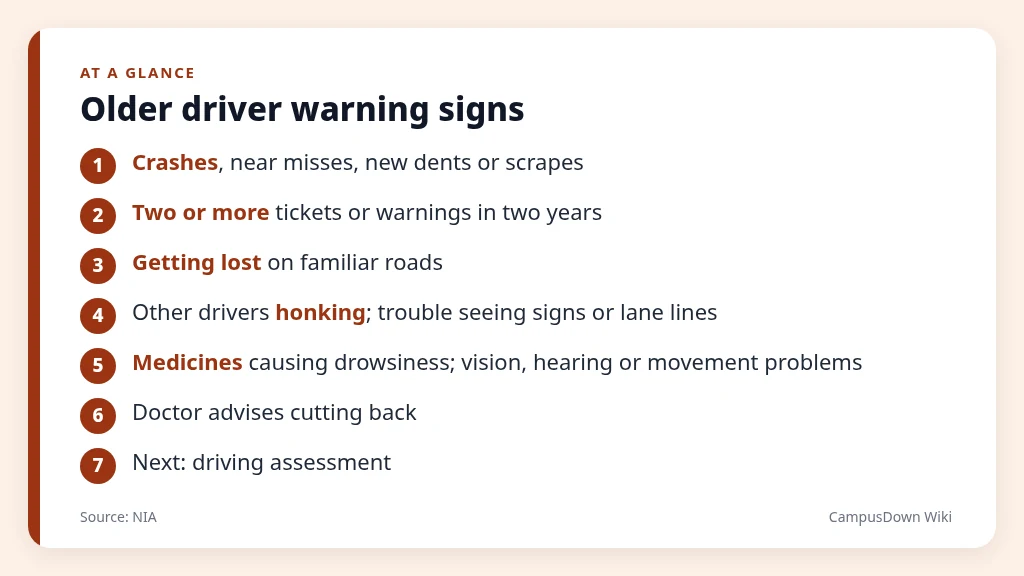
- Several crashes, near misses, or new dents or scrapes
- Two or more tickets or warnings in the last two years
- Insurance increases because of driving problems
- Neighbors or friends mentioning erratic or unsafe driving
- Anxiety about night driving
- Vision, hearing or movement problems
- Complaints about other drivers' speed or lane changes
- A doctor's advice to change or stop driving
NIA also suggests asking: Do other drivers honk at me? Do I get lost on familiar roads? Do cars seem to appear out of nowhere?
Get help now if
If a driver with dementia insists on driving after being told it's unsafe, involve their doctor right away, and don't leave keys accessible. A crash can harm them and others.
Getting a driving assessment
- A driving rehabilitation specialist or occupational therapist can test skills. The American Occupational Therapy Association keeps a database; your DMV or doctor can recommend someone. Fees may apply.
- NHTSA says decisions should never be based on age alone, and offers caregiver guides and medical-condition resources.
- AAA's RoadWise Driver course and an NHTSA online self-assessment can help.
- Driver safety courses through AARP or insurers; some insurers lower premiums.
Tips to drive more safely
- Wear glasses and hearing aids; see hearing and the brain.
- Avoid night, sunrise, sunset, rush hour and bad weather if they're hard.
- Choose routes with fewer left turns and avoid highways; use the right lane on fast roads.
- Leave more space, brake early, and never text while driving.
- Prefer cars with automatic transmission, power steering, large mirrors and backup cameras.
Having "the talk"
NIA's tips:
- Prepare first: learn local transport options before the conversation.
- Use "I" statements: "I'm worried about your safety," not "You're a bad driver."
- Talk about skills, not age.
- Focus on staying independent: "I'll help you figure out how to get where you want to go."
- Expect anger or sadness, and revisit gradually.
Losing the car can lead to isolation; keep connections strong with ideas in loneliness in older adults.
Example scenario: the dent in the bumper
- Who
- Henrik, 51, a software project manager in Phoenix, noticed a fresh dent on his mother Marisela's sedan. Marisela, 81, had macular degeneration and had gotten two warnings for drifting lanes that year.
- What happened
- When he raised it at dinner, she slammed down her fork and said he wanted to "lock her in the house." She drove to her sister's every day and to Mass on Sundays.
- How it felt
- Henrik felt sick with worry but didn't want to take away her pride or her independence.
- What they did
- Using NIA's tips, he mapped her regular trips, found a senior ride service and set up a ride app, then spoke with "I" statements. Her eye doctor suggested a formal assessment with an occupational therapist.
- How it turned out
- The assessment showed she shouldn't drive at night or on highways. She kept daytime driving to two nearby places for a while, then chose to stop the next spring. Henrik said letting her make the final decision mattered more than winning the argument.
This is an illustrative example, not a real patient or a review.
Henrik's story is an illustrative example. Talk with the driver's doctor if you have safety concerns.
Most-asked questions about older drivers
When should elderly parents stop driving?
There's no set age. NIA points to warning signs like crashes, near misses, tickets, getting lost and a doctor's advice.
Why people ask: "when should elderly parents stop driving" is #7 for "when should elderly stop driving" (US autocomplete, November 2026).
Is there an elderly driving test?
A driving rehabilitation specialist or occupational therapist can test skills. Your state DMV sets license renewal rules.
Why people ask: "elderly driving test" is #1 for "elderly driving" (US, November 2026).
Where can I get an elderly driving assessment?
Ask your doctor or DMV, or search the American Occupational Therapy Association's database of driving specialists.
Why people ask: "elderly driving assessment" is #6 for "elderly driving" (US, November 2026).
What are elderly driving laws?
NHTSA notes some state DMVs add renewal rules, tests or restrictions at a certain age. Check your state DMV.
Why people ask: "elderly driving laws" is #5 for "elderly driving" (US, November 2026).
When do most seniors stop driving?
NIA says people age differently, so there's no one recommended age to quit.
Why people ask: "when do most seniors stop driving" is #9 for "when should elderly stop driving" (US, November 2026).
Related on CampusDown
To take a closer look at memory changes that affect driving, read early signs of dementia.
Frequently asked questions
- Can a doctor report an unsafe driver?
- Rules vary by state. Ask the doctor or your DMV how medical reviews work where you live.
- Can someone with dementia drive?
- Some can early on, but NIA says they'll likely need to stop as memory and decision-making worsen.
- Do driver safety courses lower insurance?
- NIA notes some insurers may lower premiums after a course.
Driving safety is about skills, not birthdays. Watch for warning signs, get a professional assessment, plan transport first, and talk with respect so your loved one stays safe and connected.
Browse more guides like this in the Senior Health and Medicare hub.
This article is for general education and does not replace advice from your own doctor, nurse or pharmacist.