
You see "folic acid" on the prenatal vitamin, the cereal box and the enriched bread. How much do you actually need, and who should be most careful about taking extra?

This guide uses the NIH Office of Dietary Supplements (ODS) folate fact sheet for consumers (updated November 1, 2022) and the MedlinePlus folic acid page (last revised August 15, 2017). It is general information, not a prescription; your clinician or pharmacist can say what is right for you. If you want to learn more about another vitamin whose deficiency can hide behind supplements, take a closer look at vitamin B12 deficiency and metformin.
Folate versus folic acid
ODS says folate is a B vitamin found naturally in foods, and folic acid is the form used in fortified foods and most dietary supplements. Your body needs folate to make DNA and other genetic material and for cells to divide. MedlinePlus adds that folic acid is needed to make red blood cells and that a deficiency causes certain types of anemia.

How much you need
ODS gives daily amounts in mcg of dietary folate equivalents (DFEs): 400 mcg DFE for teens 14 to 18 and adults 19 and older, 600 mcg DFE during pregnancy and 500 mcg DFE while breastfeeding. It explains that 240 mcg of folic acid and 400 mcg of food folate are both 400 mcg DFE, because the body absorbs more folic acid from supplements and fortified foods.
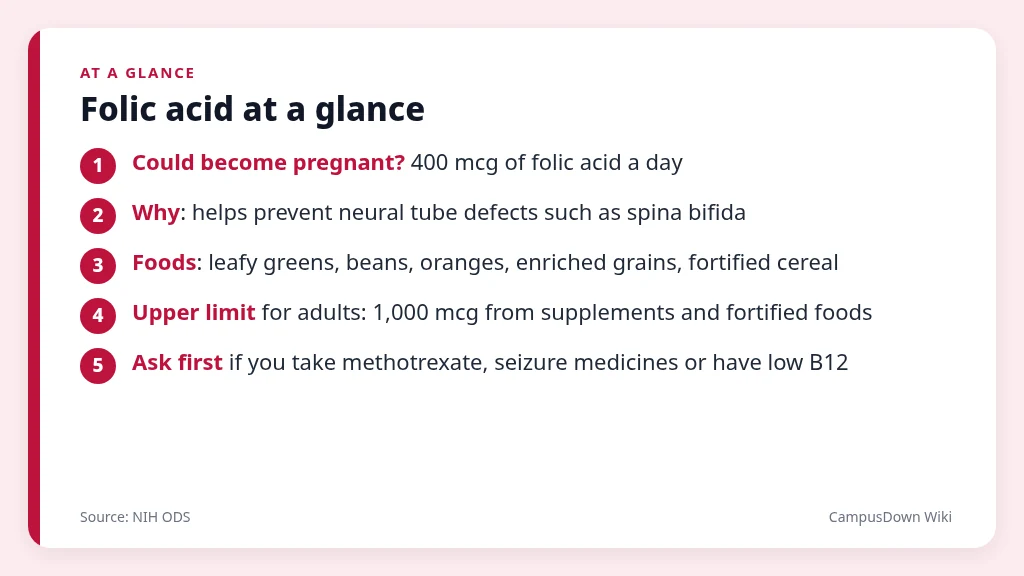
All women and teen girls who could become pregnant should consume 400 mcg of folic acid daily from supplements, fortified foods or both, in addition to the folate in a healthy eating pattern. ODS notes about half of all pregnancies are unplanned, which is why this applies even if you aren't trying.
Neural tube defects
ODS says taking folic acid before becoming pregnant and during early pregnancy helps prevent neural tube defects (NTDs), major birth defects of the baby's brain (anencephaly) or spine (spina bifida). Since 1998, FDA has required folic acid in enriched bread, flour, cornmeal, pasta, rice and other grain products, and the number of babies born with NTDs has decreased. Folate deficiency may also increase the chance of a premature or low birth weight baby.
Foods and supplements
- Naturally rich in folate: beef liver, asparagus, brussels sprouts, spinach and mustard greens, oranges and orange juice, peanuts, black-eyed peas and kidney beans.
- With added folic acid: enriched bread, flour, cornmeal, pasta and rice, fortified breakfast cereals and fortified corn masa flour. Look for folic acid on the Nutrition Facts label.
- Supplements: in multivitamins, prenatal vitamins, B-complex products and folate-only products, usually as folic acid; methylfolate (5-MTHF) is also sold. ODS says even with an MTHFR C677T gene variant, women who could become pregnant should still get 400 mcg of folic acid, not 5-MTHF.
Who may fall short
ODS says most people in the United States get enough, but teen girls, women 19 to 30, non-Hispanic Black women, people with alcohol use disorder, people with conditions that reduce absorption (celiac disease, inflammatory bowel disease) and people with an MTHFR variant are more likely to struggle. Deficiency can cause megaloblastic anemia with weakness, fatigue, trouble concentrating, irritability, headache, heart palpitations and shortness of breath, and mouth or tongue sores.
What the research says (ODS)
- Cancer: natural food folate may lower the risk of some cancers; high doses after cancer (especially colorectal) begins might speed progression, so be cautious above 1,000 mcg, especially with a history of colorectal adenomas.
- Heart disease: folic acid lowers homocysteine but doesn't directly reduce heart disease risk.
- Dementia: supplements don't seem to improve cognition or prevent dementia.
- Autism, preterm birth, other birth defects: results are inconclusive, and more research is needed.
- Depression: low folate may relate to depression; whether supplements help is unclear.
Too much
Upper limit for adults 19 and older: 1,000 mcg a day from supplements and fortified foods (800 mcg for teens 14 to 18). ODS says large folate supplements might hide a vitamin B12 deficiency by correcting the anemia while nerve damage continues, and might worsen B12 deficiency symptoms. Food folate itself is not harmful.
Medicine interactions (ODS)
- Methotrexate (when used for cancer) may be affected.
- Antiseizure medicines such as phenytoin, carbamazepine and valproate can lower folate, and folate supplements can lower their levels.
- Sulfasalazine (ulcerative colitis) can reduce folate absorption.
Tell your clinician and pharmacist about everything you take; see the brown bag medication review.
Get help now if
Numbness, tingling, balance trouble, confusion or memory changes may be signs of vitamin B12 deficiency, which folic acid can mask. Call your clinician. Call 911 for trouble breathing or swelling of the face or throat after taking a supplement.
Questions for your clinician or pharmacist
- How much folic acid is right for me, including what's in my multivitamin?
- Do I need more because of a medicine or condition?
- Should my B12 be checked?
- Are my prenatal vitamins and fortified foods adding up to more than I need?
- If I'm planning pregnancy, when should I start?
Example scenario: not planning, but not not planning
- Who
- Sabina, 27, a dental hygienist in Salt Lake City, Utah, wasn't actively trying to get pregnant but wasn't preventing it either.
- What happened
- She had never thought about folic acid, assumed she got enough from salads and wondered about taking a pill.
- How it felt
- She felt unsure whether she needed to start.
- What they did
- At a checkup her clinician explained that anyone who could become pregnant is advised to get 400 mcg of folic acid daily, from fortified foods, a supplement or both, and that she should check her multivitamin label so she didn't double up. Sabina kept her usual leafy greens, switched to a fortified cereal and reviewed her label with the pharmacist.
- How it turned out
- Sabina said the label check took two minutes.
This is an illustrative example, not a real patient or a review.
Sabina's story is an illustrative example. Talk to a clinician about the right amount for you.
Most-asked questions about folic acid
What are folic acid benefits for men?
ODS describes folate's role in making DNA and red blood cells for everyone; it doesn't list men-specific benefits.
Why people ask: "folic acid benefits for men" is #2 for "folic acid benefits" (US autocomplete, November 2026).
What are folic acid benefits for women?
For anyone who could become pregnant, 400 mcg a day helps prevent neural tube defects; deficiency can also cause anemia.
Why people ask: "folic acid benefits for women" is #3 for "folic acid benefits" (US autocomplete, November 2026).
Does folic acid help skin?
ODS doesn't list skin benefits among the effects it summarizes, though deficiency can change skin, hair and nail color.
Why people ask: "folic acid benefits for skin" is #4 for "folic acid benefits" (US autocomplete, November 2026).
What are the benefits of folic acid for pregnancy?
Taking it before and in early pregnancy helps prevent neural tube defects like spina bifida, and it may reduce the chance of a premature baby, though more research is needed.
Why people ask: "folic acid benefits for pregnancy" is #5 for "folic acid benefits" (US autocomplete, November 2026).
Does folic acid help weight loss?
ODS doesn't describe weight-loss effects.
Why people ask: "folic acid benefits weight loss" is #6 for "folic acid benefits" (US autocomplete, November 2026).
What are folic acid benefits for women over 50?
ODS doesn't separate this group; adults need 400 mcg DFE, and the 400 mcg of folic acid advice applies to people who could become pregnant.
Why people ask: "folic acid benefits for women over 50" is #7 for "folic acid benefits" (US autocomplete, November 2026).
Does folic acid help hair?
ODS doesn't list hair growth benefits, only that deficiency can change hair color.
Why people ask: "folic acid benefits for hair" is #8 for "folic acid benefits" (US autocomplete, November 2026).
What are folic acid benefits for adults?
It supports DNA creation and red blood cell production, and prevents folate-deficiency anemia.
Why people ask: "folic acid benefits for adults" is #9 for "folic acid benefits" (US autocomplete, November 2026).
What are folic acid benefits for women over 40?
ODS doesn't give age-specific benefits; the pregnancy advice applies to anyone who could still become pregnant.
Why people ask: "folic acid benefits for women over 40" is #10 for "folic acid benefits" (US autocomplete, November 2026).
What are folic acid side effects in the elderly?
ODS doesn't give age-specific effects; large doses can hide a B12 deficiency, which matters because B12 problems are a concern with age, so ask your clinician.
Why people ask: "folic acid side effects in elderly" is #2 for "folic acid side effects" (US autocomplete, November 2026).
What are folic acid side effects in men?
MedlinePlus lists skin rash, itching, redness or trouble breathing as signs to call about; it doesn't separate by sex.
Why people ask: "folic acid side effects in men" is #3 for "folic acid side effects" (US autocomplete, November 2026).
What are folic acid side effects for women?
Allergic signs are the main ones MedlinePlus lists; very high doses can hide B12 deficiency.
Why people ask: "folic acid side effects women" is #4 for "folic acid side effects" (US autocomplete, November 2026).
Does folic acid have side effects in pregnancy?
ODS recommends it before and in early pregnancy, with an adult upper limit of 1,000 mcg from supplements and fortified foods; follow your prenatal clinician's advice.
Why people ask: "folic acid side effects in pregnancy" is #5 for "folic acid side effects" (US autocomplete, November 2026).
Does folic acid cause weight gain?
The sources here don't list weight gain.
Why people ask: "folic acid side effects weight gain" is #6 for "folic acid side effects" (US autocomplete, November 2026).
What about folic acid 5 mg?
That is far above the 1,000 mcg adult upper limit for supplements and fortified foods; ODS says not to exceed it unless a health care provider recommends it.
Why people ask: "folic acid side effects 5mg" is #8 for "folic acid side effects" (US autocomplete, November 2026).
What are folic acid adverse effects?
Allergic reactions (rash, itching, redness, trouble breathing), possible masking of B12 deficiency and possible cancer concerns with high doses.
Why people ask: "folic acid side effects and adverse effects" is #9 for "folic acid side effects" (US autocomplete, November 2026).
Related on CampusDown
You can learn more about the medicines hub and check it for yourself in the brown bag medication review. For another B vitamin issue in detail, see B12 deficiency and metformin, for another vitamin with an upper limit see vitamin D3 supplements, and for hormone treatment see estradiol. Browse more in the health topics hub.
Frequently asked questions
- How much folic acid do I need if I could become pregnant?
- 400 mcg daily from supplements, fortified foods or both, plus the folate in a healthy diet, per ODS.
- What is the adult upper limit?
- 1,000 mcg a day from supplements and fortified foods.
- Why can too much be a problem?
- It can hide vitamin B12 deficiency, and high doses may speed some cancers' progression.
- Which foods have it?
- Leafy greens, beans, oranges, beef liver, enriched grains and fortified cereals.
- Which medicines interact?
- Methotrexate, seizure medicines like phenytoin and carbamazepine, and sulfasalazine.
Folic acid is simple but important before and early in pregnancy. If you could become pregnant, get 400 mcg a day from food, supplements or both, stay under the upper limit unless a clinician directs otherwise, watch for B12 problems and tell your pharmacist about medicines that interact.
Browse more guides like this in the Medicines hub.
This article is for general education and does not replace advice from your own doctor, nurse or pharmacist.