
Your instructor says you'll place your first Foley next week. Do you remember what to do if the catheter tip touches the bed rail, and who decides whether the patient needs a catheter at all?
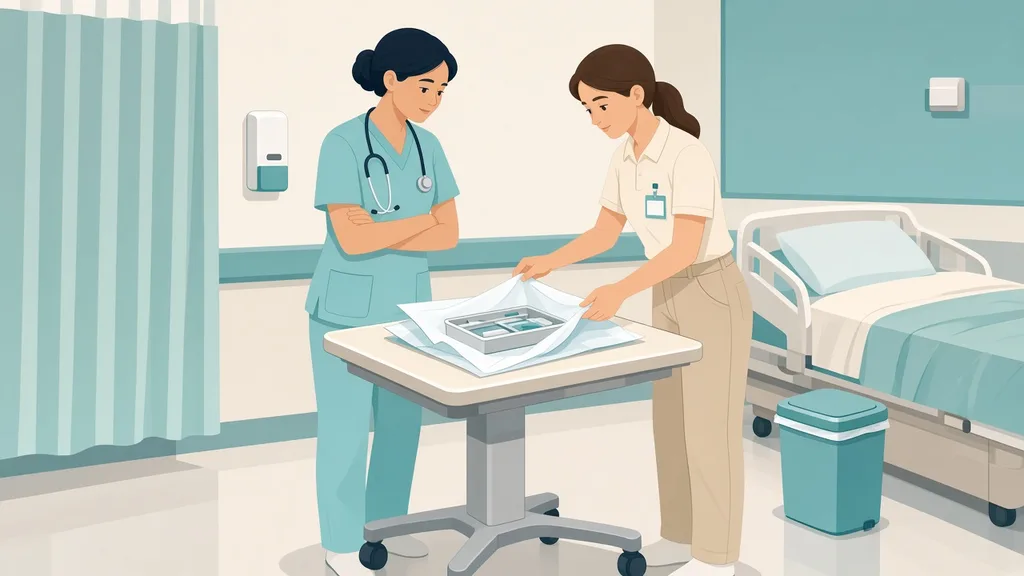
This guide uses OpenStax's Clinical Nursing Skills (19.4 Nursing Management of Elimination) and an AHRQ Safety Program for Long-Term Care CAUTI teaching module on catheter insertion, with the CDC's CAUTI prevention guideline as the reference standard. It is a study aid, not a procedure; follow your instructor, facility policy, the product's instructions and the provider's order. If you want to learn more about the infection it prevents, take a closer look at UTI and confusion in older adults.
What a Foley is
OpenStax says an indwelling urinary catheter (IUC) stays in the bladder for a time, and "Foley" is the brand name of a type of IUC invented by Frederic Foley in 1929, though the term is used interchangeably. It has two proximal lumens and an inflatable balloon at the end. The balloon volume varies, generally 10 mL to 30 mL. It is inserted through the urethra into the bladder; the balloon is inflated with sterile water through one lumen, and the other lumen drains urine into a collecting bag. A three-way catheter has a third lumen for bladder irrigation.
OpenStax distinguishes it from an intermittent (straight) catheter, inserted to drain the bladder then removed with no balloon. AHRQ also lists suprapubic catheters (placed surgically through the skin into the bladder) and external "condom" catheters for men (which don't enter the bladder and cannot treat acute urinary retention).

First question: is a catheter needed?
OpenStax calls CAUTI (catheter-associated urinary tract infection) a common, life-threatening complication linked to longer stays, higher costs and a higher risk of death, and estimates up to 69 percent of CAUTI cases are preventable (about 380,000 infections and 9,000 deaths per year, citing the CDC 2015). It says to make sure the patient meets CDC-approved indications before inserting; if not, contact the provider and advocate for an alternative.
Appropriate indications listed by OpenStax:
- End-of-life care
- Healing of open sacral and perineal wounds in patients with urinary incontinence
- Hourly urine output monitoring in critically ill patients
- Perioperative use for selected surgeries
- Prolonged immobilization
- Urinary retention or bladder outlet obstruction
Inappropriate reasons include prolonged postoperative care without appropriate indications, substituting a catheter for nursing care of a patient with incontinence, and obtaining a urine culture when the patient can void on their own. Your facility's policy and the provider's order guide the final decision.
Before you begin (AHRQ teaching points)
- Review the order and verify the catheter is clinically indicated.
- Gather the kit and supplies, and use the buddy system: a second pair of hands.
- Kit contents in the AHRQ module: a drape with an opening and sterile gloves; antiseptic solution, swabs and tongs; a single-use lubricant packet; a single-use dose of topical lidocaine jelly; a sterile catheter of the smallest size effective for the patient (the AHRQ slide gives 14 or 16 French as an example) already connected to tubing and a bag; and a catheter securing device. Your facility's kit may differ.
- Hand hygiene, gloves, positioning (supine in the AHRQ slide), and removing the kit from its outer packaging to form a sterile field.
- Wash hands again before putting on the sterile gloves.
For more on hand hygiene habits, see hand hygiene and C. diff.
Female insertion (AHRQ steps, summarized)
- Don sterile gloves; drape the lower abdomen and upper thighs for dignity; organize the tray on the sterile field; pour antiseptic over swabs; squeeze lubricant onto the tray.
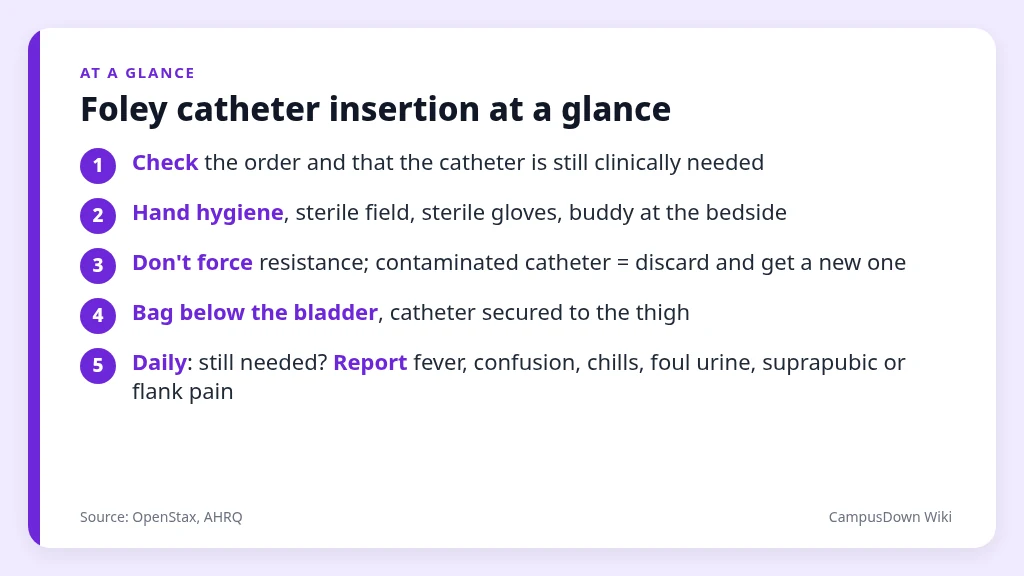
2. With the non-dominant hand, spread the labia to identify the urethra and hold the labia open with gentle traction. 3. Clean the periurethral area and urethral opening with antiseptic swabs using tongs, in an expanding circular motion; discard swabs away from the sterile field. 4. Lubricate the catheter tip, and with the dominant hand gently introduce the tip into the urethral meatus. 5. Advance slowly into the bladder. If you meet substantial resistance, do not force the catheter. 6. If the catheter touches anything not sterile, or enters the vagina by mistake, discard it and get a new one.
Male insertion (AHRQ steps, summarized)
- Same setup and sterile gloves; if uncircumcised, retract the foreskin.
2. With the non-dominant hand, grasp the penis taut and perpendicular to the body. 3. Cleanse the glans with antiseptic swabs and tongs in an expanding circular motion; discard swabs away from the field. Keep the non-dominant hand where it is. 4. Lubricate the tip, hold the coiled catheter in the dominant hand and gently introduce it into the meatus. 5. If using a coude catheter, the AHRQ slide says to point the tip upward (12 o'clock). 6. Advance slowly. Don't force resistance. If the tip is contaminated, discard and get a new one.
After urine returns
The AHRQ slide says to advance the tubing another 3 to 5 cm once urine appears, then inflate the balloon with sterile water as specified by the catheter and your policy (the slide's example is 10 cc), pull gently to confirm it is secure, secure the catheter to the medial thigh, place the drainage bag below the level of the bladder, then remove PPE and wash hands. Balloon sizes vary, so read the catheter's labeling.
Common mistakes the module warns about:
- Not washing hands before and after
- Putting on sterile gloves before opening the kit properly
- Contaminated glove or torn glove: remove it, wash hands and put on new sterile gloves
- Catheter contact with labia or non-sterile surfaces: stop, get a new sterile catheter
- Switching hands while cleansing (use tongs with the sterile hand and do not switch hands)
Get help now if
You may not insert a catheter without an order and instructor or facility approval. If you are unsure, stop, keep the field sterile and ask your instructor or preceptor.
After insertion: maintenance and daily review
OpenStax says to assess daily whether the patient still meets the CDC criteria and document it; if not, follow agency policy for removal. Follow the CDC maintenance steps and continually monitor for CAUTI signs. The CDC's 2009 guideline is the reference for aseptic technique, closed drainage and securing the device.
CAUTI signs to report urgently (OpenStax): fever above 100.4°F (38°C); a change in mental status such as confusion or lethargy; chills; foul-smelling urine; suprapubic or flank pain. OpenStax adds that older adults often present atypically: a change in personality, confusion or delirium, new incontinence, sleepiness, reduced appetite or frequent falls. See UTI and confusion in older adults, sepsis recognition and nursing charting.
Home teaching
OpenStax says to teach patients with a catheter at home to:
- Clean the catheter at least twice daily and after any bowel movement, with soap, water and a clean washcloth, gently wiping from the urinary meatus toward the collecting bag
- Wash hands before handling collecting bags
- Clean the bag connector with soap and water and let it dry when changing bags
- Wash bags with soap and water and let them dry when not in use
- Use a leg bag under clothing if they go out
Charting and handoff
Note the order and indication, the date and time, the catheter type and size, the balloon volume per the product, the urine returned, the patient's tolerance, the securing method, and the plan to review daily. Hand off with SBAR.
Questions for your instructor or preceptor
- What does our policy say about balloon volume, catheter size and the securing device?
- Who may insert, and who verifies the indication?
- What is our daily review process, and who removes the catheter?
- What is our alternative if the patient doesn't meet the indications?
- Where do we chart insertion, daily review and removal?
Example scenario: the contaminated tip
- Who
- Laurence, 24, a nursing student in Madison, Wisconsin, was assisting his preceptor with a Foley insertion when the catheter tip brushed the edge of the sterile drape.
- What happened
- He wondered if he could "just keep going" because the patient was uncomfortable and the room was busy.
- How it felt
- He felt flustered and wanted to look competent.
- What they did
- He stopped, said the tip was contaminated, and asked for a new kit; his preceptor praised him for speaking up and they restarted with fresh sterile supplies. Afterward Laurence asked how the unit reviews daily whether the catheter is still needed.
- How it turned out
- Laurence said stopping felt harder than pushing on, and it was the right call.
This is an illustrative example, not a real patient or a review.
Laurence's story is an illustrative example. Follow your instructor, facility policy and the provider's order, and report concerns about a patient's condition right away.
Most-asked questions about Foley catheter insertion
How is a Foley catheter inserted in a female patient?
With sterile technique: sterile gloves, spread the labia, cleanse with antiseptic swabs, lubricate, introduce into the meatus and advance slowly; don't force resistance and discard a contaminated catheter.
Why people ask: "foley catheter insertion female" is #2 for "foley catheter insertion" (US autocomplete, November 2026).
How is a Foley catheter inserted in a male patient?
With sterile technique: hold the penis taut, cleanse the glans, lubricate, introduce into the meatus and advance slowly; if using a coude catheter, the AHRQ slide points the tip upward.
Why people ask: "foley catheter insertion male" is #3 for "foley catheter insertion" (US autocomplete, November 2026).
What are the steps for Foley catheter insertion?
Verify the order and indication, hand hygiene, sterile field and gloves, cleanse, lubricate and insert, inflate the balloon, secure to the thigh, hang the bag below the bladder, remove PPE and wash hands.
Why people ask: "foley catheter insertion steps" is #5 for "foley catheter insertion" (US autocomplete, November 2026).
What is in a Foley catheter insertion kit?
Per AHRQ: a drape with an opening, sterile gloves, antiseptic solution with swabs and tongs, single-use lubricant, lidocaine jelly, a sterile catheter connected to tubing and a bag, and a securing device; kits vary by facility.
Why people ask: "foley catheter insertion kit" is #6 for "foley catheter insertion" (US autocomplete, November 2026).
What goes on a Foley insertion tray?
The same items as the kit: sterile field supplies, antiseptic, lubricant and the catheter and bag set; check your facility's tray and read the labels.
Why people ask: "foley catheter insertion tray" is #8 for "foley catheter insertion" (US autocomplete, November 2026).
What are the nursing interventions for a Foley catheter?
Confirm indication, use sterile technique, secure the catheter, keep the bag below the bladder, assess daily for need, monitor for CAUTI signs and teach home care.
Why people ask: "foley catheter nursing interventions" is #1 for "foley catheter nursing" (US autocomplete, November 2026).
What are the nursing diagnoses for a Foley catheter?
Diagnoses come from your program's care plan resources and the patient's assessment; OpenStax emphasizes infection risk, so ask your instructor how your program labels it.
Why people ask: "foley catheter nursing diagnosis" is #4 for "foley catheter nursing" (US autocomplete, November 2026).
What is in a Foley catheter nursing care plan?
Indication review, aseptic insertion and maintenance, daily need assessment, CAUTI monitoring, patient teaching and documentation; follow your facility's plan.
Why people ask: "foley catheter nursing care plan" is #5 for "foley catheter nursing" (US autocomplete, November 2026).
What should nurses teach about Foley catheter care?
Clean at least twice daily and after bowel movements, wash hands before handling bags, clean the connector, wash bags and use a leg bag if desired; report fever, confusion, foul urine or pain.
Why people ask: "foley catheter nursing teaching" is #6 for "foley catheter nursing" (US autocomplete, November 2026).
What belongs in Foley catheter nursing notes?
The indication and order, date and time, catheter size and type, balloon volume, urine returned, securing method, tolerance and the daily review plan.
Why people ask: "foley catheter nursing notes" is #8 for "foley catheter nursing" (US autocomplete, November 2026).
Related on CampusDown
You can learn more about the nursing student hub and check it for yourself in head-to-toe assessment. For skin and wound care around devices in detail, see wound care and dressings.
Frequently asked questions
- Who decides if a patient needs a Foley?
- The provider orders it; nurses confirm that the patient meets approved indications and advocate for alternatives if not.
- Is a Foley the same as an intermittent catheter?
- No; a Foley stays in with an inflated balloon, while an intermittent catheter is removed after draining the bladder.
- What should I do if I meet resistance?
- Don't force the catheter; stop and follow your instructor and facility policy.
- Where does the drainage bag go?
- Below the level of the bladder.
- What are CAUTI warning signs?
- Fever above 100.4°F (38°C), confusion or lethargy, chills, foul-smelling urine, suprapubic or flank pain.
A Foley catheter is for clear indications only. Verify the order, use sterile technique with a buddy, never force resistance, discard anything contaminated, inflate the balloon per the product, secure it, keep the bag below the bladder, review need daily and report fever, confusion, chills, foul urine or pain.
Browse more guides like this in the Nursing Student and NCLEX hub.
This article is for general education and does not replace advice from your own doctor, nurse or pharmacist.