
You started iron pills because your tired feeling had a name, anemia. Two weeks later your stomach hurts and you are constipated. Should you stop, switch or take them with food?

This guide uses the NIH Office of Dietary Supplements (ODS) consumer fact sheet on iron (updated August 17, 2023), with context from MedlinePlus. It is general information, not medical advice; your doctor should confirm that you need iron and choose the dose. If you want to learn more about why iron is prescribed, take a closer look at iron deficiency anemia.
What iron does
The ODS says iron is a mineral the body needs for growth and development; your body uses it to make hemoglobin, the protein in red blood cells that carries oxygen from the lungs to all parts of the body, and myoglobin, which provides oxygen to muscles. Iron in supplements is often ferrous sulfate, ferrous gluconate, ferric citrate or ferric sulfate.

Side effects of iron supplements
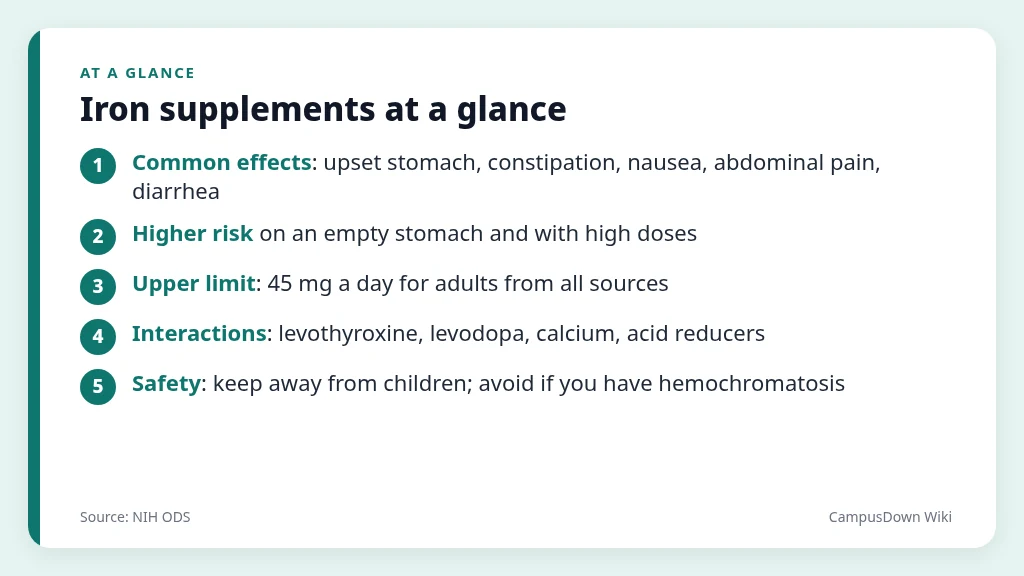
The ODS says in healthy people, taking high doses of iron supplements (especially on an empty stomach) can cause an upset stomach, constipation, nausea, abdominal pain, vomiting and diarrhea. Large amounts might cause inflammation of the stomach lining and ulcers, high doses can decrease zinc absorption, and extremely high doses (hundreds or thousands of mg) can cause organ failure, coma, convulsions and death. The ODS page doesn't give side effect rates, and it doesn't discuss stool color or headache, so ask your clinician about anything unusual. If constipation is the main problem, see constipation in older adults and docusate and senna, and check with your pharmacist first.
How much iron do people need?
Average daily recommended amounts from the ODS include 8 mg for adult men 19 to 50, 18 mg for adult women 19 to 50, 8 mg for adults 51 and older, 15 mg for teen girls 14 to 18, 27 mg for pregnant women and 9 mg for breastfeeding women. Vegetarians who don't eat meat, poultry or seafood need almost twice as much because the body doesn't absorb nonheme iron from plants as well as heme iron from animal foods. The daily upper limit for adults 19 and older is 45 mg from all sources: food, drinks and supplements, and a doctor might prescribe more than the upper limit to people who need higher doses for a while to treat iron deficiency. Don't exceed the label unless your doctor tells you to.
Food sources and absorption
Iron is found in lean meat, seafood and poultry, iron-fortified cereals and breads, white beans, lentils, spinach, kidney beans, peas, nuts and some dried fruits such as raisins. Your body absorbs iron from plant sources better when you eat it with meat, poultry, seafood or foods with vitamin C, such as citrus fruits, strawberries, sweet peppers, tomatoes and broccoli. The ODS says most people in the United States get enough iron, but teen girls and women with heavy periods, pregnant women and teens, infants, frequent blood donors and people with cancer, gastrointestinal disorders or heart failure are more likely to struggle.
Interactions to ask about
The ODS lists these examples:
- Levodopa (Sinemet, Stalevo): iron can reduce how much the body absorbs.
- Levothyroxine: taking iron with it can reduce its effectiveness; see hypothyroidism and ask your pharmacist how to space them.
- Proton pump inhibitors such as lansoprazole and omeprazole decrease stomach acid and might reduce nonheme iron absorption; see omeprazole.
- Calcium might interfere with iron absorption, and taking calcium and iron supplements at different times of the day might prevent this; see calcium and magnesium.
Tell your doctor, pharmacist and other providers about all supplements and medicines.
Who should avoid iron supplements
The ODS says some people have an inherited condition called hemochromatosis that causes toxic levels of iron to build up, and without medical treatment they can develop liver cirrhosis, liver cancer and heart disease; people with this disorder should avoid iron supplements and vitamin C supplements. The ODS also says some chronic diseases, such as rheumatoid arthritis, inflammatory bowel disease and some cancers, can lead to anemia of chronic disease, which usually doesn't improve with more iron because the main therapy is treating the underlying disease. Ask your doctor about testing before you start iron on your own.
Pregnancy
During pregnancy the amount of blood in a woman's body increases so she needs more iron, and too little iron raises her risk of iron deficiency anemia and her infant's risk of low birth weight, premature birth and low iron. Women who are pregnant should talk with their health care provider and take an iron supplement if recommended. See folic acid before and during pregnancy.
Keep iron away from children
The ODS says iron supplements carry a label warning to keep them out of the reach of children and accidental overdose of iron-containing products is a leading cause of fatal poisoning in children under 6. Store supplements in a high, locked place. If a child swallows iron, call poison control at 1-800-222-1222 or 911.
Get help now if
Call poison control at 1-800-222-1222 or 911 right away if a child may have swallowed iron pills, even if they seem fine. Tell your doctor promptly about severe stomach pain, vomiting or any unusual symptoms after starting iron.
Questions for your doctor or pharmacist
- Do I really need iron, and what is my level?
- What dose and form should I use, and should I take it with food?
- When should I space it from levothyroxine, calcium or acid reducers?
- What can I do about constipation or stomach upset?
- When will you recheck my levels?
Example scenario: the empty-stomach pills
- Who
- Mirabel, 34, a nurse's aide in Baltimore, Maryland, began iron tablets after a blood test showed iron deficiency anemia.
- What happened
- She took them first thing in the morning on an empty stomach and felt nauseated, then became constipated.
- How it felt
- She worried the tablets didn't agree with her and nearly quit.
- What they did
- She called her pharmacist, who explained that stomach upset and constipation are common with iron, asked whether she took any other medicines or calcium and told her to talk to her doctor about taking it with food and about the right dose. Mirabel added fiber-rich meals and kept her follow-up blood test.
- How it turned out
- Mirabel said the pharmacist call kept her from stopping her treatment alone.
This is an illustrative example, not a real patient or a review.
Mirabel's story is an illustrative example. Don't change your iron dose without talking to your doctor or pharmacist.
Most-asked questions about iron supplement side effects
Do iron supplements change your poop?
The ODS page lists constipation and diarrhea but doesn't discuss stool color; ask your clinician or pharmacist about any change that worries you.
Why people ask: "iron supplements side effects poop" is #2 for "iron supplements side effects" (US autocomplete, November 2026).
What are iron supplement side effects for women?
Upset stomach, constipation, nausea, abdominal pain, vomiting and diarrhea; women 19 to 50 need about 18 mg a day, and pregnant women about 27 mg.
Why people ask: "iron supplements side effects for women" is #3 for "iron supplements side effects" (US autocomplete, November 2026).
What are iron supplement side effects for men?
The same effects apply; adult men need about 8 mg a day, and hemochromatosis is a reason to avoid iron supplements.
Why people ask: "iron supplements side effects for men" is #4 for "iron supplements side effects" (US autocomplete, November 2026).
Do iron supplements cause headache?
The ODS page doesn't list headache; talk to your clinician about unusual symptoms.
Why people ask: "iron supplements side effects headache" is #5 for "iron supplements side effects" (US autocomplete, November 2026).
Can iron supplements affect the liver?
In people with hemochromatosis, uncontrolled iron buildup can lead to cirrhosis and liver cancer, and they should avoid iron supplements; the page doesn't describe liver effects in healthy people.
Why people ask: "iron supplements side effects liver" is #7 for "iron supplements side effects" (US autocomplete, November 2026).
What are iron supplement side effects in pregnancy?
The page lists the general side effects and says pregnant women should talk to their provider and take iron if recommended.
Why people ask: "iron supplements side effects pregnancy" is #8 for "iron supplements side effects" (US autocomplete, November 2026).
What are long-term iron supplement side effects?
The ODS page doesn't address long-term use except to note the 45 mg upper limit for adults and the hemochromatosis warning; ask your doctor to recheck your levels.
Why people ask: "iron supplements side effects long term" is #9 for "iron supplements side effects" (US autocomplete, November 2026).
What are iron tablet side effects for women?
Upset stomach, constipation, nausea, abdominal pain, vomiting and diarrhea, especially at high doses on an empty stomach.
Why people ask: "iron tablets side effects for women" is #2 for "iron supplements side effects for women" (US autocomplete, November 2026).
What are iron tablet side effects for pregnant women?
The same general effects; pregnant women should ask their provider about taking iron.
Why people ask: "iron tablets side effects for pregnant women" is #3 for "iron supplements side effects for women" (US autocomplete, November 2026).
Does taking iron supplements have side effects?
Yes; high doses, especially on an empty stomach, can cause stomach and bowel problems, and very high doses can be dangerous.
Why people ask: "does taking iron supplements have side effects" is #4 for "iron supplements side effects for women" (US autocomplete, November 2026).
Should females take iron supplements?
Teen girls and women with heavy periods and pregnant women are more likely to have trouble getting enough iron; ask your doctor whether you need testing or a supplement.
Why people ask: "should females take iron supplements" is #5 for "iron supplements side effects for women" (US autocomplete, November 2026).
What are the side effects of iron supplements?
Upset stomach, constipation, nausea, abdominal pain, vomiting and diarrhea, plus ulcers or stomach lining inflammation with large amounts.
Why people ask: "what are the side effects of iron supplements" is #6 for "iron supplements side effects for women" (US autocomplete, November 2026).
Do iron supplements have side effects?
Yes; start with your doctor's recommendation and ask your pharmacist about timing with food and other medicines.
Why people ask: "does iron supplements have side effects" is #7 for "iron supplements side effects for women" (US autocomplete, November 2026).
Related on CampusDown
You can learn more about the health topics hub and check it for yourself in iron deficiency anemia. For bowel trouble in detail, see constipation in older adults, and for another mineral to space apart see calcium and magnesium.
Frequently asked questions
- What side effects do iron pills cause?
- Upset stomach, constipation, nausea, abdominal pain, vomiting and diarrhea, especially at high doses on an empty stomach.
- What is the upper limit for adults?
- 45 mg a day from food, drinks and supplements, unless a doctor prescribes more for iron deficiency.
- Which medicines interact?
- Levodopa, levothyroxine, proton pump inhibitors such as omeprazole and lansoprazole, and calcium.
- Who should avoid iron supplements?
- People with hemochromatosis.
- Why keep iron away from children?
- Accidental overdose is a leading cause of fatal poisoning in children under 6.
Iron supplements are useful for people who need them, but high doses can upset the stomach and bowels, and some people should avoid them altogether. Get tested before starting, ask your pharmacist about timing with food and other medicines, stay under the upper limit unless your doctor says otherwise and store iron where children can't reach it.
Browse more guides like this in the U.S. Health Topics hub.
This article is for general education and does not replace advice from your own doctor, nurse or pharmacist.