
Did you assume Medicare would pay for your hearing aids, dentures or new glasses? Many people find out at the counter that Original Medicare doesn't. Knowing the few exceptions can save real money.

This guide is based on Medicare.gov's coverage pages for hearing aids, hearing exams, dental services, eyeglasses and routine eye exams, plus the FDA's OTC hearing aid guidance. It explains in detail what's covered and where to look instead. Coverage depends on your plan; check with your plan and talk with your doctor or audiologist.
Hearing: what Medicare covers and doesn't
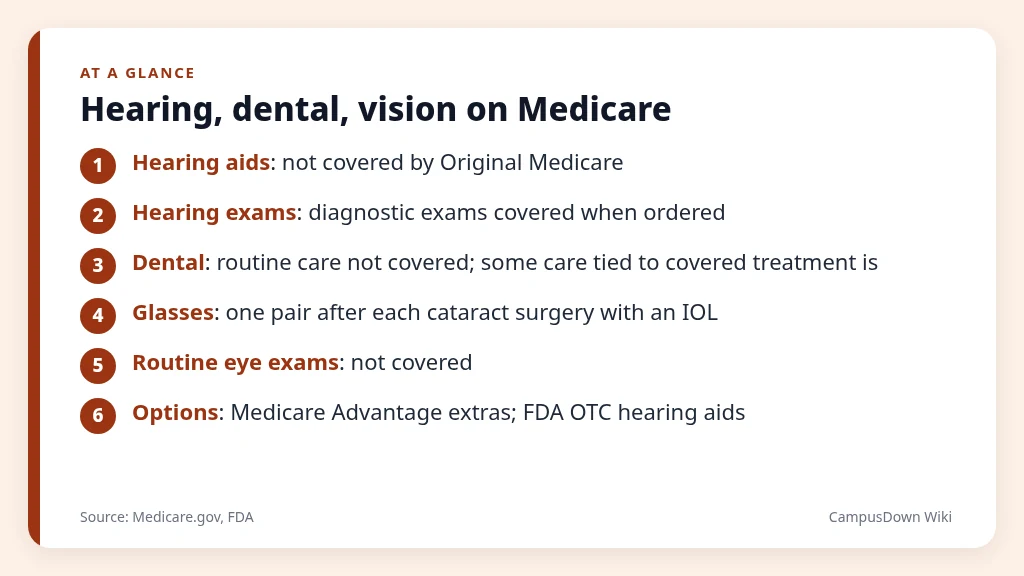
Medicare.gov says Original Medicare doesn't cover hearing aids or exams for fitting hearing aids. You pay all costs.
What Part B does cover:
- Diagnostic hearing and balance (fall risk) exams your provider orders to see if you need medical treatment. You pay 20% after the Part B deductible ($283 in 2026), plus a hospital copayment in an outpatient setting.
- You can see an audiologist once every 12 months without an order for non-acute hearing conditions (like hearing loss over many years) or services related to surgically implanted hearing devices.

Lower-cost hearing options: OTC hearing aids
The FDA created an over-the-counter (OTC) hearing aid category in effect since October 17, 2022, for adults 18 and older with perceived mild to moderate hearing loss. You can buy them in stores or online without a prescription. On September 12, 2024, the FDA authorized Apple's Hearing Aid Feature software for compatible AirPods Pro as an OTC hearing aid.
Get help now if
The FDA says OTC hearing aids are not for severe or profound hearing loss. If you suspect more serious loss, or have ear pain, drainage or sudden hearing changes, see a licensed hearing professional or doctor first.
Take a closer look in our OTC vs prescription hearing aids and AirPods Pro 2 hearing aid guides, and our page on age-related hearing loss.
Dental: mostly not covered, with key exceptions
Medicare.gov says that in most cases Medicare doesn't cover routine cleanings, fillings, extractions, dentures or implants.
Medicare may cover:
- Some dental services when you're admitted as a hospital inpatient for your dental procedure, because of your medical condition or the procedure's severity.
- Dental services directly linked to the success of a covered medical treatment.
Medicare.gov gives these examples of linked dental care:
- An oral exam and dental treatment before a heart valve replacement or a bone marrow, organ or kidney transplant
- A procedure like an extraction to treat a mouth infection before chemotherapy
- Treatment for complications of head and neck cancer treatment
- Dental or oral exams and infection treatment before and during dialysis for End-Stage Renal Disease (ESRD)
For inpatient stays, the Part A deductible is $1,736 in 2026 ($1,776 in 2027). For Part B-covered dental services, you pay 20% after the Part B deductible.
Vision: glasses and eye exams
Medicare.gov says:
- Routine eye exams for glasses or contacts (eye refractions) aren't covered.
- Eyeglasses and contacts usually aren't covered.
- Exception: Part B covers one pair of eyeglasses with standard frames, or one set of contact lenses, after each cataract surgery that implants an intraocular lens. You pay 20% after the Part B deductible, plus any cost of upgraded frames. The supplier must participate in Medicare.
Medicare Advantage extras
Medicare.gov says some Medicare Advantage (Part C) plans offer extra vision, hearing and dental benefits that Original Medicare doesn't. Benefits vary widely by plan, so compare the details and check it for yourself in each plan's Evidence of Coverage. You can change plans during Medicare Open Enrollment. Weigh the trade-offs in our Medicare Advantage vs Medigap guide.
Example scenario: the dinner-table mix-up
- Who
- Ulysses, 72, a retired postal carrier in Charlotte, North Carolina, had Original Medicare with a Medigap plan. In the same month, he struggled to follow his grandkids at dinner, cracked a molar and needed new glasses after cataract surgery on his right eye. His wife, Guinevere, 70, handled the household paperwork.
- What happened
- Ulysses assumed Medicare would cover all three. A hearing aid quote and a dental estimate, both out of pocket, left them stunned.
- How it felt
- He felt embarrassed about asking people to repeat themselves, and Guinevere felt frustrated that nobody had explained the gaps.
- What they did
- Guinevere read Medicare.gov with him. The optometrist confirmed his glasses after cataract surgery qualified, and they chose standard frames. His doctor ordered a diagnostic hearing exam, and the audiologist found mild to moderate loss, so he tried an OTC hearing aid first. They paid the dentist out of pocket and set a reminder to compare Medicare Advantage plans with dental benefits at Open Enrollment.
- How it turned out
- Ulysses said he laughed at his grandson's jokes at the next family dinner, on time for once. Guinevere said a written list of what Medicare did and didn't cover took the panic out of the next decision.
This is an illustrative example, not a real patient or a review.
Ulysses's story is an illustrative example. Your coverage and needs may differ.
Most-asked questions about Medicare hearing, dental and vision
Does Medicare cover hearing aids for seniors?
Original Medicare doesn't cover hearing aids or fitting exams. Some Medicare Advantage plans offer hearing benefits.
Why people ask: "does medicare cover hearing aids for seniors" is #2 for "does medicare cover hearing aids" (US autocomplete, November 2026).
Does Medicare cover hearing aids in 2026?
No. Medicare.gov says Original Medicare doesn't cover hearing aids, though diagnostic hearing exams are covered when ordered.
Why people ask: "does medicare cover hearing aids in 2026" is #3 for "does medicare cover hearing aids" (US autocomplete, November 2026).
Does Medicare cover hearing aids at Costco?
Original Medicare doesn't cover hearing aids from any store. A Medicare Advantage plan's hearing benefit may have its own rules.
Why people ask: "does medicare cover hearing aids at costco" is #6 for "does medicare cover hearing aids" (US autocomplete, November 2026).
Does Medicare cover dental and vision?
Mostly no. Routine dental care, routine eye exams and most glasses aren't covered by Original Medicare, with specific exceptions.
Why people ask: "does medicare cover dental and vision" is #2 for "does medicare cover dental" (US autocomplete, November 2026).
Does Medicare cover dental implants?
Medicare.gov says implants and dentures generally aren't covered.
Why people ask: "does medicare cover dental implants" is #3 for "does medicare cover dental" (US autocomplete, November 2026).
Does Medicare cover glasses after cataract surgery?
Yes. Part B covers one pair of glasses with standard frames, or one set of contacts, after each cataract surgery with an intraocular lens.
Why people ask: "does medicare cover glasses after cataract surgery" is #2 for "does medicare cover glasses" (US autocomplete, November 2026).
Does Medicare cover glasses and eye exams?
Routine eye exams and most glasses aren't covered by Original Medicare.
Why people ask: "does medicare cover glasses and eye exams" is #4 for "does medicare cover glasses" (US autocomplete, November 2026).
Related on CampusDown
Shopping for hearing help? You can learn more about Jabra Enhance Select and getting used to hearing aids.
Frequently asked questions
- Does Medicare cover a hearing test?
- Part B covers diagnostic hearing and balance exams your provider orders, and some audiologist visits without an order once every 12 months.
- Does Medicare cover dentures?
- Medicare.gov says dentures generally aren't covered.
- Will Medicare pay for designer frames after cataract surgery?
- Medicare covers standard frames; you pay any extra for upgraded frames.
- Are OTC hearing aids right for everyone?
- No. The FDA says they're for adults with perceived mild to moderate hearing loss, not severe or profound loss.
Original Medicare covers very little hearing, dental and vision care, but the exceptions matter. Ask your doctor about diagnostic exams, use your post-cataract glasses benefit, and compare plan extras and OTC options before you pay.
Browse more guides like this in the Senior Health and Medicare hub.
This article is for general education and does not replace advice from your own doctor, nurse or pharmacist.