
You've decided to quit smoking, and the pharmacy aisle has patches, gum and lozenges. Which one do you pick, and how do you use it without making it harder on your body?

This guide uses MedlinePlus pages on nicotine skin patches (last revised June 20, 2024), nicotine chewing gum (last revised October 15, 2017) and nicotine replacement therapy (review date February 13, 2025). It is general information, not a prescription; ask your pharmacist or clinician to help choose and time your plan. If you want to learn more about lung health, take a closer look at COPD flare signs.
What nicotine replacement does
MedlinePlus says these products supply low doses of nicotine without the other toxins in smoke, with the goal of cutting down cravings and easing withdrawal symptoms. It lists gum, inhalers, lozenges, nasal spray and skin patches and says all work equally well if used correctly, with people more likely to use gum and patches correctly. Adding a counseling program increases your chances of quitting. The nicotine dose should be slowly decreased.

The patch
MedlinePlus says:
- Apply once a day, usually at the same time, to clean, dry, hairless skin on the upper chest, upper arm or hip, avoiding irritated, oily, scarred or broken skin.
- Peel the strip, press the patch with your palm for about 10 seconds, and wash your hands with water alone. If it loosens or falls off, replace it.
- Wear it continuously for 16 to 24 hours, depending on your package. It may be worn in the shower.
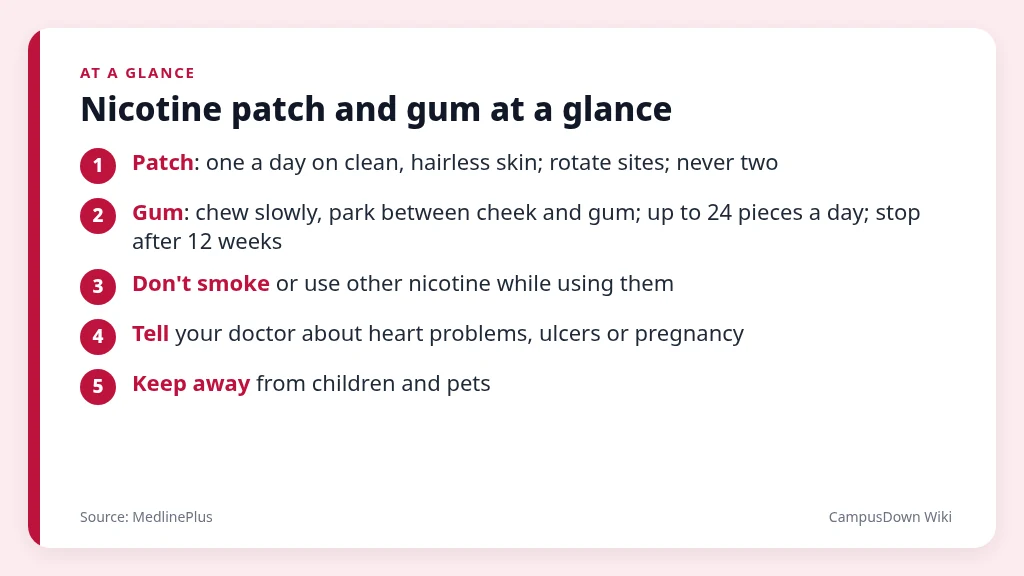
- Use a different area each time; never wear two patches at once.
- After about 2 weeks, a lower-strength patch may be considered; a gradual step-down reduces withdrawal. Use is 6 to 20 weeks depending on the package.
- The encyclopedia page says if wearing it at night causes odd dreams, try sleeping without it, and that people who smoke fewer than 10 cigarettes a day or weigh less than 99 pounds should start with a lower dose; check with your provider.
The gum
MedlinePlus says:
- Use it together with a smoking cessation program.
- 2 mg gum if your first cigarette is more than 30 minutes after waking; 4 mg if it's within 30 minutes.
- Chew slowly until you taste the nicotine or feel tingling, then park it between your cheek and gum; when the tingling fades (about a minute), chew again; repeat for about 30 minutes.
- Avoid eating and drinking for 15 minutes before and during chewing; the encyclopedia adds to wait at least 15 minutes after coffee, tea, soft drinks or acidic beverages.
- Don't chew too fast or one piece after another; that can cause hiccups, heartburn or nausea.
- No more than 24 pieces a day. The typical schedule is 1 piece every 1 to 2 hours for 6 weeks, every 2 to 4 hours for 3 weeks, then every 4 to 8 hours for 3 weeks.
- Stop after 12 weeks; talk to your doctor if you still feel the need.
Lozenges are mentioned as an over-the-counter option; check the package and ask your pharmacist.
Cautions
- Do not smoke or use other nicotine products while using these products; nicotine overdose can result.
- Tell your doctor about a heart attack, heart disease, irregular heartbeat, angina (patch), ulcers, uncontrolled high blood pressure, overactive thyroid and pheochromocytoma (patch), diabetes (gum), skin conditions (patch), age under 18 or a sodium-restricted diet (gum). See PVCs and skipped heartbeats.
- Pregnancy or breastfeeding: talk to your doctor; MedlinePlus says nicotine and patches may harm the fetus.
- Acetaminophen (Tylenol) may interact with the patch; don't start it while using patches without asking.
- Keep used and unused products away from children and pets. MedlinePlus says nicotine is a poison to children; call poison control (1-800-222-1222) if a child is exposed.
Side effects
- Patch (tell your doctor if severe or lasting): dizziness, headache, nausea, vomiting, diarrhea, redness or swelling at the site.
- Call right away for severe rash or swelling, seizures, abnormal heartbeat or rhythm or difficulty breathing.
- Gum: stop and call for mouth, tooth or jaw problems, dizziness, nausea, vomiting, diarrhea, weakness, fast, pounding or irregular heartbeat, difficulty breathing, rash or mouth blisters.
- The encyclopedia says trouble sleeping in the first days is most common with the patch and usually passes.
Get help now if
Call 911 for chest pain, trouble breathing, a seizure or a very fast or irregular heartbeat while using nicotine products. Call poison control (1-800-222-1222) if a child chews or sucks on a patch or gum.
Questions for your pharmacist or clinician
- Which form and strength fit how much I smoke?
- Can I combine a patch with gum?
- Do my heart, thyroid or stomach conditions change the plan?
- How do I step down and when do I stop?
- Where can I get counseling? NEI notes the quitline 1-800-QUIT-NOW.
Example scenario: smoking on the patch
- Who
- Zebediah, 59, a roofing contractor in Phoenix, Arizona, started a patch after his doctor mentioned his breathing.
- What happened
- On day three he had one cigarette while wearing the patch and felt dizzy and nauseated.
- How it felt
- He felt guilty and thought it had failed.
- What they did
- He called his pharmacist, who explained that smoking while using nicotine products can cause overdose symptoms, reviewed how to use the patch and told him to call his doctor about the heart-racing feeling. He restarted with support from a quit line and kept patches locked away from his grandchildren.
- How it turned out
- Zebediah said the call turned a failure into a plan.
This is an illustrative example, not a real patient or a review.
Zebediah's story is an illustrative example. Ask a clinician before using nicotine replacement with heart conditions or during pregnancy.
Most-asked questions about nicotine patches and gum
What are nicotine patch side effects?
Dizziness, headache, nausea, vomiting, diarrhea and redness or swelling at the patch site; call right away for severe rash, seizures, abnormal heartbeat or trouble breathing.
Why people ask: "nicotine patch side effects" is #2 for "nicotine patch" (US autocomplete, November 2026).
Are there nicotine patches for health benefits?
MedlinePlus describes patches as a way to stop smoking, not a general health product; it doesn't describe other health uses.
Why people ask: "nicotine patches for health" is #3 for "nicotine patch" (US autocomplete, November 2026).
What are nicotine patch adverse effects?
The same list, plus nicotine overdose if you smoke or use other nicotine while wearing it.
Why people ask: "nicotine patch adverse effects" is #4 for "nicotine patch" (US autocomplete, November 2026).
What is nicotine patch dosing?
Follow your package: one a day for 16 to 24 hours, step down after about 2 weeks, 6 to 20 weeks in total; ask your pharmacist for your strength.
Why people ask: "nicotine patch dosing" is #5 for "nicotine patch" (US autocomplete, November 2026).
What are nicotine patch benefits?
It eases withdrawal symptoms when you stop smoking; counseling raises your chances of quitting.
Why people ask: "nicotine patch benefits" is #8 for "nicotine patch" (US autocomplete, November 2026).
What are the nicotine patch health benefits?
MedlinePlus says it supplies nicotine without the other toxins in smoke and reduces withdrawal; it doesn't list other benefits.
Why people ask: "nicotine patch health benefits" is #9 for "nicotine patch" (US autocomplete, November 2026).
Does a nicotine patch help with pain?
MedlinePlus lists it only for stopping smoking; the page doesn't describe pain use.
Why people ask: "nicotine patch for pain" is #10 for "nicotine patch" (US autocomplete, November 2026).
How does nicotine gum compare with Zyn?
The sources here don't cover Zyn pouches; MedlinePlus covers nicotine gum for quitting smoking. Ask your pharmacist.
Why people ask: "nicotine gum vs zyn" is #3 for "nicotine gum" (US autocomplete, November 2026).
What is nicotine gum dosing?
2 mg if you smoke your first cigarette more than 30 minutes after waking, 4 mg if within 30 minutes; no more than 24 pieces a day; stop after 12 weeks.
Why people ask: "nicotine gum dosing" is #5 for "nicotine gum" (US autocomplete, November 2026).
What about nicotine gummies?
The sources here cover chewing gum, not gummies; read the package and ask your pharmacist before using any nicotine product.
Why people ask: "nicotine gummies" is #6 for "nicotine gum" (US autocomplete, November 2026).
What are nicotine gum instructions?
Chew slowly until tingling, park between cheek and gum, repeat for about 30 minutes, and avoid eating or drinking for 15 minutes before and during.
Why people ask: "nicotine gum instructions" is #9 for "nicotine gum" (US autocomplete, November 2026).
Related on CampusDown
You can learn more about the medicines hub and check it for yourself in the brown bag medication review. For lung conditions in detail, see COPD flare signs, and for other substances that affect the body see alcohol and aging.
Frequently asked questions
- Can I smoke while using a patch or gum?
- No; MedlinePlus says nicotine overdose can result.
- How long do I use them?
- Patches 6 to 20 weeks by package; gum up to 12 weeks, then talk to your doctor.
- Can I wear two patches?
- No; never wear two at once.
- When do I call for help?
- Severe rash, seizures, abnormal heartbeat, trouble breathing, or mouth, tooth or jaw problems with gum.
- Are these safe for children?
- No; nicotine is a poison for children, so keep products out of reach.
Nicotine replacement can ease withdrawal while you quit, especially with counseling. Use patches and gum exactly as directed, don't smoke while using them, step down on schedule, protect children and pets, and tell your clinician about heart problems or pregnancy.
Browse more guides like this in the Medicines hub.
This article is for general education and does not replace advice from your own doctor, nurse or pharmacist.