
A sharp, electric pain runs from your lower back down the back of your leg every time you sneeze. Is this something to rest off, or something to get checked?
This guide uses the MedlinePlus sciatica health topic and OrthoInfo's sciatica page from the American Academy of Orthopaedic Surgeons (AAOS). It is general information, not a diagnosis; a clinician needs to find the cause of the nerve compression. If you want to learn more about the lower-back conditions behind it, take a closer look at herniated disks.
What sciatica is
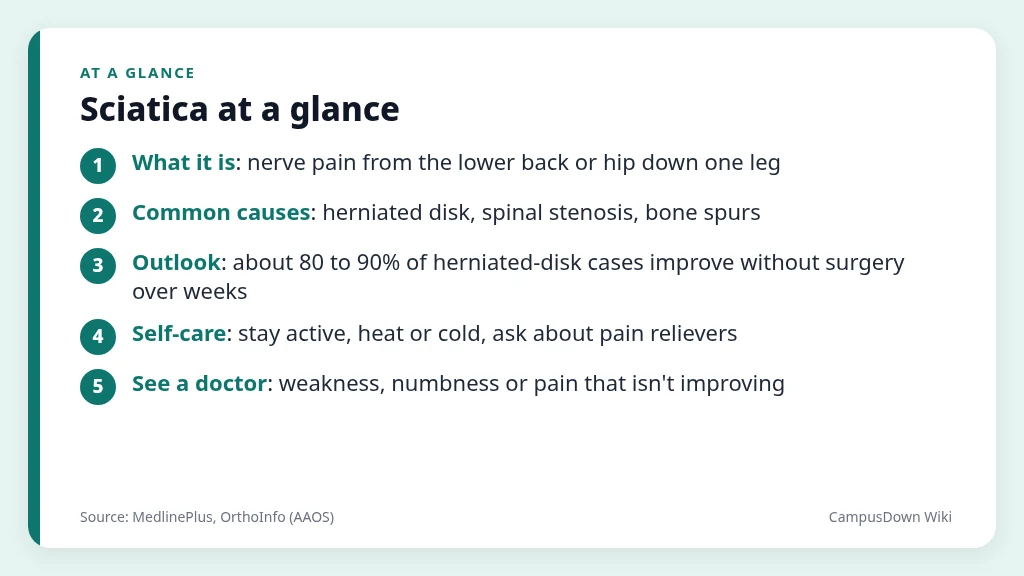
MedlinePlus says sciatica is a symptom of a problem with the sciatic nerve, the largest nerve in the body. It says you have pain, weakness, numbness or tingling that can start in the lower back and extend down your leg to the calf, foot or even toes, usually on only one side. OrthoInfo says sciatica is a very broad term for nerve pain, not a specific diagnosis; the diagnosis is the cause of the nerve compression, such as a herniated disk or spinal stenosis.

Symptoms
OrthoInfo says sciatica may feel like a bad leg cramp, sharp ("knife-like") or electrical, and you may have pain especially when you move, sneeze or cough, along with weakness, "pins and needles" numbness, or burning or tingling down the leg. It says the cramp can last for weeks before it goes away.
Causes
MedlinePlus lists a ruptured disk, spinal stenosis (narrowing of the spinal canal) and injuries such as a pelvic fracture, and says in many cases no cause can be found. OrthoInfo says you are most likely to get sciatica between ages 30 and 75, that the cause under age 40 is typically a herniated disk, and that older adults typically have bone spurs and arthritis. See osteoarthritis for the age-related joint changes that can be involved.
How it is diagnosed
OrthoInfo says your doctor will take a history and examine you, which may include squatting, walking on heels and toes or a straight-leg raising test, and that x-rays and other imaging such as MRI may confirm which nerve roots are affected.
Usual recovery and self-care
OrthoInfo says the condition usually heals itself given sufficient time; approximately 80 to 90% of patients get better over time without surgery, typically within several weeks if the cause is a herniated disk. If the cause is bone spurs and spinal stenosis, nonsurgical treatment is less successful but there is still a good chance of improvement. For symptom relief it lists:
- Nonsteroidal anti-inflammatory drugs such as ibuprofen, aspirin or naproxen, or muscle relaxants, which may offer relief. Check with a pharmacist first; see cyclobenzaprine for one muscle relaxant.
- Gentle heat or cold on painful muscles.
- Staying active: do not remain in bed, because too much rest may cause other parts of the body to feel discomfort.
- Stretching exercises as soon as possible, short walks, and physical therapy if your doctor prescribes it.
- Sometimes a cortisone-like injection near the spine from your doctor.
When surgery is considered
OrthoInfo says you might need surgery if you still have disabling leg pain after 3 or more months of nonsurgical treatment, to remove the herniated disk or bone spurs pressing on the nerve, and that it is usually very successful at relieving pain, especially if most of the pain is in the leg. It adds that a disk can rupture again.
When to see a doctor
The pages used here don't list emergency warning signs, so use this rule: tell a clinician if you have weakness, numbness, pain that is getting worse or not improving, or pain after an injury. If you ever have sudden severe weakness, loss of bladder or bowel control or numbness in the groin area, seek emergency care right away; ask your clinician about these warning signs.
Questions for your doctor
- What do you think is causing the nerve compression?
- Do I need imaging now, or can we watch how I do over a few weeks?
- Which pain relievers are safe for me with my other conditions and medicines?
- Would physical therapy help, and when should I start?
- At what point would we talk about injections or surgery?
Example scenario: the sneeze that hurt
- Who
- Lorenzo, 47, a delivery driver in Tulsa, Oklahoma, felt a sharp pain from his lower back down his right leg after lifting a heavy box.
- What happened
- It got worse when he sneezed or sat for a long stretch, and he began avoiding movement.
- How it felt
- He worried he had done permanent damage.
- What they did
- He saw his clinician, who examined him and talked through gentle activity, a plan for pain relievers that fit his other medicines, and physical therapy. Lorenzo was told to call sooner if he developed weakness or numbness, and his leg pain eased over several weeks.
- How it turned out
- Lorenzo said staying a little active helped him more than lying in bed.
This is an illustrative example, not a real patient or a review.
Lorenzo's story is an illustrative example. Your own plan depends on your exam and your clinician's advice.
Most-asked questions about sciatica
What is sciatica pain?
Pain, weakness, numbness or tingling from a problem with the sciatic nerve, often from the lower back down one leg.
Why people ask: "sciatica pain" is #2 for "sciatica" (US autocomplete, November 2026).
Which stretches help sciatica?
OrthoInfo says to start stretching exercises as soon as possible, and your doctor may prescribe physical therapy; it doesn't name specific stretches, so ask a clinician or physical therapist.
Why people ask: "sciatica stretches" is #3 for "sciatica" (US autocomplete, November 2026).
How do you get sciatica pain relief?
OrthoInfo lists NSAIDs or muscle relaxants, gentle heat or cold, staying active, stretching and sometimes an injection.
Why people ask: "sciatica pain relief" is #4 for "sciatica" (US autocomplete, November 2026).
What are sciatica symptoms?
Pain, weakness, numbness, tingling or burning from the lower back down the leg, usually on one side.
Why people ask: "sciatica symptoms" is #5 for "sciatica" (US autocomplete, November 2026).
How is sciatica treated?
Treatment depends on the cause; it may include exercises, medicines and, in some cases, surgery.
Why people ask: "sciatica treatment" is #6 for "sciatica" (US autocomplete, November 2026).
Which exercises help sciatica?
OrthoInfo says walking, stretching and physical therapy may be advised and that strengthening exercises may be given later; ask your clinician which are right for you.
Why people ask: "sciatica exercises" is #7 for "sciatica" (US autocomplete, November 2026).
What is the sciatic nerve?
The largest nerve in the body; it controls muscles in the back of the knee and lower leg and provides feeling to the back of the thigh, part of the lower leg and the sole of the foot.
Why people ask: "sciatica nerve" is #8 for "sciatica" (US autocomplete, November 2026).
What does sciatic nerve pain feel like?
OrthoInfo describes a sharp, knife-like or electrical pain, a burning or tingling sensation, or numbness.
Why people ask: "sciatica nerve pain" is #10 for "sciatica" (US autocomplete, November 2026).
What exercises relieve sciatica pain?
See above: the pages recommend staying active and stretching, and say your doctor may prescribe physical therapy.
Why people ask: "sciatica pain relief exercises" is #2 for "sciatica pain relief" (US autocomplete, November 2026).
Which medicine is used for sciatica pain relief?
OrthoInfo lists ibuprofen, aspirin, naproxen or muscle relaxants; ask a pharmacist or doctor what suits you.
Why people ask: "sciatica pain relief medicine" is #3 for "sciatica pain relief" (US autocomplete, November 2026).
What about sciatica pain relief in pregnancy?
The pages used here don't cover pregnancy; talk to your obstetric clinician before taking any medicine.
Why people ask: "sciatica pain relief pregnancy" is #4 for "sciatica pain relief" (US autocomplete, November 2026).
Do creams or devices help sciatica?
The pages used here don't discuss creams or devices; ask a clinician or pharmacist.
Why people ask: "sciatica pain relief cream" is #6 for "sciatica pain relief" (US autocomplete, November 2026).
Related on CampusDown
You can learn more about the health topics hub and check it for yourself in herniated disks. For senior health in detail, see senior health and balance exercises for seniors.
Frequently asked questions
- What is sciatica?
- Pain, weakness, numbness or tingling from a problem with the sciatic nerve, usually down one leg.
- What causes it?
- A ruptured disk, spinal stenosis, bone spurs, injury, or sometimes no cause is found.
- Does it go away on its own?
- OrthoInfo says approximately 80 to 90% of herniated-disk cases get better without surgery, typically within several weeks.
- Should I stay in bed?
- No; OrthoInfo says to keep moving and not stay in bed, with your clinician's guidance.
- When is surgery considered?
- If disabling leg pain remains after 3 or more months of nonsurgical treatment.
Sciatica is nerve pain, often from a herniated disk or spinal stenosis, and most herniated-disk cases improve over weeks with gentle activity. See a clinician for weakness, numbness or pain that isn't improving, and ask a pharmacist before taking pain relievers.
Browse more guides like this in the U.S. Health Topics hub.
This article is for general education and does not replace advice from your own doctor, nurse or pharmacist.