
Your arm aches and you have chills the day after your shingles shot. Is this normal, and do you still need the second dose?
This guide uses the CDC page "Shingles Vaccination" (dated August 19, 2025). It is general information, not personal medical advice; your clinician or pharmacist decides whether the vaccine is right for you. If you want to learn more about the illness itself, take a closer look at shingles.
What Shingrix is
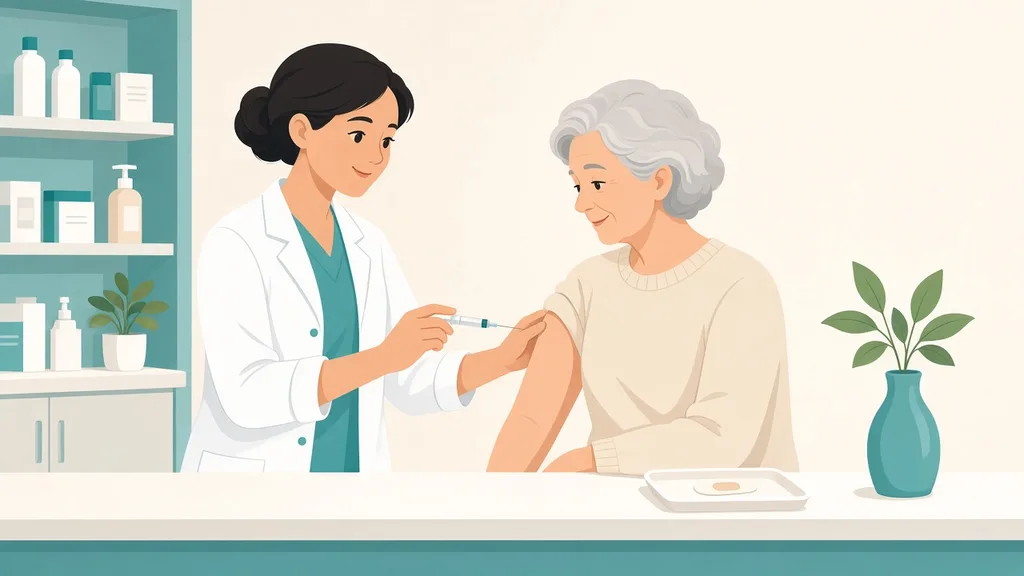
CDC says recombinant zoster (shingles) vaccine, called Shingrix, can prevent shingles, and the vaccine is given as a two-dose series in the upper arm by your doctor or pharmacist. It may be given at the same time as other vaccines. CDC says about 1 in 3 people in the United States will have shingles in their lifetime, and the risk increases with age.

Who should get it
CDC recommends:
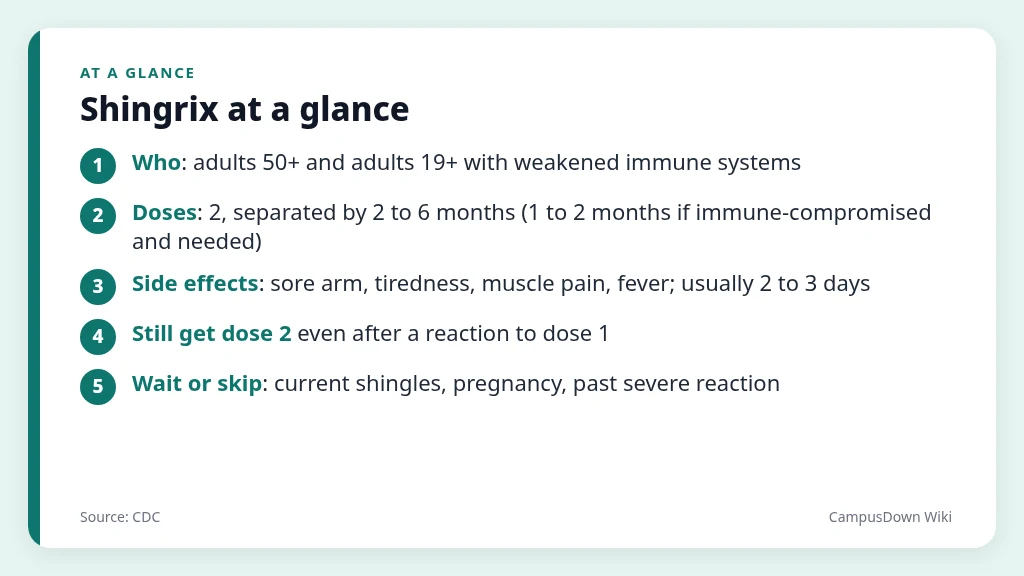
- Adults 50 and older: 2 doses, separated by 2 to 6 months.
- Adults 19 and older with weakened immune systems due to disease or therapy: 2 doses; if needed, the second dose can be given 1 to 2 months after the first.
CDC says there is no maximum age for getting Shingrix, and you should get it even if you previously had shingles, received Zostavax or had the chickenpox vaccine. It says you can get it whether or not you remember having chickenpox, and more than 99% of Americans born on or before 1980 have had chickenpox. Zostavax is no longer available in the United States. See high-dose flu vaccine for other vaccines often discussed at the same visit.
How well it works
CDC says Shingrix was 97% effective in preventing shingles in adults 50 to 69 with healthy immune systems and 91% effective in those 70 and older, and 91% effective in preventing postherpetic neuralgia (PHN), the long-term nerve pain, in adults 50 and older (89% in those 70 and older). In people with weakened immune systems, it was between 68% and 91% effective depending on the condition, and immunity remained high for at least 7 years in people 70 and older with healthy immune systems.
Possible side effects
CDC says Shingrix causes a strong immune response, so temporary side effects usually last 2 to 3 days. Common ones include:
- A sore arm with mild or moderate pain, redness and swelling at the injection site.
- Tiredness, muscle pain, headache, shivering, fever, stomach pain and nausea.
CDC says these may temporarily prevent regular activities, were more common in younger people, and you should still get the second dose even if you had one of these reactions after the first dose. If you have side effects, you may take over-the-counter medicines like ibuprofen or acetaminophen; ask your pharmacist what suits you and see acetaminophen. Guillain-Barré syndrome has been reported very rarely after Shingrix.
Get help now if
CDC says to contact your healthcare provider if symptoms aren't improving or are getting worse, and to report side effects to the Vaccine Adverse Event Reporting System (VAERS).
Who should not get it
CDC says do not get Shingrix if you have ever had a severe allergic reaction to any component of the vaccine or to a dose of Shingrix, currently have shingles, or are currently pregnant (wait). If you have a minor illness such as a cold you may still get it, but with a moderate or severe illness, with or without fever, wait until you recover. CDC says if you had shingles before, make sure the rash has gone away before vaccination, and there is no specific length of time to wait.
Cost
CDC says starting in 2023, people with Medicare Part D coverage pay nothing out of pocket for Shingrix; Medicaid may or may not cover it; many private plans cover it with possible costs; and some manufacturer programs help eligible adults. See Medicare Part D for how drug coverage works.
Questions for your doctor or pharmacist
- Am I due for Shingrix, and when should the second dose be scheduled?
- Does my health condition or medicine change the timing?
- Which over-the-counter medicine is suitable if I feel sore afterward?
- Who covers the cost under my plan?
Example scenario: the sore arm
- Who
- Griselda, 63, a retired bookkeeper in Richmond, Virginia, got her first Shingrix at the pharmacy and felt achy and tired for a couple of days.
- What happened
- She wondered whether to skip the second dose.
- How it felt
- She worried the second shot would be worse.
- What they did
- She called her pharmacist, who explained that CDC says reactions usually last 2 to 3 days and that the second dose is still recommended. Griselda set a reminder for the window between 2 and 6 months and asked how to plan the day after.
- How it turned out
- Griselda said knowing what to expect made her more comfortable.
This is an illustrative example, not a real patient or a review.
Griselda's story is an illustrative example. Ask your own pharmacist or clinician about timing and your history.
Most-asked questions about Shingrix side effects
What are shingles vaccine side effects in adults?
A sore arm, redness, swelling, tiredness, muscle pain, headache, shivering, fever, stomach pain and nausea.
Why people ask: "shingles vaccine side effects in adults" is #2 for "shingles vaccine side effects" (US autocomplete, November 2026).
How long do shingles vaccine side effects last?
CDC says symptoms usually go away on their own in 2 to 3 days.
Why people ask: "shingles vaccine side effects how long do they last" is #3 for "shingles vaccine side effects" (US autocomplete, November 2026).
What side effects come after the second dose?
CDC doesn't separate side effects by dose; it says to get the second dose even if you reacted to the first.
Why people ask: "shingles vaccine side effects second dose" is #4 for "shingles vaccine side effects" (US autocomplete, November 2026).
What are the side effects after the first dose?
The same common side effects, usually lasting 2 to 3 days.
Why people ask: "shingles vaccine side effects first dose" is #6 for "shingles vaccine side effects" (US autocomplete, November 2026).
What can I take for shingles vaccine side effects?
CDC says you may take over-the-counter medicines like ibuprofen or acetaminophen; ask a pharmacist what suits you.
Why people ask: "shingles vaccine side effects what to take" is #7 for "shingles vaccine side effects" (US autocomplete, November 2026).
Are there long-term side effects?
CDC says Guillain-Barré syndrome has been reported very rarely and that Shingrix wasn't associated with serious adverse events in clinical trials.
Why people ask: "shingles vaccine side effects long term" is #8 for "shingles vaccine side effects" (US autocomplete, November 2026).
What are 2nd dose side effects?
Same as above; CDC says to get the second dose regardless of reactions to the first.
Why people ask: "shingles vaccine side effects 2nd dose" is #9 for "shingles vaccine side effects" (US autocomplete, November 2026).
Is there a timeline for side effects?
CDC says they usually last 2 to 3 days.
Why people ask: "shingles vaccine side effects timeline" is #10 for "shingles vaccine side effects" (US autocomplete, November 2026).
When is the Shingrix second dose due, such as after 6 months?
CDC says the doses for adults 50 and older are separated by 2 to 6 months; ask your pharmacist if you are outside that window.
Why people ask: "shingrix second dose after 6 months" is #2 for "shingrix second dose" (US autocomplete, November 2026).
Does the second dose have side effects?
Reactions can occur after either dose; CDC says to still get the second dose.
Why people ask: "shingrix second dose side effects" is #3 for "shingrix second dose" (US autocomplete, November 2026).
What is the timing of the second dose?
2 to 6 months after the first for adults 50 and older; 1 to 2 months if needed for adults with weakened immune systems.
Why people ask: "shingrix second dose timing" is #4 for "shingrix second dose" (US autocomplete, November 2026).
What if the second dose is delayed?
The page doesn't say; ask your clinician or pharmacist how to proceed.
Why people ask: "shingrix second dose delayed" is #5 for "shingrix second dose" (US autocomplete, November 2026).
What is the interval between doses?
2 to 6 months for adults 50 and older.
Why people ask: "shingrix second dose interval" is #6 for "shingrix second dose" (US autocomplete, November 2026).
What about the second dose after 2 years?
The page doesn't address a long delay; ask your clinician or pharmacist.
Why people ask: "shingrix second dose after 2 years" is #8 for "shingrix second dose" (US autocomplete, November 2026).
When can immunocompromised adults get the second dose?
If needed, 1 to 2 months after the first for adults 19 and older with weakened immune systems.
Why people ask: "shingrix second dose immunocompromised" is #9 for "shingrix second dose" (US autocomplete, November 2026).
Related on CampusDown
You can learn more about the health topics hub and check it for yourself in shingles. For senior health in detail, see senior health and the Medicare annual wellness visit.
Frequently asked questions
- How many doses of Shingrix are there?
- Two.
- Who should get it?
- Adults 50 and older, and adults 19 and older with weakened immune systems.
- How long do side effects last?
- Usually 2 to 3 days.
- Do I still need dose 2 if I felt sick after dose 1?
- Yes; CDC says to still get the second dose.
- Who should not get Shingrix?
- People with a past severe allergic reaction to it, current shingles, or current pregnancy (wait).
Shingrix is a two-dose vaccine for adults 50 and older and certain younger adults with weakened immune systems, and side effects like a sore arm and tiredness usually pass in 2 to 3 days. Still get the second dose, ask your pharmacist about timing and cost, and report any lingering problems to your provider.
Browse more guides like this in the U.S. Health Topics hub.
This article is for general education and does not replace advice from your own doctor, nurse or pharmacist.