
You scraped your forearm on a fence, it turned red and warm, and now there's a bottle of capsules on the counter. What exactly is cephalexin treating, and how do you take it safely?

This guide uses MedlinePlus's drug information on cephalexin (revised June 2026) and a DailyMed prescribing label for cephalexin capsules (revised September 2026). It is general information, not a prescription; your prescriber and pharmacist decide whether this medicine is right for you. If you want to learn more about wound care, take a closer look at wound care dressings.
What it is and what it treats
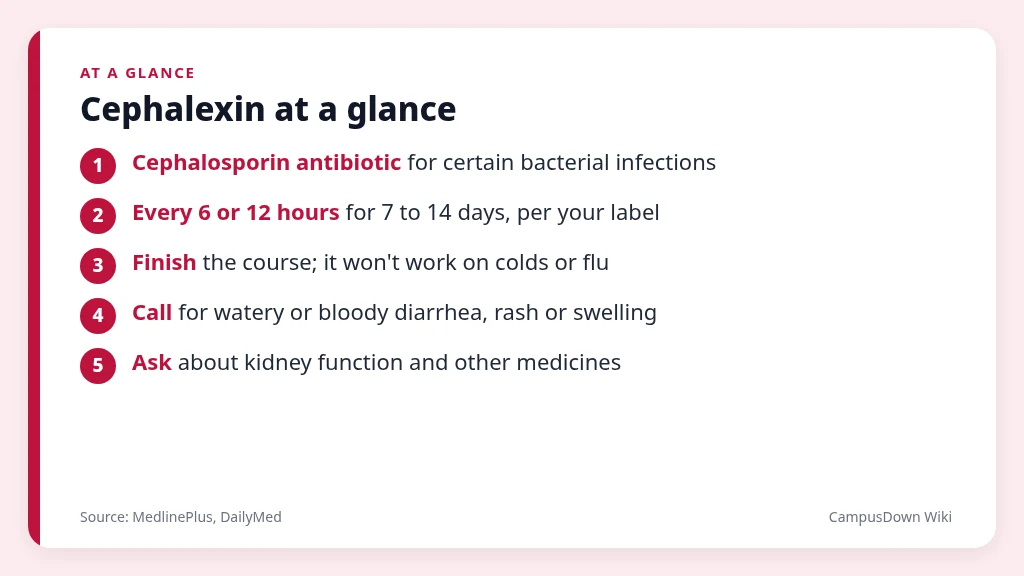
MedlinePlus says cephalexin is in a class of medicines called cephalosporin antibiotics and works by killing bacteria. It is used to treat certain infections caused by bacteria.
A DailyMed label for cephalexin capsules lists these uses:
- Respiratory tract infections
- Ear infections (otitis media)
- Skin and skin structure infections
- Bone infections
- Genitourinary tract infections
The label says it should be used only to treat infections proven or strongly suspected to be caused by susceptible bacteria, because using antibiotics without that is unlikely to help and increases the risk of drug-resistant bacteria. A clinician decides if you need it, usually after examining you and sometimes testing.
Get help now if
Antibiotics such as cephalexin will not work for colds, flu or other viral infections, and using them when they aren't needed increases your risk of an infection later that resists treatment (MedlinePlus). Don't save leftovers for later or share them.

Brand and forms
MedlinePlus lists the brand names Keflex, Keflet, Keftab and Panixine, and notes that these branded products are no longer on the market, with generic alternatives available. Cephalexin comes as a capsule, tablet and liquid suspension. The DailyMed label lists capsules in 250 mg and 500 mg strengths; which one you get depends on your prescription.
How it is taken
- With or without food, every 6 or 12 hours for 7 to 14 days, depending on the condition (MedlinePlus), at about the same times each day.
- Take it exactly as directed; don't take more, less or more often than prescribed. This page doesn't set doses, because they depend on age, kidney function and the infection.
- Shake the liquid well before each use.
- You should begin to feel better in the first few days; if you don't, or you get worse, call your doctor.
- Finish the prescription even if you feel better. Stopping early or skipping doses may leave the infection incompletely treated, and the bacteria may become resistant.
- If you still have symptoms after you finish, call your doctor. Your prescription is probably not refillable.
- A missed dose: take it when you remember unless it's almost time for the next one; don't double up.
- Unless your doctor says otherwise, continue your normal diet.
Tell your doctor or pharmacist first
Per MedlinePlus: your allergies to this or other medicines and what symptoms you had; everything you take, including vitamins, supplements and herbal products; gastrointestinal disease, especially colitis; kidney or liver disease; and pregnancy or breastfeeding. MedlinePlus also says cephalexin may decrease the effectiveness of hormonal birth control, so ask about another method while taking it.
The DailyMed label says to ask about a history of allergy to beta-lactam antibiotics (the penicillin and cephalosporin family) before use, and lists known hypersensitivity to cephalexin or other cephalosporins as a reason not to take it. See also amoxicillin, a penicillin-type antibiotic.
Side effects
Tell your doctor if these are severe or don't go away (MedlinePlus): nausea, vomiting, diarrhea, heartburn, stomach pain, rectal or genital itching, extreme tiredness, agitation, confusion, dizziness, headache and joint pain. The label lists diarrhea, nausea, vomiting, indigestion and abdominal pain as the most common reactions.
Call your doctor immediately or get emergency care for:
- Watery or bloody stools, stomach cramps or fever during treatment or for up to two or more months after stopping
- Rash, itching, hives, swelling of the face, throat, tongue, lips and eyes, difficulty breathing or swallowing, wheezing
- A return of fever, sore throat, chills or other signs of infection
- Hallucinations (seeing things or hearing voices that aren't there)
The late diarrhea warning links to C. diff after antibiotics; see hand hygiene and C. diff for prevention at home. A rash on a medicine needs a clinician, not a guess.
Older adults and kidney function
The DailyMed label says cephalexin is substantially removed by the kidneys, and that toxic reactions may be more likely when kidney function is reduced. Because older adults are more likely to have reduced kidney function, care should be taken in dose selection. It also found no overall differences in safety or effectiveness between participants 65 and over and younger participants in the studies it cites. Learn what your kidney numbers mean in the eGFR guide.
Other medicine and lab cautions on the label
- Metformin: the label says cephalexin may increase metformin levels and to monitor for low blood sugar; see metformin and tell your clinician if you take it.
- Probenecid: not recommended with cephalexin.
- Blood-clotting tests: cephalosporins may be associated with a longer prothrombin time, particularly with kidney or liver problems, poor nutrition, long antibiotic courses or blood thinners.
- Urine glucose tests can show a false positive.
Common questions
- Alcohol: the MedlinePlus page doesn't address alcohol; ask your pharmacist about your situation.
- Side effects in older adults: see the section above; report confusion, hallucinations, severe diarrhea or a new rash promptly.
- 500 mg: this is a capsule strength listed on the label; your prescription sets how many and how often.
Questions for your pharmacist
- How many capsules, how often and for how many days?
- Do my allergies or kidney function matter?
- Do any of my other medicines interact?
- Should I use a backup birth control method?
- Which diarrhea or rash symptoms mean I should call right away?
Example scenario: the red, warm forearm
- Who
- Evangeline, 52, a landscape designer in Boise, Idaho, started antibiotic capsules for a skin infection on her arm and stopped on day four because the redness faded.
- What happened
- A few days later the redness returned and she had watery diarrhea.
- How it felt
- She felt frustrated and worried she'd made things worse.
- What they did
- She called her clinic, which asked about her symptoms and what she'd taken and told her what to do next. She asked the pharmacist how to remember doses and set alarms on her phone.
- How it turned out
- Evangeline said she now treats the finish date as part of the prescription.
This is an illustrative example, not a real patient or a review.
Evangeline's story is an illustrative example. Never restart or stop an antibiotic without guidance from a clinician.
Most-asked questions about cephalexin
What does cephalexin 500mg mean?
The DailyMed label lists 250 mg and 500 mg capsules; your prescription sets how many and how often.
Why people ask: "cephalexin 500mg" is #2 for "cephalexin" (US autocomplete, November 2026).
What is a cephalexin 500 mg capsule?
A capsule strength listed on the label; follow your prescription label for how many and how often.
Why people ask: "cephalexin 500 mg capsule" is #3 for "cephalexin" (US autocomplete, November 2026).
What is cephalexin used for?
Certain bacterial infections; the DailyMed label lists respiratory, ear, skin, bone and genitourinary infections.
Why people ask: "cephalexin uses" is #4 for "cephalexin" (US autocomplete, November 2026).
What are the side effects of cephalexin?
Nausea, vomiting, diarrhea and stomach pain are the most common; watery or bloody diarrhea, rash, swelling or hallucinations need prompt attention.
Why people ask: "cephalexin side effects" is #6 for "cephalexin" (US autocomplete, November 2026).
What is the usual cephalexin 500 schedule?
MedlinePlus says it's taken every 6 or 12 hours for 7 to 14 days depending on the condition; your label sets yours.
Why people ask: "cephalexin 500" is #7 for "cephalexin" (US autocomplete, November 2026).
Can you drink alcohol with cephalexin?
MedlinePlus's page doesn't address alcohol; ask your pharmacist.
Why people ask: "cephalexin and alcohol" is #8 for "cephalexin" (US autocomplete, November 2026).
What is the brand name for cephalexin?
Keflex, Keflet, Keftab and Panixine are listed by MedlinePlus, but those branded products are no longer on the market and generics may be available.
Why people ask: "cephalexin brand name" is #10 for "cephalexin" (US autocomplete, November 2026).
What are cephalexin side effects in the elderly?
The label says older adults are more likely to have reduced kidney function, so dose selection needs care; report confusion, severe diarrhea or rash promptly.
Why people ask: "cephalexin side effects in elderly" is #2 for "cephalexin side effects" (US autocomplete, November 2026).
What are cephalexin side effects in adults?
The same as above: nausea, vomiting, diarrhea and stomach pain are the most common, with serious warnings for severe diarrhea, rash and swelling.
Why people ask: "cephalexin side effects in adults" is #5 for "cephalexin side effects" (US autocomplete, November 2026).
Related on CampusDown
You can learn more about the medicines hub and check it for yourself in the antibiotic resistance guide. For plain amoxicillin in detail, see amoxicillin.
Frequently asked questions
- Should I take it with food?
- MedlinePlus says with or without food.
- How long do I take it?
- MedlinePlus says 7 to 14 days depending on the condition; follow your label.
- Can diarrhea show up after I finish?
- Yes; watery or bloody stools or fever can appear up to two or more months later and need a call.
- Is it a penicillin?
- No; it is a cephalosporin, related to the penicillin family; tell your clinician about penicillin or cephalosporin allergies.
- Does it work for a cold?
- No; antibiotics don't work on viral infections.
Cephalexin is a cephalosporin antibiotic for proven or suspected bacterial infections. Take it on schedule, finish the course, mention allergies, kidney problems and other medicines, and call promptly for severe diarrhea, rash or swelling.
Browse more guides like this in the Medicines hub.
This article is for general education and does not replace advice from your own doctor, nurse or pharmacist.