
Your patient's CVP is 4. Is that low, normal or a problem? Your textbook says one thing, the unit protocol says another, and the preceptor says "it depends." What does it depend on?
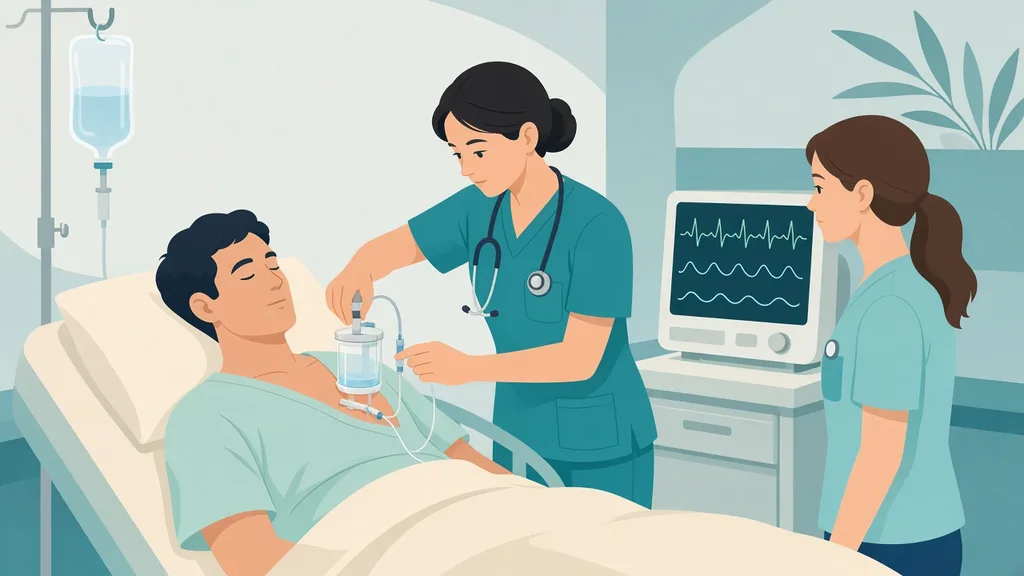
This guide explains central venous pressure the way nursing students need it for exams and the bedside, using OpenStax's Medical-Surgical Nursing (35.2 Cardiovascular Concerns and 23.1 Shock Overview) and a 2024 clinical fluid therapy guideline's chapter on static hemodynamic monitoring. It is a study aid, not orders; your instructor, protocol and the provider decide how CVP is used. If you want to learn more about related pressures, take a closer look at mean arterial pressure.
What CVP is
OpenStax's critical care chapter says right atrial pressure and central venous pressure are interchangeable terms that reflect the pressure of the blood volume in the right side of the heart at the end of diastole. It is measured through a central venous catheter, and OpenStax's shock chapter calls it a measure of the adequacy of blood volume within the vascular system. The fluid therapy guideline adds that CVP is chiefly an indicator of right ventricular preload and, to a lesser extent, left ventricular preload.

The normal range, and why sources differ
This is where students get tripped up.
| Source | CVP range given |
|---|---|
| OpenStax Med-Surg 35.2 (critical care table) | 2 to 6 mmHg |
| OpenStax Med-Surg 23.1 (shock overview) | 8 to 12 mmHg |
| Fluid therapy guideline (2024) | 2 to 6 mmHg with a transducer, or 3 to 10 cm H2O with a water manometer |
| Teaching resource on measuring CVP (CETL, 2008) | 5 to 10 cm H2O (2 to 6 mmHg) |
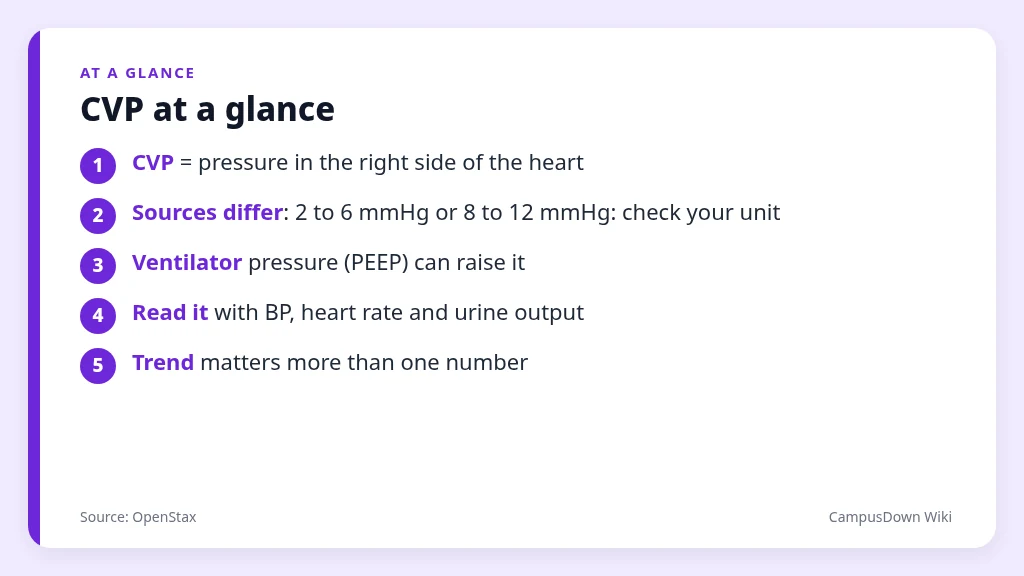
Why the gap? OpenStax doesn't explain it. The 2 to 6 mmHg range is the commonly listed resting value, while the 8 to 12 mmHg figure appears in the shock chapter, and the fluid therapy guideline separately calls 8 to 12 mmHg a reasonable target while fluids are being given when no better predictor is available. Units matter too: mmHg and cm H2O are not the same number (one mmHg is roughly 1.36 cm H2O). Always check the unit and your facility's reference range. For exams, learn the range your instructor teaches.
CVP on a ventilator
The fluid therapy guideline says that in patients on a mechanical ventilator, CVP rises with positive end-expiratory pressure (PEEP): roughly a 5 cm H2O increase in PEEP raises CVP by about 2.5 cm H2O. So a CVP in a ventilated patient isn't comparable to a spontaneously breathing patient's number without considering ventilator settings. Ask which ventilator settings apply and whether your unit has a standard point in the breathing cycle for reading.
How it is measured
- It requires a central venous catheter.
- The CETL teaching resource says CVP is usually recorded at the mid-axillary line at the fourth intercostal space (the phlebostatic axis), with the manometer arm or transducer level with that point so the reading is as close to the right atrium as possible.
- It describes more frequent readings, such as hourly, for critically ill, unstable patients, with the frequency set by condition and treatment.
- Position and technique should be consistent so changes reflect the patient, not the setup. Follow your facility's leveling and zeroing procedure.
What low and high values suggest
The fluid therapy guideline lists:
- Low CVP: true hypovolemia (blood loss, fluid loss or fluid shifts) or relative hypovolemia from widened blood vessels, as in spinal anesthesia, sepsis and anaphylaxis.
- High CVP: volume overload; cardiac causes such as heart failure, cardiac tamponade, constrictive pericarditis and tricuspid regurgitation; and pulmonary causes such as pulmonary embolism, pulmonary hypertension, tension pneumothorax, COPD and positive pressure ventilation.
OpenStax's shock chapter lists a decreased CVP as an effect of shock states, alongside decreased cardiac output and decreased MAP. See types of shock, sepsis recognition and fluid volume excess and deficit.
Limits of a single number
The guideline's key points:
- A single CVP value does not manage a patient; it is interpreted with the clinical situation.
- A normal CVP does not rule out volume depletion.
- CVP measurement can be unreliable in pulmonary vascular disease, right ventricular disease, heart failure, valve disease, tense ascites and high abdominal pressure.
- Recent literature found a poor relationship between CVP and blood volume, and the guideline says using CVP alone as a marker of fluid responsiveness is not recommended; extreme values and trends are more useful than a mid-range number.
So pair it with blood pressure, heart rate, urine output, skin signs, lung sounds and the patient's response to treatment. OpenStax's critical care case shows a patient whose blood pressure fell while CVP rose, a reminder that numbers only matter in combination.
Nursing monitoring (student view)
- Know the ordered parameters and the reference range for your unit.
- Level and read consistently, and document the unit (mmHg or cm H2O).
- Trend readings with vital signs, intake and output, and weights; see daily weights.
- Report significant changes and symptoms using a structured format.
- Protect the central line and follow policy for dressing and infection prevention.
- Understand that fluids given for a low CVP are medications with risks; see IV fluid types and high-alert medications.
Study tips
- Memorize: CVP = right atrial pressure = right-sided preload.
- Write the range your instructor uses, with its unit.
- Link low CVP to hypovolemia and high CVP to overload, right heart failure and tamponade.
- Remember that PEEP raises CVP.
- Practice a one-line report: "CVP is X in the usual unit, BP is Y and urine output is Z."
Questions for your instructor
- Which CVP reference range and unit do we use?
- How do we level and read the transducer on this unit?
- How should ventilator settings change how I read CVP?
- Which readings should I report immediately?
- How does CVP appear on exams versus in practice?
Example scenario: the number that didn't match
- Who
- Tabitha, 24, a nursing student in Madison, Wisconsin, recorded a CVP that looked low and was ready to tell her preceptor the patient needed fluid.
- What happened
- Her preceptor asked what the blood pressure, urine output and ventilator settings were.
- How it felt
- She felt flustered and a little exposed.
- What they did
- She stopped, checked the transducer position and the other numbers, and reported all of them together to the nurse, who decided the next step. Tabitha now writes the reading, the unit and two other numbers on her notes.
- How it turned out
- Tabitha said she learned to treat CVP as one voice in a conversation.
This is an illustrative example, not a real patient or a review.
Tabitha's story is an illustrative example. Real care follows your instructor, your facility and the provider's orders.
Most-asked questions about CVP
What is the normal CVP range for a ventilated patient?
Ranges are usually given for spontaneous breathing; on a ventilator, PEEP raises CVP, so interpret it with settings and your unit's guidance.
Why people ask: "cvp normal range in ventilated patient" is #2 for "cvp normal range" (US autocomplete, November 2026).
What is the normal CVP range in mmHg?
OpenStax's critical care table and a fluid therapy guideline list 2 to 6 mmHg; OpenStax's shock chapter lists 8 to 12 mmHg.
Why people ask: "cvp normal range in mmhg" is #3 for "cvp normal range" (US autocomplete, November 2026).
What is the CVP normal range on a ventilator?
PEEP raises CVP (about 2.5 cm H2O for each 5 cm H2O of PEEP per one guideline), so check your unit's reference.
Why people ask: "cvp normal range ventilator" is #4 for "cvp normal range" (US autocomplete, November 2026).
How is CVP measured?
Through a central venous catheter with the transducer or manometer level at the phlebostatic axis (mid-axillary, fourth intercostal space).
Why people ask: "cvp normal range how to measure" is #5 for "cvp normal range" (US autocomplete, November 2026).
What is the normal CVP in cm?
A water manometer range of 3 to 10 cm H2O is given in a fluid therapy guideline, and 5 to 10 cm H2O in a teaching resource.
Why people ask: "cvp normal range in cm" is #7 for "cvp normal range" (US autocomplete, November 2026).
What is the normal CVP range for an adult?
Textbook values are 2 to 6 mmHg (some sources 8 to 12 mmHg in shock contexts); use your instructor's and facility's range.
Why people ask: "cvp normal range adult" is #8 for "cvp normal range" (US autocomplete, November 2026).
What is the normal CVP in cm H2O?
A fluid therapy guideline gives 3 to 10 cm H2O; a teaching resource gives 5 to 10 cm H2O.
Why people ask: "cvp normal range in cm h2o" is #9 for "cvp normal range" (US autocomplete, November 2026).
What are the nursing responsibilities for CVP monitoring?
Level and read consistently, document the unit, trend with other vital signs and urine output, report changes and protect the line.
Why people ask: "cvp monitoring nursing responsibilities" is #3 for "cvp measurement nursing" (US autocomplete, November 2026).
What is CVP in nursing?
The pressure in the right side of the heart (right atrial pressure), read through a central line as a clue to blood volume and right-sided preload.
Why people ask: "what is cvp in nursing" is #6 for "cvp measurement nursing" (US autocomplete, November 2026).
Related on CampusDown
You can learn more about the nursing student hub and check it for yourself in the shock types guide. For fluid status in detail, see fluid volume excess and deficit.
Frequently asked questions
- Is CVP the same as right atrial pressure?
- OpenStax lists them as interchangeable terms.
- Does PEEP change CVP?
- Yes; a fluid therapy guideline says CVP rises with positive end-expiratory pressure.
- Can a normal CVP rule out low volume?
- No; a normal CVP does not exclude volume depletion.
- Where is the transducer leveled?
- At the phlebostatic axis, per a teaching resource: mid-axillary line, fourth intercostal space.
- What should I pair CVP with?
- Blood pressure, heart rate, urine output and the patient's clinical response.
CVP is right-sided preload read through a central line. Know your range and unit, level consistently, remember the ventilator effect and always read the number with blood pressure, urine output and the whole patient.
Browse more guides like this in the Nursing Student and NCLEX hub.
This article is for general education and does not replace advice from your own doctor, nurse or pharmacist.
References
- OpenStax: Medical-Surgical Nursing, 35.2 Cardiovascular Concerns
- OpenStax: Medical-Surgical Nursing, 23.1 Shock Overview
- Pandya S.: Static Hemodynamic Monitoring Techniques, 2024 Practical Guidelines on Fluid Therapy, Chapter 17
- Cole E.: Measuring central venous pressure (CETL, City University London, 2008)