
Your dermatologist says the next step for stubborn eczema is a biologic, and the box in your hands says Dupixent. What is it, how does the pen work, and what should you watch for after the first shot?

This guide uses MedlinePlus's drug information on dupilumab injection (revised August 2025) to explain the basics. It is general information, not a prescription; your doctor and pharmacist decide whether this medicine is right for you and how often you use it. If you want to learn more about the skin condition behind many prescriptions, take a closer look at atopic dermatitis (eczema).
What it is
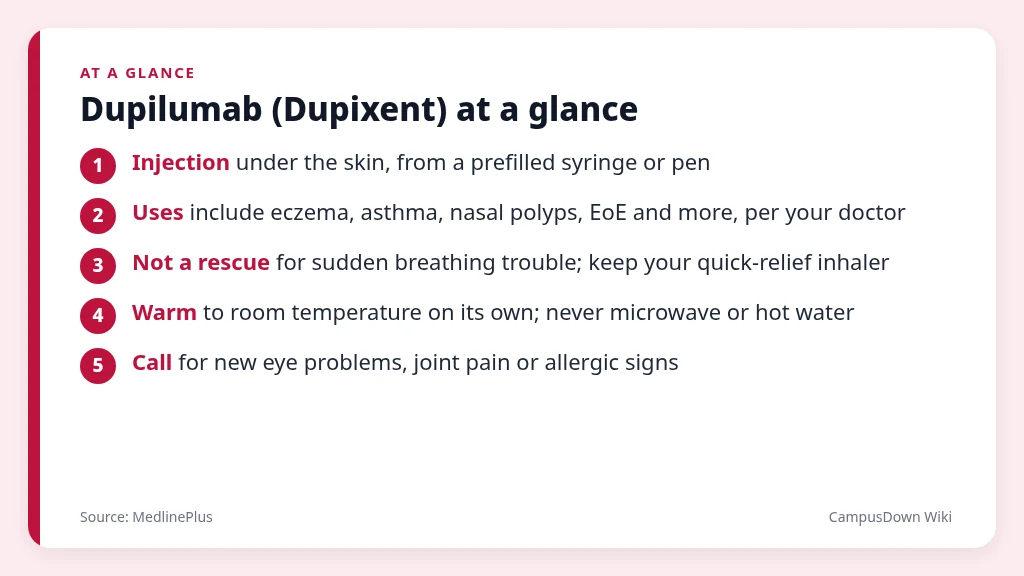
MedlinePlus lists the brand name Dupixent and describes dupilumab injection as belonging to a class called monoclonal antibodies. It works by stopping the action of certain substances in the body that cause inflammation. Because it is an antibody medicine given by injection, it is not a pill and not a cream.

What it treats
MedlinePlus says dupilumab injection is used to treat:
- Eczema (atopic dermatitis), a skin disease with dry, itchy skin and red, scaly rashes
- Asthma
- Chronic rhinosinusitis with nasal polyps
- Eosinophilic esophagitis (EoE), where certain blood cells build up in and damage the esophagus
- Prurigo nodularis, crusty lumps with severe itching
- Certain types of COPD
- Chronic spontaneous urticaria, hives that last longer than 6 weeks without a known trigger
- Bullous pemphigoid, a blistering skin condition
Which of these applies to you, and at what age, is your prescriber's decision. MedlinePlus says dosing depends on your condition, age, and weight (for children), and your doctor will tell you how often to use it. Dose amounts aren't listed on the page, so this article doesn't list any; follow your prescription label and the manufacturer's patient information.
How the prefilled syringe or pen is used
MedlinePlus says it comes as a prefilled syringe and a prefilled pen to inject subcutaneously (under the skin). Key points from the page:
- Use exactly as directed. Don't inject more or less, or more often, than prescribed.
- You may get your first dose in your doctor's office. After that, you may be allowed to inject at home. Ask your doctor or pharmacist to show you or your caregiver how.
- Use each syringe and pen only once and dispose of them in a puncture-resistant container; ask your pharmacist about disposing of the container.
- If it was refrigerated, place it on a flat surface and let it warm to room temperature on its own. Don't use a microwave, hot water or any other method to warm it.
- Leave the cap on until you are ready to inject, and don't put it back on.
- Don't shake it. Don't use it if you dropped it or it is cracked or broken.
- Look at the liquid first. Check the expiration date; the liquid should be clear and colorless or slightly yellow with no visible particles. Don't use it if it is expired, frozen, cloudy or contains small particles.
Get help now if
Never use a syringe or pen that was dropped, cracked, frozen, expired, cloudy or has particles in it. Ask your pharmacist for a replacement.
Where to inject
MedlinePlus says you can inject anywhere on the front of your thighs or your stomach, except your navel and the area 2 inches (5 centimeters) around it. If a caregiver gives it, the back of the upper arm may also be used. Use a different site for each injection to reduce soreness or redness, and avoid skin that is tender, bruised, red, hard, scarred or has stretch marks.
Keep your other treatments
MedlinePlus says to continue to take or use all other medications your doctor prescribed and not to stop or change them unless your doctor says so. It also says dupilumab injection is not used to treat sudden breathing problems. Your doctor will prescribe a short-acting inhaler for sudden symptoms, and you should talk to your doctor about how to treat them. If your asthma or COPD symptoms get worse, or breathing problems happen more often, talk to your doctor. For quick-relief inhaler basics, see albuterol inhaler and AeroChamber spacer.
Before you start: what to tell your care team
MedlinePlus lists these items to mention:
- Allergies to the drug, any part of it, or other drugs, foods or substances
- All medicines, vitamins and supplements you use
- Eye problems
- Herpes infections such as shingles or genital herpes
- Worm infections (hookworm, roundworm, whipworm, threadworm)
- Asthma, if you are using dupilumab for eczema, nasal polyps, EoE, prurigo nodularis, hives or bullous pemphigoid
- Pregnancy, plans to become pregnant or breastfeeding
- Vaccines: ask first; don't have any vaccination during treatment without talking to your doctor
Side effects to know
MedlinePlus says to tell your doctor if these are severe or don't go away: redness or pain at the injection site; sore throat, runny nose, cough, fever or other signs of infection; mouth or lip sores; toothache; trouble sleeping; dizziness; diarrhea; muscle pain; headache.
Call your doctor immediately or get emergency care for:
- New or worsening eye problems, including eye pain, blurred vision, pink or red eyes, red or swollen eyelids, or vision changes
- Rash, shortness of breath, fever, chest pain, brown or dark urine, pins and needles or numbness in the arms or legs
- New or worsening joint pain
- New or worsening skin problems
Stop using it and call right away or get emergency care for swelling of the face, eyelids, tongue or throat; swollen lymph nodes; trouble swallowing or breathing; tightness in the chest or throat; fast heartbeat; fainting or lightheadedness; rash, hives or itching; flat, firm, hot, red and painful skin lumps; or nausea, vomiting, stomach cramps or fever. You or your doctor may report side effects to the FDA MedWatch program.
Missed doses and storage
MedlinePlus says that for a dose given every 2 or 4 weeks, inject the missed dose as soon as you remember and resume your schedule, but if it has been more than 7 days after the missed dose, skip it and continue as usual. For a once-a-week schedule, inject the missed dose when you remember and start a new weekly schedule from that date. Don't double up. Call your doctor if you have questions.
For storage, MedlinePlus says to keep it in the original container, tightly closed. Store it in the refrigerator or at room temperature for up to 14 days; do not freeze, and keep syringes and pens in their cartons to protect them from light. Use a take-back program for unneeded medicine.
Questions for your doctor or pharmacist
- Which condition am I treating, and how will we know it is working?
- Who will show me how to inject, and can I practice with a trainer?
- How often is my schedule, and what do I do if I miss one?
- Should I have an eye exam first, or sooner if I notice changes?
- What should I use if my breathing suddenly gets worse?
- Do I need any vaccines before or during treatment?
Example scenario: the first pen at home
- Who
- Rhiannon, 34, a bookkeeper in Albany, New York, had her first Dupixent dose in the clinic and was sent home with a prefilled pen for the next one.
- What happened
- She worried she would freeze up or do it wrong with nobody watching.
- How it felt
- She felt anxious and a little embarrassed.
- What they did
- She called the pharmacist, who walked her through the steps and reminded her to let the pen warm on the counter instead of heating it; she wrote the injection date on her calendar and made a note to report any eye changes. Rhiannon rotated the injection spot each time and kept her quick-relief inhaler within reach.
- How it turned out
- Rhiannon said having the steps explained out loud made the pen feel less scary.
This is an illustrative example, not a real patient or a review.
Rhiannon's story is an illustrative example. Call your doctor for new eye problems, joint pain or new skin problems, and call 911 for swelling of the face or throat, trouble breathing or fainting.
Most-asked questions about Dupixent
What does Dupixent treat?
MedlinePlus lists eczema, asthma, chronic rhinosinusitis with nasal polyps, eosinophilic esophagitis, prurigo nodularis, certain types of COPD, chronic spontaneous urticaria and bullous pemphigoid.
Why people ask: "dupixent uses" is #6 for "dupixent" (US autocomplete, November 2026).
How is the Dupixent injection given?
Under the skin from a prefilled syringe or pen, in the front of the thighs or stomach (not within 2 inches of the navel); a caregiver may also use the back of the upper arm.
Why people ask: "dupixent injection" is #3 for "dupixent" (US autocomplete, November 2026).
Is Dupixent used for eczema?
Yes; MedlinePlus lists eczema (atopic dermatitis) first among its uses, and your doctor decides if it fits you.
Why people ask: "dupixent for eczema" is #8 for "dupixent" (US autocomplete, November 2026).
What is the Dupixent dosing?
It depends on your condition, age and weight (for children); MedlinePlus doesn't list amounts, so follow your label and ask your doctor.
Why people ask: "dupixent dosing" is #9 for "dupixent" (US autocomplete, November 2026).
Is Dupixent used for EoE?
MedlinePlus lists eosinophilic esophagitis (EoE) among its uses; your gastroenterologist or allergist decides if it applies.
Why people ask: "dupixent for eoe" is #10 for "dupixent" (US autocomplete, November 2026).
What are the Dupixent side effects on the skin?
MedlinePlus lists redness or pain at the injection site as a common effect and says to call right away for any new or worsening skin problem or hives, rash or itching.
Why people ask: "dupixent side effects skin" is #7 for "dupixent side effects" (US autocomplete, November 2026).
What can happen after the first dose?
MedlinePlus doesn't describe a first-dose pattern, but it says the first dose may be given in your doctor's office, and serious allergic signs such as facial swelling or trouble breathing need emergency care.
Why people ask: "dupixent side effects after first dose" is #8 for "dupixent side effects" (US autocomplete, November 2026).
What are the long-term Dupixent side effects?
MedlinePlus doesn't address long-term effects separately; keep your appointments and report new eye problems, joint pain or new skin problems promptly.
Why people ask: "dupixent side effects long term" is #5 for "dupixent side effects" (US autocomplete, November 2026).
Does Dupixent cause cancer or weight gain?
Neither is listed on the MedlinePlus page; if you are worried, ask your doctor to review the full prescribing information with you.
Why people ask: "dupixent side effects cancer" is #4 for "dupixent side effects" (US autocomplete, November 2026).
Are Dupixent side effects different in children?
MedlinePlus says dosing for children depends on weight but doesn't list child-specific side effects; ask your child's prescriber.
Why people ask: "dupixent side effects in children" is #3 for "dupixent side effects" (US autocomplete, November 2026).
Related on CampusDown
You can learn more about the medicines hub and check it for yourself in a brown bag medication review. For nursing teaching on inhalers and controllers in detail, see asthma medicines for nursing students, and for another allergy-related condition see alpha-gal syndrome. For the airway disease itself, read the asthma overview.
Frequently asked questions
- Is Dupixent a steroid?
- MedlinePlus describes it as a monoclonal antibody that stops the action of certain substances that cause inflammation, not as a steroid.
- Can I stop my other medicines once I start it?
- No; MedlinePlus says to keep using your other prescribed medicines unless your doctor tells you otherwise.
- Can I use it for a sudden asthma attack?
- No; it is not used for sudden breathing problems. Use the short-acting inhaler your doctor prescribed and get emergency help if needed.
- Can I warm the pen in hot water?
- No; let it come to room temperature on a flat surface without a microwave, hot water or other heating method.
- What if I miss a dose?
- Inject it as soon as you remember and resume your schedule, but skip it if it has been more than 7 days after a dose given every 2 or 4 weeks; call your doctor with questions.
Dupilumab (Dupixent) is an injectable monoclonal antibody for several allergic and inflammatory conditions. Follow your prescriber's schedule, let the pen warm up on its own, rotate sites, keep your rescue inhaler and other medicines, and call promptly for new eye problems, joint pain, skin problems or allergic signs.
Browse more guides like this in the Medicines hub.
This article is for general education and does not replace advice from your own doctor, nurse or pharmacist.