
A patient's lithium level comes back at 1.6 mEq/L and the nurse asks what you'd check first. Is that "a little high," or the start of toxicity?

This guide uses OpenStax Pharmacology (section 13.3, Mood Stabilizers) and MedlinePlus's lithium drug information (revised April 2017). It is for education only. Follow your instructor, facility policy and the provider's orders; lab ranges and timing vary by facility. If you want to learn more about electrolytes that interact with lithium, take a closer look at sodium normal range for nursing.
What lithium is
OpenStax calls lithium a naturally occurring metallic salt used mainly to treat and prevent mania, historically the "gold standard" mood stabilizer. MedlinePlus says it is used to treat and prevent episodes of mania in bipolar disorder and is in a class called antimanic agents. It also says lithium may help control the condition but is not a one-time fix, and that it may take 1 to 3 weeks or longer to feel the full benefit.

The key idea: a narrow margin of safety
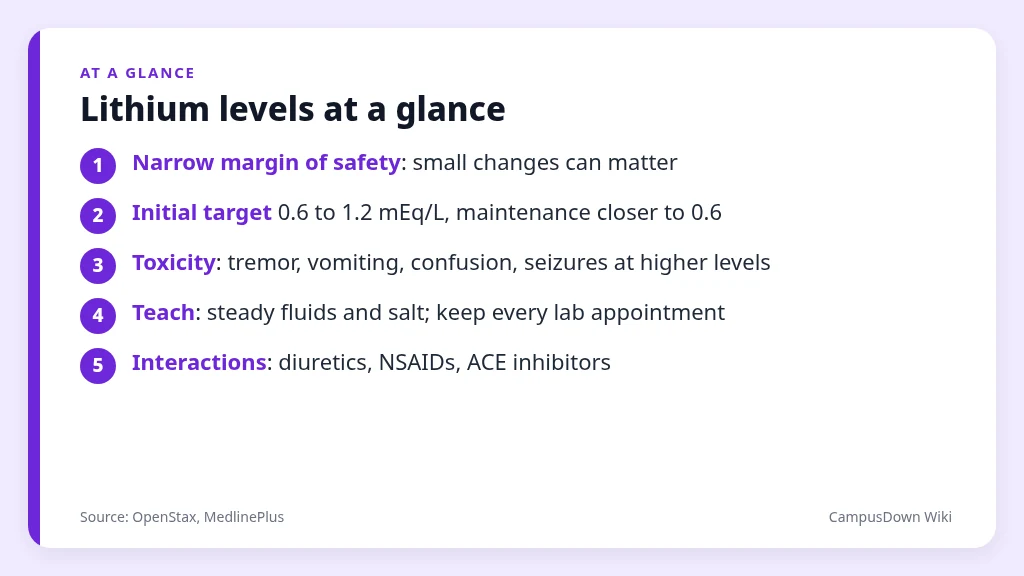
OpenStax says lithium has a narrow margin of safety; even small increases in the dose could be toxic. The goal is initially to maintain a serum lithium level between 0.6 and 1.2 mEq/L; target maintenance levels are closer to 0.6 mEq/L. Your facility's protocol gives exact ranges and when to draw. OpenStax's teaching list says the morning dose is held until blood is drawn, with the draw timed relative to the last dose (about 12 hours after in the teaching list); check your facility's rule.
Toxicity levels and signs (OpenStax Table 13.16)
| Serum level | What may be seen |
|---|---|
| 1.5 to 2.5 mEq/L | Lethargy, tremors, nausea and vomiting |
| 2.5 to 3.5 mEq/L | Confusion, agitation, delirium, tachycardia, hypertonia |
| Above 3.5 mEq/L | Coma, seizures, hyperthermia, hypotension |
MedlinePlus lists patient-facing warning signs: stop taking lithium and call your doctor immediately for drowsiness, uncontrollable shaking, muscle weakness, stiffness or twitching, loss of coordination, diarrhea, vomiting, slurred speech, giddiness, ringing in the ears or blurred vision. Report confusion, hallucinations, fainting, seizures, an irregular or pounding heartbeat or excessive thirst and frequent urination too.
Get help now if
Vomiting, diarrhea, shaking, slurred speech, confusion, fainting or seizures in a person taking lithium need urgent medical attention. Call the prescriber right away or 911.
Why sodium and kidneys matter
OpenStax says lithium is excreted through the kidneys unchanged, so adequate renal function is essential, and because lithium is tied to sodium resorption, any drug that affects sodium balance may alter lithium concentrations, leading to treatment failure or toxicity. Examples: diuretics, NSAIDs and ACE inhibitors. See furosemide, lisinopril and eGFR and kidney function. Addison's disease is a contraindication because the kidneys reabsorb lithium when sodium is lost. Other OpenStax interactions: carbamazepine (CNS toxicity), neuromuscular blocking agents (prolonged effects) and other serotonergic drugs (serotonin syndrome). Theophylline increases renal excretion of lithium, giving subtherapeutic effects. Lithium inhibits thyroid hormone synthesis and release and can cause hypothyroidism.
MedlinePlus adds that the nonprescription products sodium bicarbonate and NSAIDs such as ibuprofen (Advil, Motrin) and naproxen (Aleve) may interact, and that severe diarrhea, excessive sweating or fever need a call to the doctor.
Nursing implications from OpenStax
- Baseline and periodic labs: lithium level, CBC, electrolytes, liver function and thyroid (TSH)
- History and baseline ECG before starting
- Assess for suicidal ideation
- Monitor renal function
- Safety measures for CNS effects such as drowsiness and tremor
Patient teaching points
- Drink 8 to 12 glasses of water daily and keep sodium intake consistent; MedlinePlus says to follow the right amounts of fluid and salt your doctor gives you
- Take with food if it upsets the stomach
- Continue even if you feel well; don't stop abruptly
- Keep every lab appointment; MedlinePlus says your doctor will order tests to check your response
- Avoid dehydration and heavy exercise in hot weather; avoid sunburn
- Talk to the doctor before starting any new medicine, including NSAIDs
- Tell the prescriber about pregnancy plans
- Ask about caffeine: MedlinePlus says to talk to your doctor about tea, coffee, cola and chocolate milk
Questions to ask your instructor or pharmacist
- What is our facility's target range and draw timing?
- Which medicines on this patient's list change lithium levels?
- When do we hold a dose and call the provider?
- How do we handle dehydration or vomiting in a patient on lithium?
- What teaching do patients get in writing?
Example scenario: the quiet bedside question
- Who
- Maxwell, 24, a nursing student in Columbus, Ohio, was caring for a patient on lithium whose level returned slightly above the range with new hand tremor and mild nausea.
- What happened
- He wasn't sure whether to wait for the next draw.
- How it felt
- He felt anxious and worried about missing something.
- What they did
- He told his nurse right away, and they notified the provider, held the next dose until instructed and checked the patient's fluids, sodium and medicine list, including a new NSAID the patient had started. Maxwell wrote down what he saw and what was done.
- How it turned out
- Maxwell said speaking up early was the lesson that stuck.
This is an illustrative example, not a real patient or a review.
Maxwell's story is an illustrative example. Always follow your instructor, facility policy and the provider's orders.
Most-asked questions about lithium levels
What are normal lithium levels in nursing?
OpenStax gives an initial goal of 0.6 to 1.2 mEq/L, with maintenance closer to 0.6; your facility and prescriber set exact targets.
Why people ask: "normal lithium levels nursing" is #2 for "lithium levels nursing" (US autocomplete, November 2026).
What are the toxicity levels for lithium?
OpenStax lists 1.5 to 2.5 mEq/L for lethargy, tremors, nausea and vomiting, 2.5 to 3.5 for confusion, agitation, delirium and tachycardia, and above 3.5 for coma and seizures.
Why people ask: "lithium toxicity levels nursing" is #3 for "lithium levels nursing" (US autocomplete, November 2026).
What are the lithium level guidelines?
Use your facility's protocol and the provider's orders; OpenStax and MedlinePlus support baseline and periodic lab monitoring.
Why people ask: "lithium level guidelines" is #4 for "lithium levels nursing" (US autocomplete, November 2026).
What is a lithium level protocol?
Protocols are set by each facility; OpenStax says to hold the morning dose until blood is drawn and to monitor renal function and electrolytes.
Why people ask: "lithium level protocol" is #5 for "lithium levels nursing" (US autocomplete, November 2026).
What do low lithium levels while taking lithium mean?
OpenStax says drugs that change sodium balance or increase lithium excretion (such as theophylline) can lead to treatment failure or subtherapeutic effects; talk to the prescriber.
Why people ask: "low lithium levels while taking lithium" is #7 for "lithium levels nursing" (US autocomplete, November 2026).
Does caffeine affect lithium levels?
MedlinePlus says to talk to your doctor about caffeine drinks; the sources don't give details.
Why people ask: "does caffeine affect lithium levels" is #8 for "lithium levels nursing" (US autocomplete, November 2026).
What are lithium toxicity symptoms for nursing?
Tremor, lethargy, nausea and vomiting at lower toxic levels; confusion and tachycardia higher; seizures and coma highest.
Why people ask: "lithium toxicity symptoms nursing" is #2 for "lithium toxicity symptoms" (US autocomplete, November 2026).
What are the signs of lithium toxicity?
Drowsiness, shaking, muscle weakness, loss of coordination, diarrhea, vomiting and slurred speech, per MedlinePlus.
Why people ask: "lithium toxicity symptoms and signs" is #3 for "lithium toxicity symptoms" (US autocomplete, November 2026).
Is there a mnemonic for lithium toxicity?
The sources here don't give one; your instructor may have a favorite, but learn the level-to-sign table.
Why people ask: "lithium toxicity symptoms mnemonic" is #5 for "lithium toxicity symptoms" (US autocomplete, November 2026).
How does lithium toxicity show up on the NCLEX?
We can't say what any exam asks; focus on the narrow margin of safety, sodium and fluids, interactions and the toxicity table.
Why people ask: "lithium toxicity symptoms nclex" is #6 for "lithium toxicity symptoms" (US autocomplete, November 2026).
What is the list of lithium toxicity symptoms?
See the table above and MedlinePlus's list: drowsiness, uncontrollable shaking, weakness, loss of coordination, diarrhea, vomiting, slurred speech and blurred vision.
Why people ask: "lithium toxicity symptoms list" is #8 for "lithium toxicity symptoms" (US autocomplete, November 2026).
What is the treatment for lithium toxicity?
The sources here don't detail treatment; stop-and-call is the patient instruction, and care follows the provider's orders in a facility.
Why people ask: "lithium toxicity symptoms and treatment" is #9 for "lithium toxicity symptoms" (US autocomplete, November 2026).
Related on CampusDown
You can learn more about the nursing student hub and check it for yourself in sodium normal range for nursing. For mental status changes in detail, see delirium in the hospital, and for another long-term mood medicine topic see depression in older adults.
Frequently asked questions
- What is the usual target range?
- OpenStax gives an initial goal of 0.6 to 1.2 mEq/L, with maintenance closer to 0.6; your facility sets exact targets.
- Which drugs raise lithium levels?
- OpenStax names diuretics, NSAIDs and ACE inhibitors as drugs that alter sodium balance and lithium concentrations.
- Why keep salt and fluids steady?
- Lithium is tied to sodium resorption and cleared by the kidneys, so changes can alter levels.
- Should patients stop lithium if they feel well?
- No; MedlinePlus says to continue unless the doctor says otherwise.
- When should I call?
- For drowsiness, shaking, weakness, loss of coordination, diarrhea, vomiting or slurred speech, per MedlinePlus.
Lithium works within a narrow margin of safety. Know the 0.6 to 1.2 mEq/L initial target, the toxicity table, the sodium-and-kidney link, the interacting drugs, the lab schedule and the teaching points, and escalate quickly when signs appear.
Browse more guides like this in the Nursing Student and NCLEX hub.
This article is for general education and does not replace advice from your own doctor, nurse or pharmacist.