
You started running again and now your shins ache every time your foot hits the ground. Is it shin splints, or something that needs a scan?
This guide uses OrthoInfo's page "Shin Splints" from the American Academy of Orthopaedic Surgeons (AAOS). It is general information, not a diagnosis; a clinician should examine pain that doesn't improve. If you want to learn more about another overuse injury, take a closer look at Achilles tendinitis.
What shin splints are
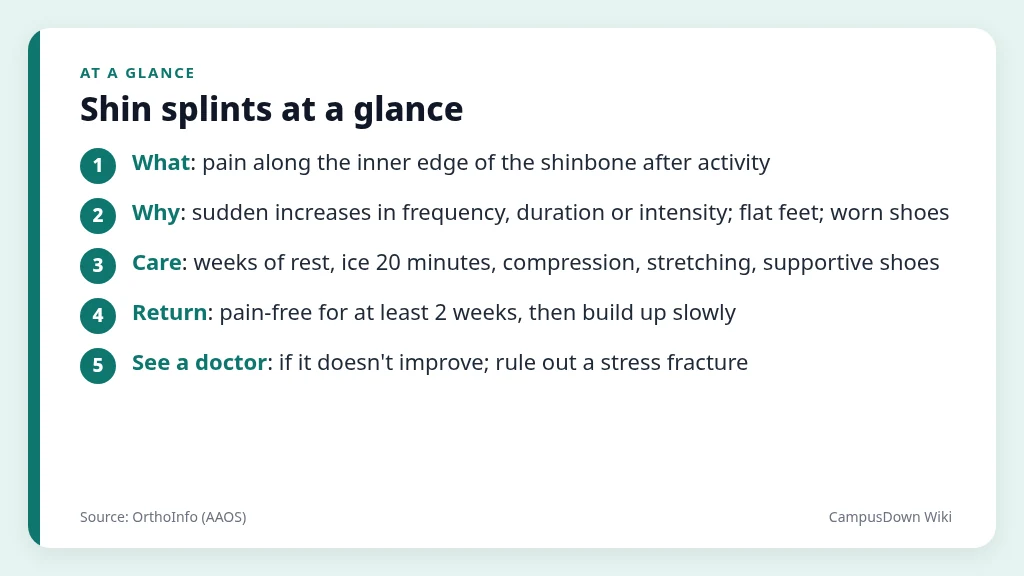
OrthoInfo says shin splints refers to pain along the inner edge of the shinbone (tibia), typically developing after physical activity and often associated with running, especially if you are just starting a fitness program. It describes medial tibial stress syndrome as inflammation of the muscles, tendons and bone tissue around the tibia, where muscles attach to the bone.

Causes and risk factors
OrthoInfo says shin splints develop when the muscle and bone tissue in the leg become overworked by repetitive activity, often after sudden changes in:
- Frequency: adding exercise days.
- Duration: running longer distances.
- Intensity: adding hills after flat running.
Flat feet or abnormally rigid arches, and exercising with improper or worn-out footwear also contribute. Runners have the highest risk; dancers and military recruits are also frequently diagnosed.
Symptoms
OrthoInfo says the most common symptom is pain along the border of the tibia, with mild swelling possible. The pain may be sharp and razor-like or dull and throbbing, occur during and after exercise and be aggravated by touching the sore spot.
Other causes of shin pain
OrthoInfo says your doctor may order imaging to rule out other problems, including a stress fracture (a small crack in the tibia, shown by bone scan or MRI), tendinitis, and chronic exertional compartment syndrome (an uncommon condition where pressure within the muscles builds during exercise and pain usually goes away soon after activity stops). If shin splints are not responsive to treatment, your doctor may check for a stress fracture. See osteoarthritis for joint pain that is different from overuse injuries.
Treatment
OrthoInfo lists nonsurgical care:
- Rest: standard care includes several weeks of rest from the activity that caused the pain, with lower-impact substitutes such as swimming, a stationary bike or an elliptical trainer.
- NSAIDs such as ibuprofen, aspirin and naproxen reduce pain and swelling; ask a pharmacist what suits you.
- Ice: cold packs for 20 minutes at a time, several times a day, not directly on the skin.
- Compression with an elastic bandage may prevent additional swelling. See compression socks for how compression is measured.
- Flexibility exercises: stretching the lower leg muscles may help.
- Supportive shoes with good cushioning, and orthotics for flat feet or recurrent shin splints (custom or off the shelf).
Returning to exercise
OrthoInfo says before returning to exercise you should be pain-free for at least 2 weeks, and you should not exercise as often, as long or as intensely as before the injury. Warm up and stretch thoroughly, increase training slowly, and if the same pain returns, stop, use a cold pack and rest for a day or two, then return for shorter periods at lower intensity with more rest between workouts.
Prevention
OrthoInfo advises a properly fitting athletic shoe designed for your sport (it describes a "wet test" to see your foot's shape), cross training by alternating jogging with swimming or cycling, and going gradually with any barefoot running. It says there is no clear evidence that barefoot running reduces the risk of any injury.
Get help now if
OrthoInfo says if shin splints do not improve after rest and other methods, see a doctor to determine whether something else is causing your leg pain.
Questions for your doctor
- Does my pain look like shin splints, or should we check for a stress fracture?
- Would orthotics or different shoes help my foot type?
- Which low-impact activities can I do in the meantime?
- How should I build back my training?
Example scenario: the new running plan
- Who
- Radcliffe, 39, an accountant in Boise, Idaho, joined a running group and went from two to five days a week.
- What happened
- His shins began to ache on the inside edge, and the pain lingered after each run.
- How it felt
- He worried he would have to quit running altogether.
- What they did
- He rested from running and cycled instead, wore cushioned shoes, and asked a clinician whether he needed a scan, which was recommended if pain continued. Radcliffe was pain-free for two weeks before building back slowly, and he was told to call if the pain returned.
- How it turned out
- Radcliffe said the slower build-up was what finally helped.
This is an illustrative example, not a real patient or a review.
Radcliffe's story is an illustrative example. Your own plan depends on your exam.
Most-asked questions about shin splints
What causes shin splints?
Overworked muscle and bone tissue from repetitive activity, often after sudden changes in frequency, duration or intensity, plus flat feet or worn footwear.
Why people ask: "shin splints causes" is #2 for "shin splints" (US autocomplete, November 2026).
What are shin splints symptoms?
Sharp or dull pain along the inner border of the tibia during and after exercise, with mild swelling possible.
Why people ask: "shin splints symptoms" is #3 for "shin splints" (US autocomplete, November 2026).
Which stretches help shin splints?
OrthoInfo says stretching the lower leg muscles may make shins feel better, but it doesn't name specific stretches; ask a clinician or physical therapist.
Why people ask: "shin splints stretches" is #4 for "shin splints" (US autocomplete, November 2026).
How is shin splints different from a stress fracture?
A stress fracture is a small crack in the tibia that bone scan or MRI can show; if shin splints don't respond to treatment, your doctor may check for one.
Why people ask: "shin splints vs stress fracture" is #5 for "shin splints" (US autocomplete, November 2026).
What gives shin splints relief?
Rest, ice, compression, stretching, supportive shoes and sometimes NSAIDs or orthotics.
Why people ask: "shin splints relief" is #6 for "shin splints" (US autocomplete, November 2026).
Can walking cause shin splints?
OrthoInfo links them to repetitive activity and sudden increases in frequency, duration or intensity; it doesn't single out walking, so ask a clinician.
Why people ask: "shin splints from walking" is #7 for "shin splints" (US autocomplete, November 2026).
Which exercises help shin splints?
OrthoInfo recommends flexibility exercises, low-impact cross training during recovery and a gradual return to exercise.
Why people ask: "shin splints exercises" is #9 for "shin splints" (US autocomplete, November 2026).
What does shin splints pain feel like?
Sharp and razor-like or dull and throbbing, along the inner edge of the shinbone.
Why people ask: "shin splints pain" is #10 for "shin splints" (US autocomplete, November 2026).
What is shin splints treatment at home?
Rest from the aggravating activity, ice for 20 minutes at a time, compression, stretching and supportive shoes.
Why people ask: "shin splints treatment at home" is #1 for "shin splints treatment" (US autocomplete, November 2026).
What exercises are part of shin splints treatment?
Flexibility exercises and low-impact aerobic activity such as swimming, a stationary bike or an elliptical trainer.
Why people ask: "shin splints treatment exercises" is #3 for "shin splints treatment" (US autocomplete, November 2026).
Which stretches are used in treatment?
OrthoInfo recommends stretching the lower leg muscles without naming specific stretches.
Why people ask: "shin splints treatment stretches" is #6 for "shin splints treatment" (US autocomplete, November 2026).
What treatment is best for runners?
Weeks of rest from running, cross training, supportive shoes and a gradual return; ask a clinician about your training plan.
Why people ask: "shin splints treatment for runners" is #7 for "shin splints treatment" (US autocomplete, November 2026).
Does massage or physical therapy help shin splints?
OrthoInfo doesn't list massage; ask your doctor whether physical therapy would help in your case.
Why people ask: "shin splints treatment physical therapy" is #9 for "shin splints treatment" (US autocomplete, November 2026).
Should I use heat on shin splints?
OrthoInfo recommends cold packs, not heat; ask your clinician if you are unsure.
Why people ask: "shin splints treatment heat" is #10 for "shin splints treatment" (US autocomplete, November 2026).
Related on CampusDown
You can learn more about the health topics hub and check it for yourself in Achilles tendinitis. For balance and leg strength in detail, see balance exercises for seniors and tai chi for fall prevention.
Frequently asked questions
- What are shin splints?
- Pain along the inner edge of the shinbone, often after running or a sudden increase in activity.
- What causes them?
- Overworked muscle and bone tissue from sudden changes in training, flat feet or worn-out shoes.
- How long should I rest?
- OrthoInfo says standard treatment includes several weeks of rest from the activity that caused the pain.
- When can I run again?
- When you've been pain-free for at least 2 weeks, building back gradually.
- When should I see a doctor?
- If they don't improve with rest and self-care, to check for a stress fracture or other causes.
Shin splints usually come from doing too much too soon, and they usually improve with several weeks of rest, ice, stretching and supportive shoes before a slow return to exercise. If the pain doesn't improve, see a doctor to rule out a stress fracture or other problems.
Browse more guides like this in the U.S. Health Topics hub.
This article is for general education and does not replace advice from your own doctor, nurse or pharmacist.