
You got a few mosquito bites at a late-summer barbecue, and now you feel feverish and achy. Could it be West Nile, or just a bug going around?

This guide uses the CDC page "Symptoms of West Nile" (dated June 16, 2026) and the MedlinePlus West Nile Virus health topic. It is general information, not a diagnosis; your clinician decides what tests you need. If you want to learn more about another bite-borne illness, take a closer look at tick bites and Lyme disease.
How it spreads
MedlinePlus says West Nile virus (WNV) is most often spread by the bite of an infected mosquito, and in rare cases it can spread through an organ transplant or blood transfusion, from a pregnant person to the fetus, or through breastfeeding. CDC says anyone who lives in or travels to an area where the virus circulates is at risk, and all states in the contiguous United States have reported cases.

Symptoms and timing
CDC says symptoms usually start 2 to 6 days after the bite but can start anywhere from 2 to 14 days, and may take longer in people with a weakened immune system.
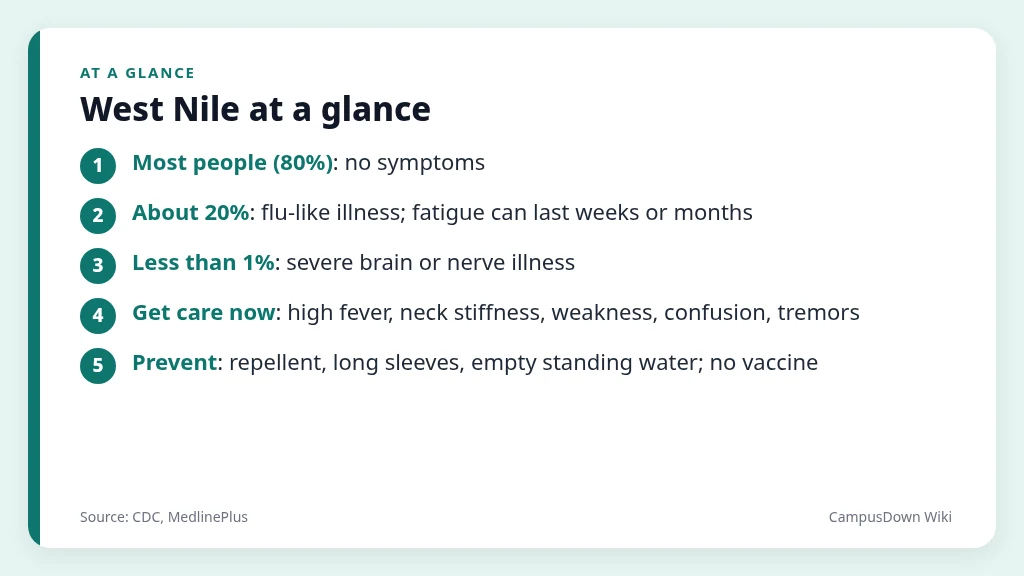
- Most people (80%) have no symptoms.
- About 20% develop flu-like symptoms, such as fever with headache, body aches, joint pains, vomiting, diarrhea or rash. Most recover completely, but fatigue and weakness can last for weeks or months.
- Less than 1% develop severe illness affecting the central nervous system, which can include inflammation of the brain (encephalitis) and of the membranes around the brain and spinal cord (meningitis). Severe symptoms can include high fever, headache, neck stiffness, stupor, disorientation, coma, tremors, convulsions, muscle weakness, vision loss, numbness and paralysis.
CDC says about 10% of people with severe illness affecting the central nervous system die, and recovery can take weeks or months, with some effects possibly permanent.
Get help now if
CDC says to seek immediate medical attention if you have high fever, neck stiffness, muscle weakness, confusion or tremors.
Who is at higher risk of severe illness
CDC says the risk of severe illness increases with age; people 65 and older are three times as likely to develop neurologic illness as those younger than 65, and risk is higher for people with chronic conditions such as cancer, diabetes, high blood pressure or kidney disease, and people with a weakened immune system. MedlinePlus lists people over 60, those with those conditions and organ transplant recipients. See diabetes in older adults and high blood pressure.
Testing and treatment
CDC says providers diagnose West Nile based on signs and symptoms, history of possible mosquito exposure and laboratory testing, and may test for other infections that look similar. No medicines are available to treat West Nile, says CDC; MedlinePlus says there are no specific vaccines or treatments for human WNV disease, rest, fluids and over-the-counter pain medicines may relieve some symptoms, and you may need to be hospitalized if you have serious symptoms. Ask a pharmacist before taking any pain medicine. For other infections with overlapping symptoms see influenza.
Preventing mosquito bites
MedlinePlus says there are no vaccines or medicines to prevent WNV; the best way is to prevent mosquito bites:
- Wear insect repellent with DEET or another EPA-registered repellent, and follow the label instructions.
- Wear long-sleeved shirts and pants outside.
- Empty standing water from flowerpots, buckets and barrels.
- Stay indoors between dusk and dawn, when mosquitoes are most active.
- Use screens on windows.
See heat illness for summer safety that overlaps with time outdoors.
Questions for your doctor
- Do my age or conditions raise my risk of severe illness?
- Which symptoms mean I should call you or go to the emergency room?
- Which insect repellent is suitable for me, and how should I use it?
- If I'm recovering, how long should I expect fatigue to last?
Example scenario: the late-summer fever
- Who
- Nathaniel, 68, a retired electrician in Omaha, Nebraska, got several mosquito bites at an evening cookout in September.
- What happened
- A week later he had a fever, headache and body aches that felt like a bad flu.
- How it felt
- He assumed it would pass and didn't want to bother the clinic.
- What they did
- When his daughter noticed he seemed confused and his neck felt stiff, she took him to the emergency room, where he was tested and cared for. Nathaniel was told fatigue can last for weeks or months and to use repellent and long sleeves next season.
- How it turned out
- Nathaniel said he wished he had called earlier.
This is an illustrative example, not a real patient or a review.
Nathaniel's story is an illustrative example. Confusion, neck stiffness or weakness needs immediate medical attention.
Most-asked questions about West Nile virus
What are West Nile virus symptoms in humans?
Most people have none; about 20% have fever, headache, body aches, joint pains, vomiting, diarrhea or rash, and less than 1% have severe illness.
Why people ask: "west nile virus symptoms in humans" is #2 for "west nile virus symptoms" (US autocomplete, November 2026).
Does West Nile cause a rash?
CDC and MedlinePlus list rash among possible mild symptoms; the pages don't describe how it looks, so ask a clinician about any rash.
Why people ask: "west nile virus symptoms rash pictures" is #3 for "west nile virus symptoms" (US autocomplete, November 2026).
What are the symptoms and treatment?
See symptoms above; no medicines treat West Nile, and rest, fluids and over-the-counter pain medicines may relieve some symptoms, with hospital care for serious illness.
Why people ask: "west nile virus symptoms and treatment" is #4 for "west nile virus symptoms" (US autocomplete, November 2026).
How long do West Nile symptoms last?
MedlinePlus says mild symptoms usually go away within a few days to several weeks, and CDC says fatigue and weakness can last for weeks or months.
Why people ask: "west nile virus symptoms how long do they last" is #8 for "west nile virus symptoms" (US autocomplete, November 2026).
Does West Nile cause a sore throat?
Sore throat isn't on the symptom lists in the pages used here; mention all symptoms to your clinician.
Why people ask: "west nile virus symptoms sore throat" is #10 for "west nile virus symptoms" (US autocomplete, November 2026).
How is West Nile treated in humans?
There are no specific treatments; care is supportive, and hospital care is possible for serious symptoms.
Why people ask: "west nile virus treatment in humans" is #2 for "west nile virus treatment" (US autocomplete, November 2026).
Are there treatment guidelines for West Nile?
The pages used here are consumer information; they say there is no specific medicine, and your clinician decides care.
Why people ask: "west nile virus treatment guidelines" is #4 for "west nile virus treatment" (US autocomplete, November 2026).
What does treatment and recovery look like?
Rest, fluids and over-the-counter pain medicines for mild illness; recovery from severe illness can take weeks or months.
Why people ask: "west nile virus treatment and recovery" is #5 for "west nile virus treatment" (US autocomplete, November 2026).
What are the treatment options?
Supportive care only; MedlinePlus says no specific vaccines or treatments exist for human WNV disease.
Why people ask: "west nile virus treatment options" is #6 for "west nile virus treatment" (US autocomplete, November 2026).
Is there an antiviral for West Nile?
CDC says no medicines are available to treat West Nile; ask your clinician about any research or hospital options.
Why people ask: "west nile virus treatment antiviral" is #8 for "west nile virus treatment" (US autocomplete, November 2026).
How long does it take to recover from West Nile virus?
Most people with mild illness recover completely, though fatigue and weakness can last weeks or months; severe illness can take weeks or months, and some effects might be permanent.
Why people ask: "how long does it take to recover from west nile virus" is #9 for "west nile virus treatment" (US autocomplete, November 2026).
Can you recover from West Nile virus?
Most people with mild illness do; about 10% of people with severe nervous system illness die, per CDC.
Why people ask: "can you recover from west nile virus" is #10 for "west nile virus treatment" (US autocomplete, November 2026).
Related on CampusDown
You can learn more about the health topics hub and check it for yourself in senior health. For another viral illness in detail, see shingles.
Frequently asked questions
- What is West Nile virus?
- An infectious disease usually spread by the bite of an infected mosquito.
- Do most people get sick?
- No; about 80% have no symptoms and about 20% have flu-like illness.
- What are warning signs of severe illness?
- High fever, neck stiffness, muscle weakness, confusion or tremors; get immediate medical attention.
- Is there a vaccine or treatment?
- No specific vaccine or medicine; rest, fluids and over-the-counter pain medicines may relieve symptoms.
- How can I lower my risk?
- Use EPA-registered repellent, wear long sleeves and pants, empty standing water, use screens and avoid dusk to dawn outdoors.
Most people with West Nile virus feel nothing and some feel like they have the flu, but a few develop serious brain or nerve illness, especially older adults and people with certain conditions. Prevent bites, and get immediate medical help for high fever, stiff neck, weakness or confusion.
Browse more guides like this in the U.S. Health Topics hub.
This article is for general education and does not replace advice from your own doctor, nurse or pharmacist.