
Two patients, same gland, opposite problems. One is weak and dizzy and craving salt. The other has a round face, new bruises and a high blood sugar. How do you keep Addison's and Cushing's straight on exam day, and at the bedside?

This guide compares them using MedlinePlus's articles on Addison disease and Cushing syndrome (both reviewed April 2025). It is a study aid, not orders; your instructor and the provider decide diagnosis and treatment. If you want to learn more about the electrolyte clues, take a closer look at high potassium and low sodium.
The core idea
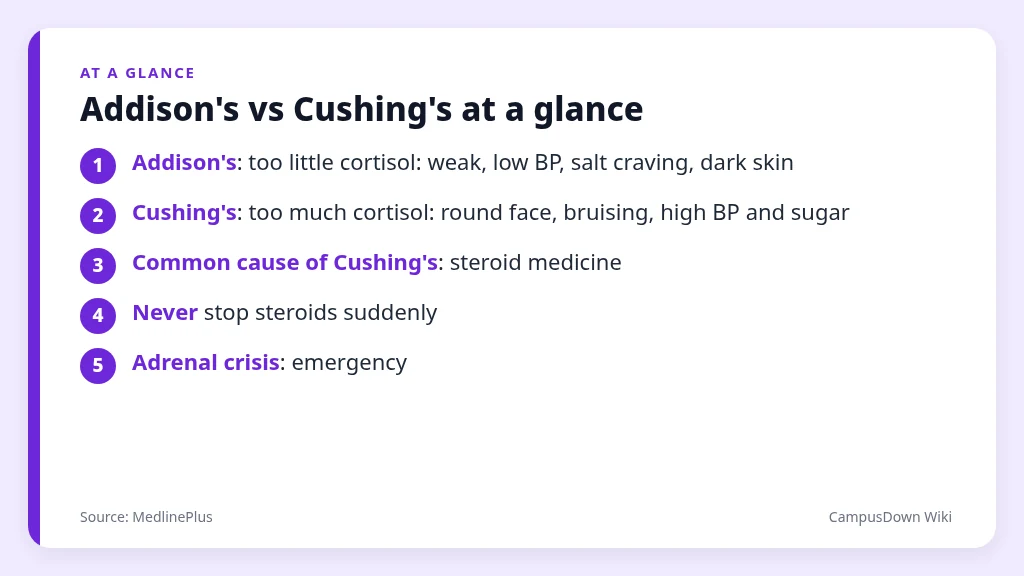
- Addison disease: too little. MedlinePlus says the adrenal glands don't produce enough hormones because of damage to the adrenal cortex. The cortex makes cortisol (blood sugar, blood pressure, immune response, stress response), aldosterone (sodium, water and potassium balance) and sex hormones.
- Cushing syndrome: too much cortisol. MedlinePlus says it occurs when the body has a high level of cortisol.
A memory hook: Addison's drops, Cushing's climbs (cortisol, blood pressure and blood sugar tendencies).

Causes
| Addison disease | Cushing syndrome | |
|---|---|---|
| Direction | Cortisol too low | Cortisol too high |
| Most common cause | Immune system attacking the adrenal glands (autoimmune) | Taking too much glucocorticoid medicine (exogenous), such as prednisone, dexamethasone or prednisolone |
| Other causes | Infections (TB, HIV, fungal), bleeding into the glands, tumors | Pituitary tumor making ACTH (Cushing disease), adrenal tumor, tumors elsewhere making ACTH or CRH |
MedlinePlus lists that glucocorticoid medicines treat conditions such as asthma, skin inflammation, cancer, bowel disease and arthritis, which is why Cushing's can appear in patients on long-term steroids; see asthma medications.
Symptoms side by side
Addison disease (MedlinePlus):
- Extreme weakness and fatigue, slow sluggish movement
- Weight loss and reduced appetite
- Abdominal pain, nausea, vomiting, chronic diarrhea
- Low blood pressure, especially when changing position; dizziness on standing
- Low blood sugar
- Salt craving
- Darkening of the skin, including the inside of the cheeks and lips
- Dehydration, low-grade fever
Symptoms may not be present all the time and often show up during infection or other stress.
Cushing syndrome (MedlinePlus):
- Round, red, full face ("moon face")
- Weight gain with fat on the trunk but thin arms, legs and buttocks
- Purple stretch marks on the abdomen, arms, thighs and breasts
- Thin skin and easy bruising
- Weak muscles in the hips and shoulders, backache, bone pain and fractures from thinning bones
- High blood pressure, type 2 diabetes and high cholesterol
- Skin infections and frequent infections
- Mood changes, such as depression or anxiety, and increased thirst and urination
- In women, extra facial hair and irregular or absent periods; in men, low libido and erection problems
Lab clues
MedlinePlus says blood tests in Addison disease may show increased potassium, low cortisol, low sodium, low pH and a high eosinophil count, and an ACTH (cosyntropin) stimulation test may be done. For Cushing syndrome, tests include blood, saliva and 24-hour urine cortisol, a dexamethasone suppression test, an ACTH level, blood sugar, and imaging and bone density to find the cause or complications. MedlinePlus says diagnosing Cushing's can be complicated, and an endocrinologist is often involved. See the lab values cheat sheet.
Treatment
- Addison: MedlinePlus says replacement corticosteroids and mineralocorticoids control symptoms and usually need to be taken for life. Never skip doses, because life-threatening reactions may occur. The provider may increase the dose for a short time during infection, injury, stress or surgery.
- Adrenal crisis (extreme adrenal insufficiency): hydrocortisone must be injected right away, and low blood pressure is usually treated too. Some patients or family are taught to give an emergency injection, and patients should carry medical ID. Symptoms include trouble breathing, dizziness or lightheadedness, low blood pressure and reduced consciousness; if the injection isn't available, go to the nearest emergency room or call 911. Hypotension links to types of shock.
- Cushing from steroid medicine: the provider will have the patient slowly decrease the dose; stopping suddenly can be dangerous. If the medicine can't be stopped, high blood sugar, cholesterol and bone thinning should be closely monitored and treated.
- Cushing from tumors: surgery to remove the tumor, sometimes radiation, hormone replacement afterward and medicines that block cortisol, depending on the cause. MedlinePlus says untreated Cushing syndrome can be life threatening.
Get help now if
Vomiting that stops a patient from keeping steroid medicine down, severe weakness, dizziness, low blood pressure, confusion or trouble breathing in someone with adrenal insufficiency can be adrenal crisis. Tell your instructor or the nurse immediately and call 911 or follow facility policy.
Nursing priorities (student view)
Addison's: watch blood pressure (including position changes), sodium, potassium, blood sugar and hydration; protect steroid medicine schedules; teach stress-day rules and carrying medical ID; report vomiting or signs of crisis at once. Cushing's: monitor blood pressure, blood sugar, signs of infection, skin and bruising and fracture risk; teach never to stop steroids abruptly; support mood concerns; see fall prevention for bone fragility. Also see hypoglycemia for low sugar signs.
Study tips
- Draw two columns: low cortisol vs high cortisol, and list blood pressure, sugar, skin, weight and electrolytes.
- Link salt craving to Addison's and moon face to Cushing's.
- Remember: the most common cause of Cushing syndrome is steroid medicine.
- Memorize adrenal crisis as an emergency that needs steroid replacement.
Questions for your instructor
- Which unit protocol covers suspected adrenal crisis?
- How do we monitor patients on long-term steroids?
- What teaching do we give on stress-day dose changes?
- How do exam questions separate Cushing syndrome from Cushing disease?
- Which labs matter most for each?
Example scenario: the sick-day rule
- Who
- Theodora, 27, a nursing student in Sacramento, California, cared for a patient with Addison disease admitted with vomiting and dizziness who had missed his medicine for a day.
- What happened
- She wasn't sure it was urgent because his vitals weren't dramatic yet.
- How it felt
- She felt anxious about speaking up.
- What they did
- She told her nurse right away, who recognized the risk, called the provider and had the care team act on orders. Theodora then wrote "vomiting plus steroid replacement equals call now" in her notes.
- How it turned out
- Theodora said the pattern stuck because a real patient showed it to her.
This is an illustrative example, not a real patient or a review.
Theodora's story is an illustrative example. Real care follows your instructor, your facility and the provider's orders.
Most-asked questions about Addison's vs Cushing's
What is the difference between Addison's disease and Cushing's disease?
Addison's means too little cortisol from damaged adrenal glands; Cushing's syndrome means too much cortisol, most often from steroid medicine, and Cushing disease is a pituitary tumor cause.
Why people ask: "addisons vs cushings disease" is #2 for "addisons vs cushings" (US autocomplete, November 2026).
What are the symptoms of Addison's vs Cushing's?
Addison's: weakness, low blood pressure, salt craving, darker skin; Cushing's: moon face, stretch marks, bruising, high blood pressure and sugar.
Why people ask: "addisons vs cushings symptoms" is #3 for "addisons vs cushings" (US autocomplete, November 2026).
What are the nursing priorities for Addison's vs Cushing's?
Monitor blood pressure, sugar and electrolytes, protect steroid schedules and recognize adrenal crisis.
Why people ask: "addisons vs cushings nursing" is #6 for "addisons vs cushings" (US autocomplete, November 2026).
How are Addison's vs Cushing's treated?
Addison's with lifelong hormone replacement; Cushing's by treating the cause, including tapering steroid medicine under a provider's direction.
Why people ask: "addisons vs cushings treatment" is #8 for "addisons vs cushings" (US autocomplete, November 2026).
What are the signs and symptoms of Addison's vs Cushing's?
See the side-by-side lists above; skin darkening and salt craving point to Addison's, a round face and purple stretch marks to Cushing's.
Why people ask: "addisons vs cushings signs and symptoms" is #10 for "addisons vs cushings" (US autocomplete, November 2026).
Related on CampusDown
You can learn more about the nursing student hub and check it for yourself in the lab values cheat sheet. For electrolytes in detail, see high potassium.
Frequently asked questions
- Which one causes salt craving?
- Addison disease, per MedlinePlus.
- Which one causes moon face?
- Cushing syndrome.
- What is the most common cause of Cushing syndrome?
- Taking too much glucocorticoid medicine, such as prednisone.
- Can steroids be stopped suddenly?
- No; stopping suddenly can be dangerous, so a provider tapers the dose.
- What is adrenal crisis?
- An extreme form of adrenal insufficiency that needs an immediate hydrocortisone injection and emergency care.
Addison's and Cushing's are opposite sides of cortisol. Learn the symptom patterns, remember that steroid medicines are the leading cause of Cushing syndrome and treat adrenal crisis as an emergency.
Browse more guides like this in the Nursing Student and NCLEX hub.
This article is for general education and does not replace advice from your own doctor, nurse or pharmacist.