
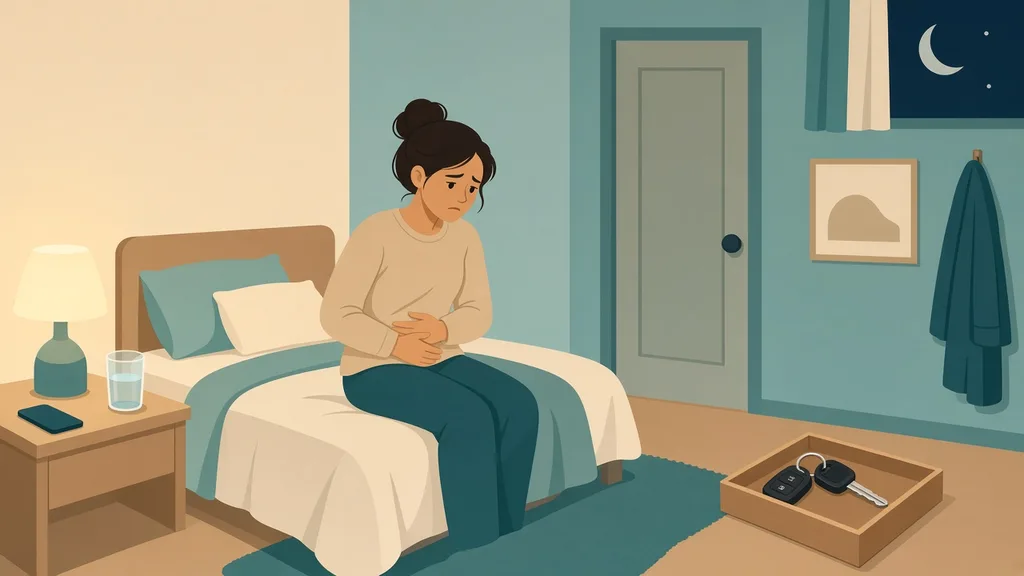
You've had an odd ache around your belly button since dinner, and now it's turning sharper on the lower right side. Is it gas, or something that shouldn't wait?
This guide uses the MedlinePlus encyclopedia article on appendicitis (reviewed April 21, 2025). It is general information, not a diagnosis; only an in-person exam and tests can tell what is causing belly pain. If you want to learn more about other belly conditions, take a closer look at diverticulitis.
What appendicitis is
MedlinePlus says appendicitis is a condition in which your appendix gets inflamed; the appendix is a small pouch attached to the end of the large intestine. It says it is a very common reason for emergency surgery and that it most often occurs when the appendix becomes blocked by feces, a foreign object, a tumor or, rarely, a parasite.

The typical pattern
MedlinePlus describes this sequence:
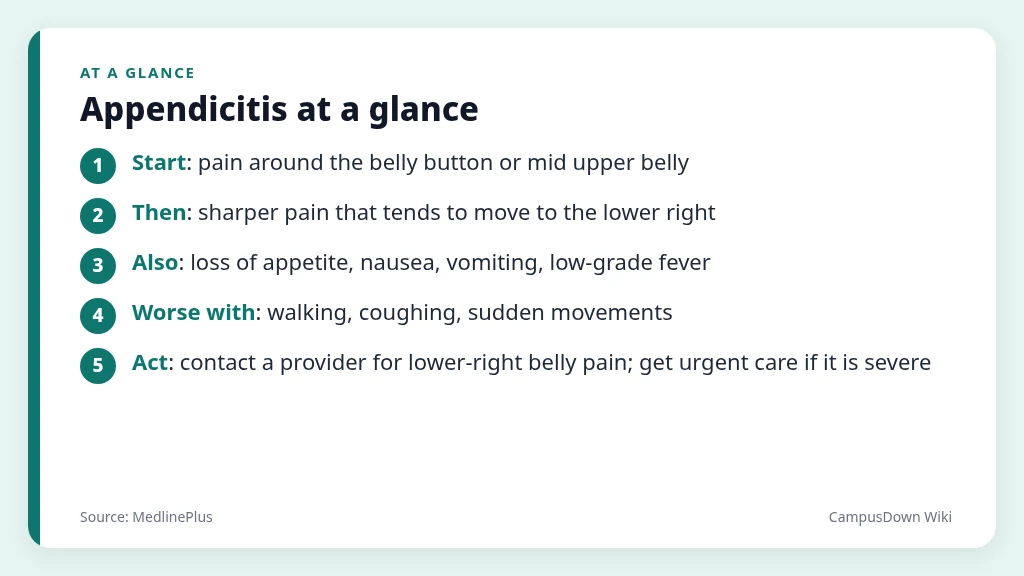
- The first symptom is often pain around the belly button or mid upper abdomen. It may be minor at first, then become sharper and more severe.
- Loss of appetite, nausea, vomiting and a low-grade fever can follow.
- The pain tends to move into the right lower part of the belly, focusing on McBurney point, and this most often happens 12 to 24 hours after the illness starts.
- Pain may be worse when you walk, cough or make sudden movements.
- Later symptoms may include chills and shaking, diarrhea, fever, hard stools, and nausea and vomiting.
It can be hard to spot
MedlinePlus says the symptoms vary, and appendicitis can be hard to detect in young children, older people and women of childbearing age. That is one reason a clinician, not a search, should sort out belly pain that is getting worse. See infections and confusion in older adults for another example where older adults can show unusual signs.
How it is diagnosed
MedlinePlus says your provider will suspect appendicitis from the symptoms you describe and do a physical exam; pain increases when the lower right belly is pressed. If the appendix has ruptured, touching the belly may cause a lot of pain and you may tighten your muscles. Tests that help include a blood test (often a high white blood cell count) and imaging such as a CT scan or ultrasound of the abdomen. The page says the tests are not perfect, so the operation may show a normal appendix, in which case the surgeon will look for other causes of pain.
Treatment
MedlinePlus says most of the time a surgeon will remove your appendix as soon as you are diagnosed. If a CT scan shows an abscess, you may be treated with antibiotics first and have the appendix removed after the infection and swelling have gone away.
Outlook and complications
MedlinePlus says most people recover quickly after surgery if the appendix is removed before it ruptures; if it ruptures, recovery may take longer and an abscess, intestinal blockage, infection inside the abdomen (peritonitis) or wound infection become more likely. See sepsis recognition for how serious infection is recognized in hospital settings.
When to get care
MedlinePlus says to contact your provider if you have pain in the lower right portion of your belly or other symptoms of appendicitis. Severe or worsening pain, fever or vomiting are reasons to seek urgent or emergency care. Ask a clinician or nurse line rather than waiting to see if it passes.
Questions for your doctor
- Which tests do you recommend for my symptoms, and why?
- Could this be something else, such as diverticulitis or a urinary problem?
- If surgery is needed, what should I expect during recovery?
- What symptoms should send me back sooner?
Example scenario: the pain that moved
- Who
- Katarina, 34, a graphic designer in Pittsburgh, Pennsylvania, felt an ache near her belly button after lunch.
- What happened
- By evening the pain was sharper on the lower right and worse when she coughed, and she had no appetite.
- How it felt
- She thought it was a stomach bug and didn't want to overreact.
- What they did
- Her partner convinced her to call a nurse line, which sent her to the emergency room, where an exam, blood test and imaging were done. Katarina was told the team would decide on treatment, and she recovered with her clinicians' guidance.
- How it turned out
- Katarina said she wished she hadn't waited a few hours.
This is an illustrative example, not a real patient or a review.
Katarina's story is an illustrative example. Belly pain that moves and gets sharper deserves a prompt call or visit.
Most-asked questions about appendicitis
What are appendicitis symptoms in women?
MedlinePlus says appendicitis can be hard to detect in women of childbearing age; the symptoms listed are the same, so see a clinician for lower-right belly pain.
Why people ask: "appendicitis symptoms in women" is #3 for "appendicitis symptoms" (US autocomplete, November 2026).
What are appendicitis symptoms in men?
The page doesn't separate symptoms by sex; the pattern is belly button pain moving to the lower right with appetite loss, nausea and low-grade fever.
Why people ask: "appendicitis symptoms in men" is #4 for "appendicitis symptoms" (US autocomplete, November 2026).
What are the symptoms and treatment of appendicitis?
Symptoms are listed above; most of the time a surgeon removes the appendix soon after diagnosis, with antibiotics first if there is an abscess.
Why people ask: "appendicitis symptoms and treatment" is #8 for "appendicitis symptoms" (US autocomplete, November 2026).
What are appendicitis symptoms while pregnant?
The page doesn't cover pregnancy; call your obstetric clinician promptly for belly pain.
Why people ask: "appendicitis symptoms while pregnant" is #10 for "appendicitis symptoms" (US autocomplete, November 2026).
Where does appendicitis pain start in women?
MedlinePlus doesn't separate by sex; it says pain often starts around the belly button and moves to the right lower belly, and that diagnosis can be harder in women of childbearing age.
Why people ask: "appendicitis pain location female" is #2 for "appendicitis pain location" (US autocomplete, November 2026).
Where does appendicitis pain start in men?
The same pattern: around the belly button or mid upper abdomen, then to the lower right.
Why people ask: "appendicitis pain location male" is #3 for "appendicitis pain location" (US autocomplete, November 2026).
Is there a diagram of appendicitis pain location?
MedlinePlus shows anatomy images on its page, and describes pain focusing at McBurney point in the lower right belly.
Why people ask: "appendicitis pain location diagram" is #4 for "appendicitis pain location" (US autocomplete, November 2026).
Which abdominal quadrant is appendicitis pain in?
The right lower part of the belly, as the pain tends to move there.
Why people ask: "appendicitis pain location quadrant" is #6 for "appendicitis pain location" (US autocomplete, November 2026).
Can appendicitis pain be felt in the back?
The page doesn't mention back pain; it lists belly button, mid upper abdomen and right lower belly, so mention any back pain to your clinician.
Why people ask: "appendicitis pain location back" is #7 for "appendicitis pain location" (US autocomplete, November 2026).
Can appendicitis pain be on the left side?
The page describes right lower belly pain and doesn't mention the left side; any severe or worsening belly pain needs care.
Why people ask: "appendicitis pain location left side" is #9 for "appendicitis pain location" (US autocomplete, November 2026).
Related on CampusDown
You can learn more about the health topics hub and check it for yourself in diverticulitis. For related belly symptoms in detail, see constipation in older adults and irritable bowel syndrome.
Frequently asked questions
- What is appendicitis?
- Inflammation of the appendix, a small pouch attached to the end of the large intestine.
- Where does the pain start?
- Often around the belly button or mid upper abdomen, then it tends to move to the lower right.
- How is it diagnosed?
- By symptoms, a physical exam, a blood test and imaging such as CT or ultrasound.
- How is it treated?
- Most of the time a surgeon removes the appendix soon after diagnosis; antibiotics may come first if there is an abscess.
- When should I seek care?
- Contact a provider for lower-right belly pain; severe or worsening pain needs urgent care.
Appendicitis often starts as pain near the belly button that sharpens and moves to the lower right, with appetite loss, nausea and a low-grade fever. Because it can be hard to spot, call a clinician or go to urgent care for worsening belly pain instead of waiting it out.
Browse more guides like this in the U.S. Health Topics hub.
This article is for general education and does not replace advice from your own doctor, nurse or pharmacist.