
You take Symbicort every morning and evening, and one rough afternoon you wonder: can it replace your rescue inhaler? And why does your mouth need rinsing?

This guide uses MedlinePlus's drug information on budesonide and formoterol oral inhalation (revised August 2026) and a DailyMed label for budesonide and formoterol inhalation aerosol. It is general information, not a prescription; your prescriber and pharmacist decide your regimen and your plan for bad days. If you want to learn more about the rescue side, take a closer look at the albuterol inhaler.
What it is
MedlinePlus says budesonide and formoterol is used to prevent and treat difficulty breathing, wheezing, shortness of breath, coughing and chest tightness caused by asthma, and to treat COPD in adults. It combines two medicines:
- Budesonide is a steroid that reduces swelling in the airways.
- Formoterol is a long-acting beta agonist (LABA) that relaxes and opens the air passages.
MedlinePlus lists the brand names Symbicort (and Symbicort Aerosphere) and Breyna. Ask your pharmacist which version your plan dispenses. Brand-name Symbicort's ingredients are budesonide and formoterol.

How it differs from albuterol
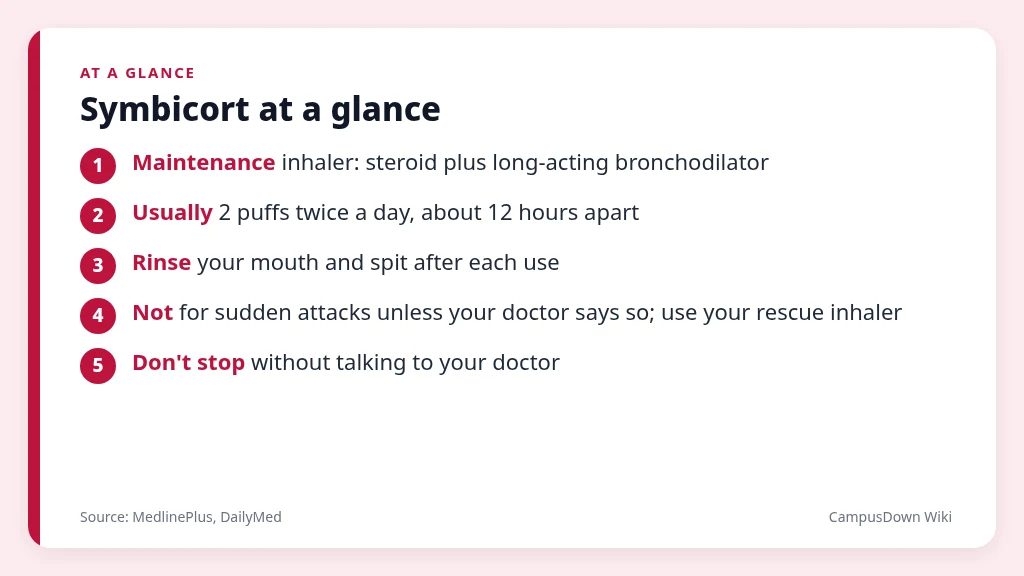
- Symbicort is a maintenance (controller) inhaler taken on a schedule to keep symptoms controlled. The DailyMed label says it is not indicated for the relief of acute bronchospasm and should not be started to treat acute symptoms.
- Albuterol is a short-acting rescue inhaler for sudden symptoms. MedlinePlus says that if you used a short-acting inhaler such as albuterol regularly, your doctor will probably tell you to stop using it regularly but keep using it for sudden attacks.
- MedlinePlus also notes that some doctors recommend budesonide-formoterol as a rescue medicine for acute asthma flares. That is a specific plan from your prescriber. Don't change how you use it unless your prescriber tells you to.
For a bad day, follow your written action plan; see asthma attack signs. For how the medicine classes fit together, see the asthma medications guide.
How it is used
- An aerosol inhaler, inhaled by mouth.
- MedlinePlus says it is taken as 2 puffs twice a day, in the morning and evening, about 12 hours apart, at about the same times each day. Your label sets your dose; the label for the generic aerosol lists strengths of budesonide 80 or 160 mcg with formoterol 4.5 mcg per puff and says the starting dose depends on severity.
- Use it exactly as directed; don't use more or less, or more often.
- Rinse your mouth with water and spit it out after inhaling; don't swallow the water. This helps lower the chance of mouth and throat side effects.
- Read the written instructions, and ask your doctor, pharmacist or respiratory therapist to show you the technique and watch you practice. See the spacer guide and nebulizer vs inhaler.
- Watch the dose counter and throw the inhaler away when it reads zero.
- It controls symptoms but does not make asthma or COPD go away. Keep using it even if you feel well, and don't stop without talking to your doctor, because symptoms may return.
- If a child uses the inhaler, make sure they know how, and watch each time.
- Missed dose: inhale it when you remember unless it's almost time for the next dose; don't double up.
Tell your doctor before you start
Per MedlinePlus: allergies; all your medicines, vitamins, supplements and herbal products; and a family or personal history of osteoporosis, irregular heartbeat or QT prolongation, heart disease, high blood pressure, low potassium, diabetes, seizures, TB in the lungs, cataracts, glaucoma, thyroid or liver disease, conditions that affect the immune system, untreated infections, a herpes eye infection, smoking, or being on bedrest. Also tell them about pregnancy or breastfeeding, upcoming surgery (including dental), and if you've never had chickenpox or measles and aren't vaccinated; MedlinePlus says to stay away from sick people, especially anyone with those infections, and to call right away if you're exposed. Bring a medication list to every visit; see the brown bag review.
Side effects
Tell your doctor if these are severe or don't go away (MedlinePlus): throat irritation or pain, hoarseness, stuffy or runny nose, back pain, headache, muscle spasms, uncontrollable shaking of a part of the body, and nervousness.
Call your doctor immediately or get emergency care for:
- Hives or rash; swelling of the face, throat, tongue, lips, hands, feet, ankles or lower legs
- Burning, tingling or numbness in the hands or feet
- White spots or sores in the mouth or throat (possible thrush)
- Pounding, fast or irregular heartbeat, fainting, chest pain, tiredness, tremor
- Fever, weakness, cough, difficulty breathing, a change in the color of sputum, chills or body aches (signs of infection)
- Fatigue, muscle weakness, weight loss, decreased appetite, nausea, vomiting, muscle and joint pain
Get help now if
If breathing gets worse right after using it, MedlinePlus says to use your fast-acting rescue medicine right away and call your doctor, and not to use it again unless your doctor says to. For severe trouble breathing, call 911.
Other cautions MedlinePlus lists: it may cause children to grow more slowly, so a child's doctor monitors growth; it may raise the risk of glaucoma or cataracts, so regular eye exams are likely, and call if you have eye pain, redness, blurred vision or halos around lights; and it may increase the risk of osteoporosis.
If anxiety or nervousness is part of what you feel, see anxiety and chest pain and discuss with your prescriber, since a racing heartbeat with chest pain needs prompt attention.
Common questions
- Weight gain or depression: MedlinePlus doesn't list these for budesonide-formoterol; tell your clinician about any change that bothers you.
- Price or coupons and alternatives: MedlinePlus doesn't cover cost or substitutes; ask your pharmacist or prescriber about options.
- Sleep or stomach upset: not listed by MedlinePlus either; mention any new symptom to your clinician.
Questions for your pharmacist
- Is this a maintenance inhaler for me, or is it also my rescue plan?
- How many puffs and when, and what do I do if I miss a dose?
- How do I know the inhaler is empty?
- Do I need eye exams or bone checks?
- Which symptoms mean I should call right away?
Example scenario: the skipped rinse
- Who
- Augustina, 67, a retired seamstress in Savannah, Georgia, began a new daily inhaler and noticed white patches and a sore throat after a week.
- What happened
- She'd skipped rinsing because she thought it was optional.
- How it felt
- She felt embarrassed and a bit alarmed.
- What they did
- She called her clinic, who looked at her mouth and told her what to do next; her pharmacist reviewed the rinse-and-spit step and her technique. She kept the inhaler by her toothbrush as a reminder.
- How it turned out
- Augustina said the little routine mattered more than she expected.
This is an illustrative example, not a real patient or a review.
Augustina's story is an illustrative example. Real care follows your clinician's plan; call 911 for severe breathing trouble.
Most-asked questions about Symbicort
What is the Symbicort inhaler?
A maintenance inhaler combining budesonide (a steroid) and formoterol (a long-acting bronchodilator) for asthma and COPD.
Why people ask: "symbicort inhaler" is #2 for "symbicort" (US autocomplete, November 2026).
Is there a generic for Symbicort?
MedlinePlus lists Breyna as another brand of budesonide and formoterol; ask your pharmacist which version your plan covers.
Why people ask: "symbicort generic" is #3 for "symbicort" (US autocomplete, November 2026).
What is the Symbicort dosing?
MedlinePlus says 2 puffs twice a day, about 12 hours apart; your label and prescriber set your exact dose.
Why people ask: "symbicort dosing" is #4 for "symbicort" (US autocomplete, November 2026).
What are the side effects of Symbicort?
Throat irritation, hoarseness, stuffy nose, headache and shakiness are listed; mouth sores, pounding heartbeat, infection signs and swelling need prompt attention.
Why people ask: "symbicort side effects" is #6 for "symbicort" (US autocomplete, November 2026).
What is the generic name for Symbicort?
Budesonide and formoterol.
Why people ask: "symbicort generic name" is #7 for "symbicort" (US autocomplete, November 2026).
How does Symbicort compare to albuterol?
Symbicort is for daily control; albuterol is a rescue inhaler for sudden symptoms unless your prescriber directs otherwise.
Why people ask: "symbicort vs albuterol" is #9 for "symbicort" (US autocomplete, November 2026).
Does Symbicort affect children's growth?
MedlinePlus says it may cause children to grow more slowly, so a child's doctor monitors growth.
Why people ask: "symbicort side effects in kids" is #2 for "symbicort side effects" (US autocomplete, November 2026).
Can Symbicort cause anxiety?
MedlinePlus lists nervousness and shakiness among side effects; tell your doctor if they are severe or persist.
Why people ask: "symbicort side effects anxiety" is #3 for "symbicort side effects" (US autocomplete, November 2026).
Can Symbicort affect the heart?
MedlinePlus lists pounding, fast or irregular heartbeat, fainting and chest pain as reasons to call right away.
Why people ask: "symbicort side effects heart" is #9 for "symbicort side effects" (US autocomplete, November 2026).
Can Symbicort cause fatigue?
MedlinePlus lists tiredness and fatigue among the symptoms that warrant a call, especially with muscle weakness, weight loss or nausea.
Why people ask: "symbicort side effects fatigue" is #10 for "symbicort side effects" (US autocomplete, November 2026).
Related on CampusDown
You can learn more about the medicines hub and check it for yourself in the asthma medications guide. For the rescue inhaler in detail, see the albuterol inhaler.
Frequently asked questions
- Why rinse my mouth?
- MedlinePlus says to rinse with water and spit after inhaling; it helps reduce mouth and throat problems.
- Can I use it for a sudden attack?
- Only if your prescriber has told you to; otherwise use your rescue inhaler and call your doctor.
- When do I replace the inhaler?
- When the dose counter reads zero.
- Can I stop it when I feel well?
- No; it controls symptoms, so don't stop without talking to your doctor.
- Does it need eye checks?
- MedlinePlus says you will probably need regular eye exams because of the risk of glaucoma or cataracts.
Budesonide-formoterol is a daily maintenance inhaler for asthma and COPD. Use it as directed, rinse your mouth, keep your rescue plan clear and call promptly for worsening breathing, mouth sores, a pounding heartbeat or infection signs.
Browse more guides like this in the Medicines hub.
This article is for general education and does not replace advice from your own doctor, nurse or pharmacist.