
The first week on a new antidepressant is full of questions. Is that jittery feeling normal, and which symptoms mean you should call your prescriber the same day?

This guide uses the MedlinePlus bupropion page (AHFS patient information, last revised November 15, 2025). It is general information, not a prescription; your prescriber and pharmacist decide whether bupropion is right for you. If you want to learn more about mood changes later in life, take a closer look at depression in older adults.
What bupropion is used for
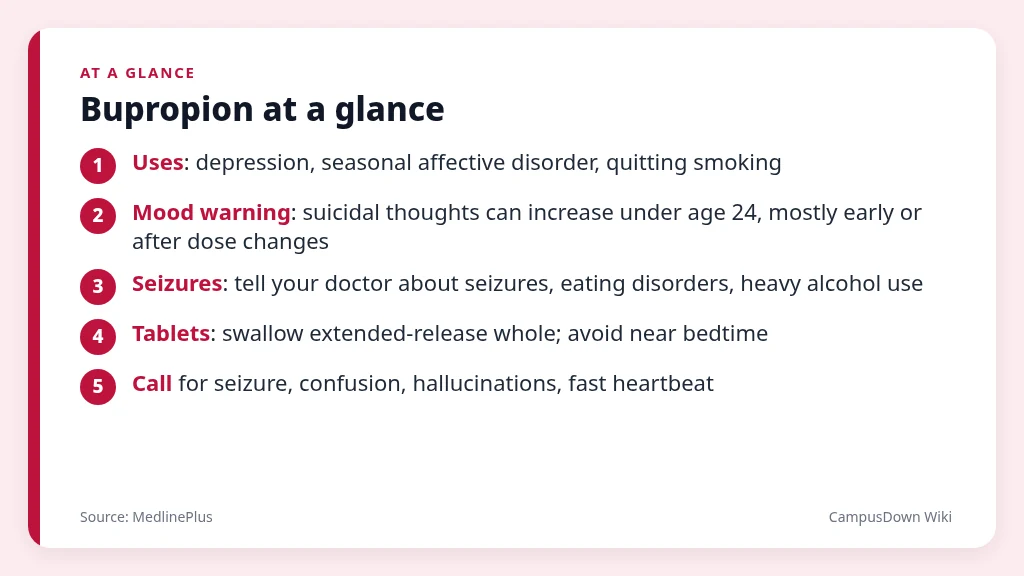
MedlinePlus says bupropion treats depression and seasonal affective disorder (SAD) and helps people stop smoking. It is an antidepressant that works by increasing certain types of activity in the brain. Brand names on the page include Wellbutrin, Wellbutrin SR, Wellbutrin XL, Aplenzin, Forfivo XL and Zyban; Auvelity and Contrave are combination products. Some doctors also prescribe it for depression episodes in bipolar disorder and for ADHD, with discussion of the risks.

The mood warning
MedlinePlus says medications such as bupropion may increase the risk of suicidal thoughts and actions in children, teenagers and young adults under 24, and the risk may be more likely in the first few months of treatment and when the dose is increased. Call your doctor right away for new or worsening depression, thoughts of harming or killing yourself, extreme worry, agitation, panic attacks, trouble sleeping, aggressive behavior, irritability, acting without thinking, severe restlessness or frenzied abnormal excitement. Make sure family or a caregiver knows which symptoms are serious. You will receive an FDA Medication Guide with each prescription.
If you are in crisis, call or text 988 in the US, or call 911.
How it is taken
MedlinePlus says bupropion comes as a tablet and sustained-release or extended-release tablets, taken 1 to 4 times a day depending on the form.
- Take at about the same times each day, with food if it upsets your stomach, and not too close to bedtime if you have trouble sleeping.
- Swallow sustained-release and extended-release tablets whole; don't split, chew or crush them.
- It may take 4 weeks or longer to feel the full benefit. Continue even if you feel well and don't stop without talking to your doctor, who may lower the dose gradually.
- For SAD, it is taken once a day in the morning from early fall through winter and stopped in early spring.
- Missed dose: skip it, allow the full time between doses, and never double up.
Who should be careful
MedlinePlus says to tell your prescriber if you take an MAO inhibitor (such as isocarboxazid, linezolid, methylene blue, phenelzine, selegiline or tranylcypromine) now or within the past two weeks. Some medications should not be taken with bupropion, and others may need dose changes or monitoring. Tell your doctor if you have or have had seizures, anorexia nervosa or bulimia; also tell them if you drink large amounts of alcohol but expect to stop suddenly, or take sedatives or seizure medicines you expect to suddenly stop, because your doctor will probably tell you not to take bupropion. Also mention heavy alcohol or street drug use, heart attack, head injury, a brain or spine tumor, high blood pressure, diabetes, or liver, kidney or heart disease. Alcohol can make side effects worse; see alcohol and aging.
MedlinePlus adds that bupropion may raise blood pressure (check it regularly, especially if also using nicotine replacement), may make you drowsy (don't drive until you know how it affects you), and may cause angle-closure glaucoma (ask about an eye exam; call right away for nausea, eye pain, vision changes, colored rings around lights or a red, swollen eye). See nicotine patches and gum if you combine them.
Side effects
Tell your doctor if severe or lasting: drowsiness, anxiety, agitation, trouble sleeping, dry mouth, nausea, belly pain, constipation, dizziness, headache, uncontrollable shaking of a body part, loss of appetite, heavy sweating, ringing in the ears and sore throat.
Get help now if
Call your doctor immediately or get emergency care for a seizure, confusion, hallucinations, irrational fears, a rapid, pounding or irregular heartbeat, or unusual high energy, severe sleeplessness, racing thoughts or reckless behavior. Stop the medicine and get help for fever, rash or blisters, hives, swelling of the face, throat or tongue, or trouble breathing or swallowing.
Questions for your prescriber or pharmacist
- Is bupropion right for me, given my history and other medicines?
- Which symptoms in the first weeks should make me call right away?
- How should I take my form, and what time of day is best?
- Should I have my blood pressure or eyes checked?
- How will we taper if we decide to stop?
Example scenario: the sleepless first week
- Who
- Marcellus, 29, a graduate student in Austin, Texas, started an extended-release bupropion tablet for depression.
- What happened
- In the first week he felt jittery and couldn't fall asleep, and he was taking his tablet in the evening.
- How it felt
- He felt worried the medicine "wasn't working" and nearly quit.
- What they did
- He called his prescriber, who reminded him to take it earlier in the day and not near bedtime, asked about mood and any thoughts of self-harm, and planned a check-in soon. Marcellus kept swallowing the tablet whole and reported his sleep at the follow-up.
- How it turned out
- Marcellus said the early call kept him from stopping on his own.
This is an illustrative example, not a real patient or a review.
Marcellus's story is an illustrative example. Never stop an antidepressant suddenly without talking to your prescriber.
Most-asked questions about bupropion
What are bupropion side effects in females?
MedlinePlus lists the same side effects for everyone, such as dry mouth, nausea, insomnia, anxiety and headache; tell your doctor if you are pregnant or planning pregnancy.
Why people ask: "bupropion side effects in females" is #2 for "bupropion side effects" (US autocomplete, November 2026).
What are bupropion side effects in males?
The page doesn't separate by sex; the common effects are drowsiness, anxiety, trouble sleeping, dry mouth, nausea and headache.
Why people ask: "bupropion side effects in males" is #3 for "bupropion side effects" (US autocomplete, November 2026).
Does bupropion cause weight changes?
MedlinePlus lists loss of appetite as a side effect; weight changes aren't otherwise discussed, so ask your prescriber.
Why people ask: "bupropion side effects weight" is #6 for "bupropion side effects" (US autocomplete, November 2026).
What happens when stopping bupropion?
MedlinePlus says don't stop without talking to your doctor, who may decrease the dose gradually; it doesn't list stopping symptoms.
Why people ask: "bupropion side effects when stopping" is #7 for "bupropion side effects" (US autocomplete, November 2026).
What are long-term bupropion side effects?
The page doesn't cover long-term effects; it advises regular blood pressure checks and discussing an eye exam, so keep your follow-ups.
Why people ask: "bupropion side effects long term" is #8 for "bupropion side effects" (US autocomplete, November 2026).
Does bupropion affect libido?
MedlinePlus doesn't list sexual desire changes; report any unusual problems to your doctor.
Why people ask: "bupropion side effects libido" is #9 for "bupropion side effects" (US autocomplete, November 2026).
Does bupropion cause weight loss?
Loss of appetite is listed as a side effect; the page doesn't describe weight loss otherwise, and eating disorders are a reason to avoid it.
Why people ask: "bupropion side effects weight loss" is #10 for "bupropion side effects" (US autocomplete, November 2026).
What are Wellbutrin side effects in the first week?
Possible trouble sleeping, anxiety, dry mouth, nausea, headache and dizziness; call right away for new or worsening depression, suicidal thoughts, seizures or confusion.
Why people ask: "wellbutrin side effects first week" is #3 for "bupropion side effects first week" (US autocomplete, November 2026).
What are Wellbutrin side effects in the first week for women?
MedlinePlus doesn't separate by sex; tell your doctor if you are pregnant or planning pregnancy.
Why people ask: "wellbutrin side effects first week women" is #5 for "bupropion side effects first week" (US autocomplete, November 2026).
Does Wellbutrin cause diarrhea in the first week?
MedlinePlus lists nausea, belly pain and constipation but not diarrhea; tell your doctor about any unusual problem.
Why people ask: "wellbutrin side effects first week diarrhea" is #6 for "bupropion side effects first week" (US autocomplete, November 2026).
Does Wellbutrin cause anxiety in the first week?
Anxiety and agitation are listed side effects; severe worry, panic attacks or restlessness need a call right away, especially under age 24.
Why people ask: "wellbutrin side effects first week anxiety" is #7 for "bupropion side effects first week" (US autocomplete, November 2026).
What are bupropion side effects on the first day?
The page doesn't give a timeline; trouble sleeping, nausea and dizziness are possible, and serious signs need immediate care.
Why people ask: "bupropion side effects first day" is #8 for "bupropion side effects first week" (US autocomplete, November 2026).
What are Wellbutrin side effects in the first 1st week?
See the common and serious lists above; the page doesn't give week-by-week effects.
Why people ask: "wellbutrin side effects 1st week" is #9 for "bupropion side effects first week" (US autocomplete, November 2026).
What are bupropion XL side effects in the first week?
Extended-release tablets share the same listed effects; swallow them whole and avoid taking them near bedtime.
Why people ask: "bupropion xl side effects first week" is #10 for "bupropion side effects first week" (US autocomplete, November 2026).
Related on CampusDown
You can learn more about the medicines hub and check it for yourself in the brown bag medication review. For mood in detail, see depression in older adults, and for another medicine used to quit smoking see nicotine patches and gum.
Frequently asked questions
- What is bupropion used for?
- Depression, seasonal affective disorder and quitting smoking.
- How long does it take to work?
- It may take 4 weeks or longer to feel the full benefit.
- Why avoid bedtime dosing?
- It can cause trouble sleeping, so avoid taking it close to bedtime.
- Who should not take it?
- People with seizures, certain eating disorders, those suddenly stopping alcohol or sedatives, and those on MAO inhibitors within two weeks.
- Which warning needs urgent help?
- New or worsening depression, suicidal thoughts, seizures, confusion or hallucinations.
Bupropion can help with depression, seasonal depression and quitting smoking, but it comes with mood, seizure, blood pressure and eye warnings. Take it as directed, swallow extended-release tablets whole, avoid bedtime doses, report early mood changes and never stop suddenly without your prescriber.
Browse more guides like this in the Medicines hub.
This article is for general education and does not replace advice from your own doctor, nurse or pharmacist.