
Your dentures feel fine in the morning and rub by dinner, and someone at the pharmacy says "just use the cream." Is a sore spot something to put up with, or a sign the fit has changed?
This guide uses MedlinePlus's health topic "Dentures" and its encyclopedia article "Denture problems" (reviewed February 2026) to explain everyday care and fit problems. It is general information, not dental advice; your dentist decides how your dentures should be cared for, adjusted or replaced. If you want to learn more about mouth dryness, which can make dentures feel worse, take a closer look at dry mouth and medications.
What dentures are
MedlinePlus says dentures are false teeth made to replace teeth you have lost. They can be complete, covering the entire upper or lower jaw, or partial, replacing one or a few teeth. A denture is a removable plate or frame made of plastic or a combination of metal and plastic.

What to expect at first
MedlinePlus says dentures may feel strange at first, and speaking and eating may feel different. In the beginning, your dentist may want to see you often to make sure they fit. Over time, your mouth will change, and you may need them adjusted or replaced. It adds: be sure to let your dentist handle these adjustments.
Get help now if
Dentures can make it harder to feel hot foods and liquids, and you may not notice biting on a bone from your food. Let drinks cool and eat carefully.
Daily cleaning
MedlinePlus gives these tips:
- Keep dentures clean and free from food that can cause stains, bad breath or swollen gums.
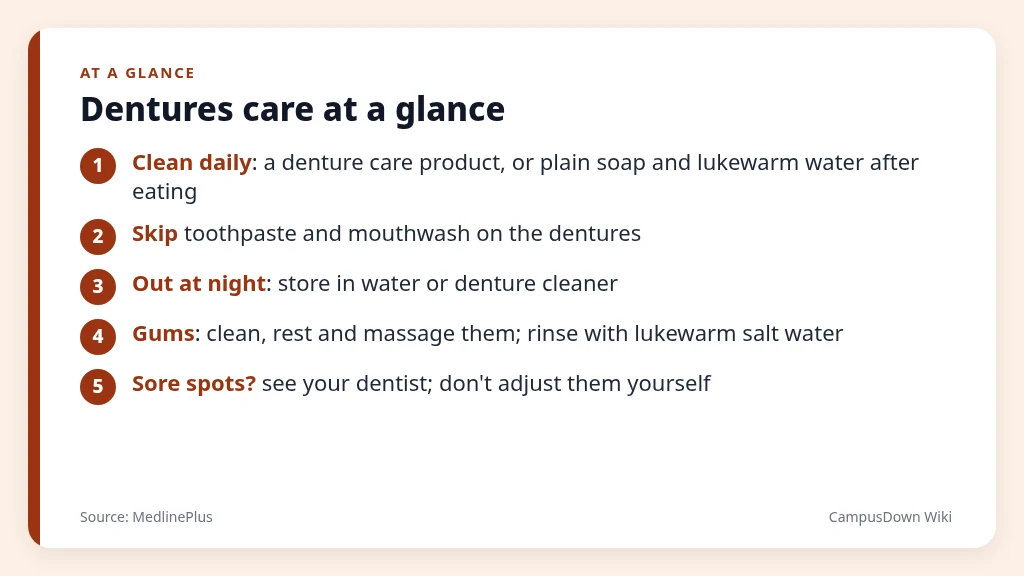
- Brush them every day with a denture care product.
- The encyclopedia article says scrub with plain soap and lukewarm water after eating and do not clean them with toothpaste or mouthwash.
- Take your dentures out at night (it says this helps prevent sores, infections and inflammation), and put them in water or a denture-cleansing liquid.
- Do not use toothpicks when wearing dentures.
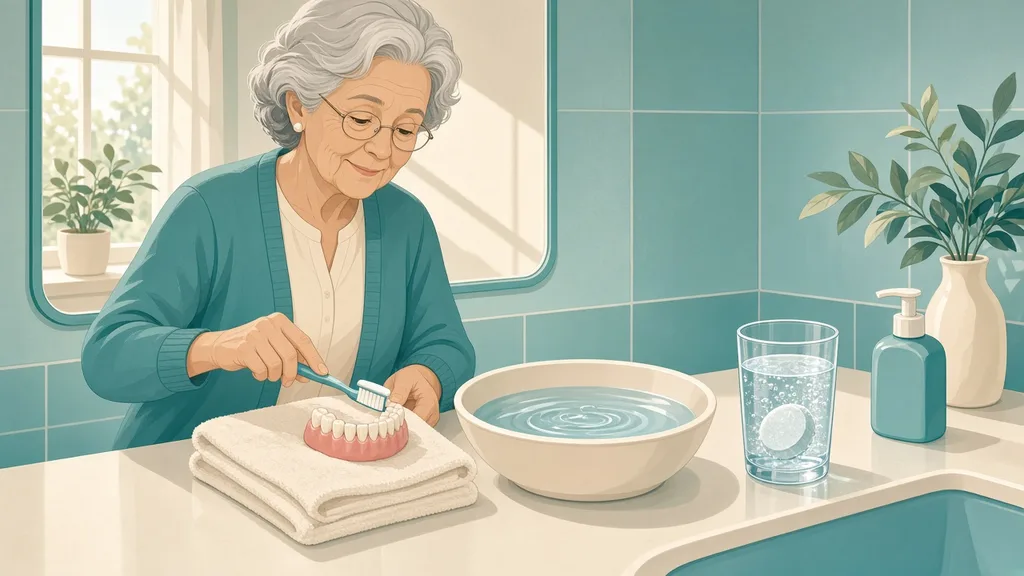
Ask your dentist which denture cleaner is right for your type of denture and how long to soak; MedlinePlus doesn't specify. Cleaning over a towel or a basin of water can cut the chance of cracking them if you drop them; that is a common-sense step rather than a MedlinePlus instruction.
Caring for your gums
MedlinePlus says to clean, rest and massage your gums regularly, and to rinse daily with lukewarm salt water to help clean them. Taking your dentures out at night is part of letting the gums rest.
Why sore spots happen
MedlinePlus says ill-fitting dentures can cause discomfort or irritation by moving, and these are called sore spots. Possible steps:
- See a dentist if your dentures do not fit correctly; they may need to be adjusted or relined.
- Denture adhesive may help cut down on movement.
- Dental implants may be recommended in most cases; MedlinePlus says implants help stabilize the denture, minimize movement and prevent sores, and should only be placed by a well-trained dentist skilled in implant placement.
MedlinePlus doesn't recommend creams, pastes or marker-style "sore spot finders" to treat sore spots. Whether a product is right for you is a question for your dentist or pharmacist, and a sore spot that keeps coming back or doesn't improve is a reason to book a visit rather than wait.
New, partial and lower dentures
MedlinePlus doesn't separate advice by denture type, but its statement that your mouth will change over time and that early visits help check the fit applies to new dentures too. Partial and lower dentures are not discussed separately, so ask your dentist what to expect.
Helping a family member
If you help someone with dentures, keep gentle hands, let them rest the gums overnight, and check for red or sore areas, swollen gums, or a poor fit. See caregiver burnout if the routine feels heavy, and what Medicare covers for hearing, dental and vision for cost questions, since original Medicare generally has limited dental coverage and plans differ. Hospital and rehab discharge teams can also help; see hospital discharge planning.
When to call the dentist
Call your dentist if you notice:
- Dentures that move, click or don't fit
- A sore spot that doesn't heal or keeps returning
- Swollen, red or bleeding gums
- Cracks, chips or missing teeth in the denture
- Trouble eating or speaking
Call sooner for fever, facial swelling or difficulty swallowing or breathing, which need urgent medical care.
Questions for your dentist
- Which cleaner and brush should I use for my type of denture?
- Should I soak them overnight, and in what?
- How often should I come back for a fit check?
- Is a reline, adhesive or an implant right for me?
- What should I do if I get a sore spot between visits?
- How can I keep my gums healthy under the denture?
Example scenario: the afternoon rub
- Who
- Gertrude, 72, a retired seamstress in Sioux Falls, South Dakota, noticed a sore spot under her new lower denture after two weeks and tried sliding it back with her tongue to avoid the rub.
- What happened
- She worried that calling meant admitting she couldn't "handle" her dentures.
- How it felt
- She felt embarrassed and a little discouraged.
- What they did
- She phoned the dentist's office, who offered an earlier visit; she kept her denture out overnight in a cleaner, rinsed with lukewarm salt water and wrote down where it hurt. The dentist adjusted the fit and showed her how to clean it with plain soap and water.
- How it turned out
- Gertrude said the quick visit was easier than weeks of rubbing.
This is an illustrative example, not a real patient or a review.
Gertrude's story is an illustrative example. Call your dentist for sores that don't heal or dentures that don't fit, and seek urgent care for facial swelling or trouble breathing.
Most-asked questions about dentures
How do I care for and clean my dentures?
MedlinePlus says to brush daily with a denture care product, or scrub with plain soap and lukewarm water after eating, and not to use toothpaste or mouthwash on them.
Why people ask: "dentures care and cleaning" is #3 for "dentures care" (US autocomplete, November 2026).
What are the denture care instructions?
Clean daily, take them out at night, store them in water or denture cleaner, rest and massage your gums, rinse with lukewarm salt water and skip toothpicks.
Why people ask: "dentures care instructions" is #4 for "dentures care" (US autocomplete, November 2026).
How do I maintain my dentures over time?
See your dentist for fit checks and adjustments, since your mouth changes over time and the dentist should handle adjustments.
Why people ask: "dentures care and maintenance" is #5 for "dentures care" (US autocomplete, November 2026).
Is there a care plan for dentures in a facility?
MedlinePlus doesn't describe facility care plans; follow your facility's procedure and the resident's dentist.
Why people ask: "dentures care plan" is #8 for "dentures care" (US autocomplete, November 2026).
How are denture sore spots treated?
See a dentist; MedlinePlus says dentures may need adjusting or relining, and adhesive or implants may reduce movement.
Why people ask: "denture sore spots treatment" is #2 for "dentures sore spots" (US autocomplete, November 2026).
Is there a cream for denture sore spots?
MedlinePlus doesn't name a cream; the cause is usually a poor fit, so ask your dentist before using any product.
Why people ask: "denture sore spot cream" is #4 for "dentures sore spots" (US autocomplete, November 2026).
Why do new dentures cause sore spots?
MedlinePlus says ill-fitting dentures move and irritate; the dentist may want to see you often at first to check the fit.
Why people ask: "new dentures sore spots" is #7 for "dentures sore spots" (US autocomplete, November 2026).
What about sore spots from partial dentures?
MedlinePlus doesn't separate partials from complete dentures; the same rule applies: see your dentist if the fit is poor.
Why people ask: "partial denture sore spots" is #9 for "dentures sore spots" (US autocomplete, November 2026).
What about sore spots from a lower denture?
MedlinePlus doesn't discuss lower dentures separately; poor fit and movement are the usual cause, so see your dentist for an adjustment.
Why people ask: "lower denture sore spots" is #10 for "dentures sore spots" (US autocomplete, November 2026).
Related on CampusDown
You can learn more about the senior health hub and check it for yourself in dehydration in older adults. For nighttime dryness in detail, see CPAP and dry mouth.
Frequently asked questions
- Can I use toothpaste on dentures?
- MedlinePlus says not to clean dentures with toothpaste or mouthwash; use plain soap and lukewarm water or a denture care product.
- Should I wear them overnight?
- MedlinePlus says to take them out at night and keep them in water or a denture cleaner.
- Can I adjust my own dentures?
- No; MedlinePlus says to let your dentist handle adjustments.
- Can I use toothpicks?
- No; MedlinePlus says not to use toothpicks when wearing dentures.
- Will adhesive fix a poor fit?
- It may help reduce movement, but see a dentist if dentures don't fit correctly.
Dentures need daily cleaning, nighttime rest out of the mouth and healthy gums. Use a denture care product or plain soap and lukewarm water, skip toothpaste and mouthwash on the dentures, store them in water or cleaner overnight, and see your dentist for sore spots or fit changes instead of adjusting them yourself.
Browse more guides like this in the Senior Health and Medicare hub.
This article is for general education and does not replace advice from your own doctor, nurse or pharmacist.