
You were prescribed duloxetine for nerve pain, your neighbor takes it for depression, and the leaflet starts with an important mood warning. Is it the same medicine for both, and what should you know before the first capsule?

This guide uses MedlinePlus's drug information on duloxetine (revised October 2025) to explain the basics. It is general information, not a prescription; your doctor and pharmacist decide whether this medicine is right for you and how much to take. If you want to learn more about another common antidepressant, take a closer look at sertraline.
What it is and what it treats
MedlinePlus says duloxetine is used to treat depression and generalized anxiety disorder (GAD), and also pain from diabetic neuropathy (nerve damage in people with diabetes), fibromyalgia, and ongoing bone or muscle pain. It is in a class of medications called selective serotonin and norepinephrine reuptake inhibitors (SNRIs) and works by increasing the amounts of certain natural substances in the brain. It is sometimes used to treat stress urinary incontinence in women. MedlinePlus lists the brand names Cymbalta and Drizalma Sprinkle. To learn about the conditions themselves, see generalized anxiety disorder, peripheral neuropathy in the feet and depression in older adults.

Important warning: mood and suicidal thoughts
MedlinePlus opens with an important warning: medicines such as duloxetine may increase the risk of suicidal thoughts and actions in children, teenagers and young adults (younger than 24). The risk may be more likely in the first few months of treatment and when the dose is raised. MedlinePlus says to call your doctor right away for new or worsening depression; thinking about harming or killing yourself, or planning or trying to; extreme worry; agitation; panic attacks; trouble falling or staying asleep; aggressive or hostile behavior; irritability; acting without thinking; severe restlessness; frenzied abnormal excitement; or other unusual behavior changes. Ask your family or caregiver to check on you daily and learn which symptoms are serious so they can call for you if you can't. You can also read the Medication Guide from your pharmacy or the FDA.
Get help now if
If you or someone you know is thinking about suicide or self-harm, call or text 988 (the 988 Suicide & Crisis Lifeline in the United States) or call 911 right away.
How it is taken
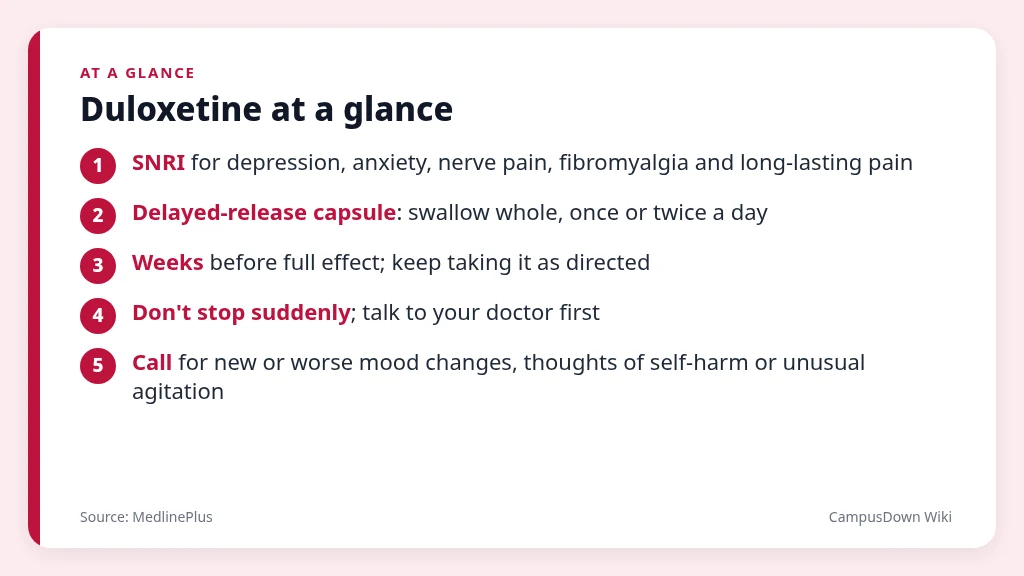
MedlinePlus says duloxetine comes as a delayed-release capsule to take by mouth, 1 to 2 times daily with or without food depending on why it is used, at about the same time every day.
- Take exactly as directed; don't take more, more often or for longer than prescribed.
- Swallow capsules whole; don't split, chew or crush them.
- If you can't swallow capsules, MedlinePlus says Drizalma Sprinkle capsules may be opened and sprinkled over applesauce, or given through a nasogastric tube; ask your doctor or pharmacist for instructions.
- Your doctor may start with a low dose and increase it after one week.
- It may help control symptoms but won't make the condition go away, and it may take 1 to 4 weeks or longer to feel the full benefit. Keep taking it even if you feel well.
MedlinePlus doesn't list capsule strengths such as 20, 30 or 60 mg, so this article doesn't either. Your label shows your strength and how often to take it.
Don't stop it suddenly
MedlinePlus says don't stop duloxetine without talking to your doctor. If you suddenly stop, you may have withdrawal symptoms such as nausea, vomiting, diarrhea, anxiety, dizziness, tiredness, headache; pain, burning, numbness or tingling in the hands or feet; irritability; trouble sleeping; sweating; and nightmares. If you want to stop, ask your prescriber how to do it safely.
Interactions and things to tell your doctor
MedlinePlus says to tell your doctor and pharmacist if you take, or stopped within the last two weeks, thioridazine or an MAO inhibitor (such as isocarboxazid, linezolid, methylene blue, phenelzine, selegiline or tranylcypromine); your doctor will probably say not to take duloxetine. If you stop duloxetine, wait at least 5 days before starting an MAO inhibitor.
It also lists possible interactions with St. John's wort, tryptophan, proton pump inhibitors (lansoprazole, omeprazole, pantoprazole, rabeprazole), cimetidine, aspirin and other NSAIDs such as ibuprofen and naproxen. Don't start any of these without talking to your provider. See the brown bag medication review.
Also tell your doctor if you drink or have drunk large amounts of alcohol, use street drugs or overused prescription medicines, or have low blood sodium, glaucoma, a recent heart attack, high blood pressure, diabetes, seizures, coronary artery disease, bleeding problems, slow stomach emptying, or heart, liver or kidney disease. Also mention pregnancy (especially the last few months), plans for pregnancy or breastfeeding.
Dizziness, blood pressure and eyes
- Drowsiness and thinking: it may make you drowsy, dizzy or affect your judgment, thinking or coordination; don't drive until you know how it affects you.
- Alcohol: ask your doctor; alcohol can increase the risk of serious side effects from duloxetine.
- Standing up: it may cause dizziness, lightheadedness and fainting when you get up too quickly, more common when starting or increasing the dose; get out of bed slowly, resting your feet on the floor first. See orthostatic hypotension.
- Blood pressure: it may cause high blood pressure, so have it checked before starting and regularly.
- Eyes: it may cause or worsen angle-closure glaucoma; talk to your doctor about an eye exam before starting. Call right away or get emergency care for nausea, eye pain, vision changes such as colored rings around lights, and swelling or redness in or around the eye.
Side effects
MedlinePlus says to tell your doctor if these are severe or don't go away: nausea, vomiting, diarrhea, constipation; decreased appetite; weight changes; dry mouth; sweating or night sweats; tiredness; and sexual problems (lower sex drive or erection and ejaculation changes in males; lower sex drive or delayed or absent orgasm in females).
Call your doctor immediately or get emergency care for:
- Loss of appetite, unusual bruising or bleeding, itching, pain in the upper right stomach, yellow skin or eyes, dark urine
- Extreme tiredness or weakness, confusion, unsteady walking that may cause falls
- Agitation, hallucinations, fever, sweating, confusion, fast or irregular heartbeat, severe muscle stiffness or twitching, loss of coordination, nausea, vomiting or diarrhea
- Seizures
- Fever, rash, hives, blisters or peeling skin, trouble breathing or swallowing, hoarseness, or swelling of the face, throat, tongue, lips, eyes, hands, feet, ankles or lower legs
- Difficulty urinating
You or your doctor may report side effects to the FDA's MedWatch program.
Missed doses and overdose
MedlinePlus says to take a missed dose when you remember, but skip it if it is almost time for the next one; don't double up. In case of overdose, call poison control at 1-800-222-1222, or 911 if someone has collapsed, had a seizure, has trouble breathing or can't be awakened.
Questions for your pharmacist
- Which condition am I treating, and when should I expect to notice a difference?
- Is my capsule the standard delayed-release type, and can I open it?
- Which of my other medicines, including pain relievers like ibuprofen, interact?
- How often should my blood pressure be checked?
- Who should I call if my mood changes in the first few months?
- How should I taper if I want to stop?
Example scenario: the tingling that wouldn't quit
- Who
- Marvin, 58, a long-haul trucker in Amarillo, Texas, started duloxetine for burning pain in his feet from diabetes.
- What happened
- He was nervous about the mood warning and wondered whether to say anything if he felt off.
- How it felt
- He felt wary and a bit skeptical.
- What they did
- He kept a short daily note of pain, sleep and mood, shared it at his follow-up and asked his pharmacist to review his ibuprofen use; his wife learned the warning symptoms so she could call if she saw changes. Marvin also asked how to stop safely if he ever decided to.
- How it turned out
- Marvin said knowing who to call made the warning feel less scary.
This is an illustrative example, not a real patient or a review.
Marvin's story is an illustrative example. Call your prescriber right away for new or worsening mood changes, and call or text 988 or 911 for thoughts of self-harm.
Most-asked questions about duloxetine
What is duloxetine used for?
Depression, generalized anxiety disorder, diabetic nerve pain, fibromyalgia and ongoing bone or muscle pain, and sometimes stress urinary incontinence in women.
Why people ask: "duloxetine uses" is #3 for "duloxetine" (US autocomplete, November 2026).
What is the brand name for duloxetine?
Cymbalta and Drizalma Sprinkle, according to MedlinePlus.
Why people ask: "duloxetine brand name" is #4 for "duloxetine" (US autocomplete, November 2026).
What does duloxetine 30 mg mean?
MedlinePlus doesn't list capsule strengths; your doctor may start low and increase after a week, and your label shows your strength.
Why people ask: "duloxetine 30 mg" is #5 for "duloxetine" (US autocomplete, November 2026).
What does duloxetine 60 mg mean?
MedlinePlus doesn't list strengths; ask your pharmacist what your label means and what your doctor's plan is.
Why people ask: "duloxetine 60 mg" is #6 for "duloxetine" (US autocomplete, November 2026).
What does duloxetine 20 mg mean?
MedlinePlus doesn't list strengths; follow your label and ask your pharmacist if anything is unclear.
Why people ask: "duloxetine 20 mg" is #8 for "duloxetine" (US autocomplete, November 2026).
What drug class is duloxetine?
A selective serotonin and norepinephrine reuptake inhibitor (SNRI).
Why people ask: "duloxetine drug class" is #9 for "duloxetine" (US autocomplete, November 2026).
What are duloxetine side effects in females?
MedlinePlus lists delayed or absent orgasm and lower sex drive for females, plus the general effects such as nausea, dry mouth, sweating and tiredness; tell your doctor about pregnancy plans.
Why people ask: "duloxetine side effects in females" is #2 for "duloxetine side effects" (US autocomplete, November 2026).
What are duloxetine side effects in males?
MedlinePlus lists lower sex drive, trouble getting or keeping an erection, and delayed or absent ejaculation, along with the general effects.
Why people ask: "duloxetine side effects in males" is #3 for "duloxetine side effects" (US autocomplete, November 2026).
What are duloxetine side effects in older adults?
MedlinePlus doesn't give an age-specific list; call for confusion, unsteady walking or falls, and ask about dizziness on standing.
Why people ask: "duloxetine side effects in elderly" is #4 for "duloxetine side effects" (US autocomplete, November 2026).
Does duloxetine cause weight gain?
MedlinePlus lists decreased appetite and weight changes without a direction; tell your doctor if your weight changes.
Why people ask: "duloxetine side effects weight gain" is #7 for "duloxetine side effects" (US autocomplete, November 2026).
What are the long-term effects of duloxetine?
MedlinePlus doesn't address long-term effects separately; keep appointments, get your blood pressure checked regularly and report new symptoms.
Why people ask: "duloxetine side effects long term" is #8 for "duloxetine side effects" (US autocomplete, November 2026).
What happens when you stop duloxetine?
Withdrawal-type symptoms such as nausea, anxiety, dizziness, headache, tingling, irritability, sleep trouble, sweating and nightmares can occur if you stop suddenly; talk to your doctor first.
Why people ask: "duloxetine side effects when stopping" is #10 for "duloxetine side effects" (US autocomplete, November 2026).
Related on CampusDown
You can learn more about the medicines hub and check it for yourself in the Beers Criteria guide. For anxiety conditions in detail, see panic disorder, and for sleep problems that often come with mood or pain, see insomnia and CBT-I.
Frequently asked questions
- How long until it works?
- MedlinePlus says it may take 1 to 4 weeks or longer to feel the full benefit.
- Can I stop it when I feel better?
- Keep taking it even if you feel well, and don't stop without talking to your doctor.
- Can I take ibuprofen with it?
- MedlinePlus lists aspirin and NSAIDs like ibuprofen and naproxen as possible interactions; ask your provider first.
- Can it raise blood pressure?
- Yes; MedlinePlus says to have your blood pressure checked before starting and regularly.
- What should family watch for?
- New or worsening depression, thoughts of self-harm, extreme worry, agitation, panic, sleep trouble, aggression, severe restlessness or unusual behavior changes.
Duloxetine is an SNRI for depression, anxiety and several kinds of long-lasting pain. Take the capsule whole as directed, give it weeks to work, watch mood changes closely in the first months and after dose changes, avoid stopping suddenly, check blood pressure, and call promptly for thoughts of self-harm, unusual bleeding, yellow skin or serious reactions.
Browse more guides like this in the Medicines hub.
This article is for general education and does not replace advice from your own doctor, nurse or pharmacist.