
Your heart suddenly takes off at 180 beats a minute while you're sitting still, then stops just as fast. Is that normal, or something to get checked?
This guide uses the Mayo Clinic page "Supraventricular tachycardia - Symptoms and causes" (dated August 11, 2026) and the MedlinePlus Arrhythmia health topic. It is general information, not a diagnosis; a clinician needs to confirm the rhythm with a heart tracing. If you want to learn more about other rhythm problems, take a closer look at atrial fibrillation.
What SVT is
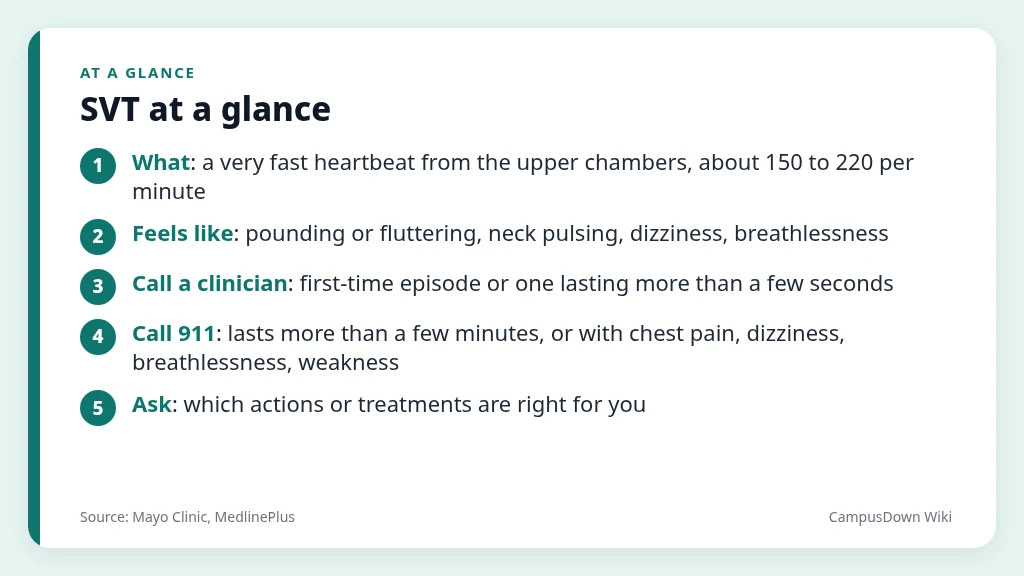
Mayo Clinic says supraventricular tachycardia (SVT) is a type of irregular heartbeat, a very fast or erratic heartbeat that affects the heart's upper chambers. A typical heart beats about 60 to 100 times a minute; during SVT it beats about 150 to 220 times a minute, sometimes faster or slower. Most people with SVT don't need treatment. MedlinePlus defines tachycardia as a heart rate faster than normal, and says some arrhythmias are harmless, such as when your heart speeds up during exercise, but a frequent irregular rhythm may mean your heart isn't pumping enough blood.

Types
Mayo Clinic lists three main groups: AVNRT (the most common), AVRT (the second most common, most often seen in younger people) and atrial tachycardia (more common in people with heart disease), plus less common types.
Symptoms
Mayo Clinic says the main symptom is a very fast heartbeat that may last a few minutes to a few days and may come and go quickly. Symptoms may include palpitations, a pounding feeling in the neck, chest pain, fainting or almost fainting, a lightheaded or dizzy feeling, shortness of breath, sweating, and weakness or extreme tiredness. Some people with SVT don't notice any symptoms. In infants and very young children it says symptoms may be vague, such as sweating, poor feeding, a change in skin color and a fast pulse. See palpitations at night and skipped heartbeats for other rhythm sensations.
Get help now if
Mayo Clinic says to call a healthcare professional if you have a very fast heartbeat for the first time, or if an irregular heartbeat lasts longer than a few seconds. Call 911 or your local emergency number if you have a very fast heartbeat that lasts for more than a few minutes, or one that comes with chest pain, dizziness or near fainting, shortness of breath or weakness.
Causes
Mayo Clinic says SVT is caused by faulty signaling in the heart: a change in electrical signals causes the heartbeat to start too early in the upper chambers, and the heart can't fill with blood properly, which can lead to symptoms such as lightheadedness or dizziness.
Who is more likely to have it
Mayo Clinic says SVT is the most common type of irregular heartbeat in infants and children and tends to happen more often in women, especially during pregnancy. Conditions or treatments that may raise the risk include coronary artery disease, heart valve disease, heart failure and other heart disease, long-term lung conditions, a heart condition present at birth, past heart surgery, obstructive sleep apnea, thyroid disease, diabetes with high blood sugar, and some medicines, including those used for asthma, allergies and colds. Other factors include stress, too much caffeine, too much alcohol, a family history of SVT, smoking and nicotine, and stimulant drugs. See normal resting heart rate and anxiety and chest pain.
Complications
Mayo Clinic says without treatment, frequent bouts over time may weaken the heart and lead to heart failure, and a serious bout may cause fainting or sudden cardiac arrest. It says SVT is usually not life-threatening unless you have heart damage or another heart condition.
Treatment and stopping an episode
Mayo Clinic says that if treatment is needed, options may include specific actions or movements that a healthcare professional recommends, and medicines; some people need treatment to reset the heart rhythm or block faulty signals, and others need a device. The pages used here don't describe those actions step by step, and they should be taught by a clinician who knows your heart; don't try unfamiliar maneuvers on your own.
Prevention and everyday habits
Mayo Clinic suggests a heart-healthy lifestyle (nutritious diet, no smoking, regular exercise, stress management, 7 to 9 hours of sleep for adults), keeping a journal of symptoms, heart rate and activity to find triggers, using medicines carefully (some over-the-counter products contain stimulants), and working with your healthcare team on blood sugar, cholesterol and blood pressure. It says for most people with SVT, moderate amounts of caffeine do not trigger episodes.
Questions for your doctor
- What heart rhythm test do I need to confirm SVT?
- Do I have a heart condition that changes how seriously we treat it?
- Which actions or medicines are right for me, and when should I use them?
- What symptoms mean I should call 911?
- Are any of my medicines or supplements triggers?
Example scenario: the racing heart at the desk
- Who
- Sigrid, 29, a software tester in Portland, Oregon, felt her heart suddenly race while sitting at her desk, with pounding in her neck and lightheadedness.
- What happened
- It stopped on its own after several minutes, then happened again two weeks later.
- How it felt
- She worried she was having panic attacks.
- What they did
- She wrote down when each episode started and stopped and called her clinician, who talked through a heart rhythm test and told her to call 911 if an episode lasted more than a few minutes or came with chest pain or fainting. Sigrid was given a plan and a follow-up appointment.
- How it turned out
- Sigrid said the notes helped her feel less afraid.
This is an illustrative example, not a real patient or a review.
Sigrid's story is an illustrative example. A diagnosis needs a heart rhythm test and a clinician's review.
Most-asked questions about SVT
What are SVT symptoms in women?
Mayo Clinic says SVT happens more often in women, especially during pregnancy, and lists the same symptoms: a very fast heartbeat, pounding in the neck, dizziness, shortness of breath and weakness.
Why people ask: "svt symptoms in women" is #2 for "svt symptoms" (US autocomplete, November 2026).
What are SVT symptoms in men?
The page doesn't separate symptoms by sex; the same symptoms apply.
Why people ask: "svt symptoms in men" is #3 for "svt symptoms" (US autocomplete, November 2026).
What are SVT symptoms and treatment?
Symptoms are above; most people don't need treatment, and when they do, options include clinician-recommended actions or movements, medicines and procedures.
Why people ask: "svt symptoms and treatment" is #5 for "svt symptoms" (US autocomplete, November 2026).
What are SVT symptoms in adults?
A very fast heartbeat with palpitations, neck pounding, chest pain, dizziness, shortness of breath, sweating and weakness; some people have none.
Why people ask: "svt symptoms in adults" is #6 for "svt symptoms" (US autocomplete, November 2026).
What does Mayo Clinic say about SVT symptoms?
This article summarizes the Mayo Clinic page: a heartbeat of about 150 to 220 beats a minute, with symptoms like palpitations, dizziness and shortness of breath.
Why people ask: "svt symptoms mayo clinic" is #8 for "svt symptoms" (US autocomplete, November 2026).
What are SVT symptoms and causes?
Faulty electrical signaling starts the heartbeat too early in the upper chambers; symptoms are listed above.
Why people ask: "svt symptoms and causes" is #9 for "svt symptoms" (US autocomplete, November 2026).
Is there a printable guide to vagal maneuvers for SVT?
The pages used here don't describe the maneuvers or offer a handout; Mayo Clinic says a healthcare professional may recommend specific actions or movements, so ask yours before trying anything.
Why people ask: "svt vagal maneuvers pdf" is #2 for "svt vagal maneuvers" (US autocomplete, November 2026).
Are vagal maneuvers the same as supraventricular tachycardia treatment?
Mayo Clinic mentions clinician-recommended actions or movements among SVT treatment options, along with medicines and procedures.
Why people ask: "supraventricular tachycardia vagal maneuvers" is #4 for "svt vagal maneuvers" (US autocomplete, November 2026).
What is vagal stimulation for SVT?
The sources used here don't define it; ask your clinician.
Why people ask: "svt vagal stimulation" is #5 for "svt vagal maneuvers" (US autocomplete, November 2026).
Is treatment of SVT done with vagal maneuvers?
Only as recommended by a healthcare professional; options also include medicines, procedures and devices.
Why people ask: "svt treatment vagal maneuvers" is #8 for "svt vagal maneuvers" (US autocomplete, November 2026).
Related on CampusDown
You can learn more about the health topics hub and check it for yourself in atrial fibrillation. For rhythm problems in older adults in detail, see AFib symptoms in women and senior health.
Frequently asked questions
- What is SVT?
- A very fast or erratic heartbeat that affects the heart's upper chambers.
- How fast is the heart in SVT?
- About 150 to 220 beats a minute, versus 60 to 100 typically.
- Is SVT dangerous?
- It is usually not life-threatening unless you have heart damage or another heart condition, but severe episodes can cause fainting or cardiac arrest.
- When should I call 911?
- For a very fast heartbeat lasting more than a few minutes, or with chest pain, dizziness, shortness of breath or weakness.
- Can I stop an episode myself?
- Ask your clinician; Mayo Clinic says specific actions or movements, when advised, are recommended by a healthcare professional.
SVT is a sudden, very fast heartbeat from the upper chambers that often stops by itself and usually isn't life-threatening, but it can sometimes cause dizziness, chest pain or fainting. Call a clinician for a first episode or one lasting more than a few seconds, call 911 for symptoms lasting more than a few minutes or with chest pain or breathlessness, and ask which actions or treatments are right for you.
Browse more guides like this in the U.S. Health Topics hub.
This article is for general education and does not replace advice from your own doctor, nurse or pharmacist.